 Craig D
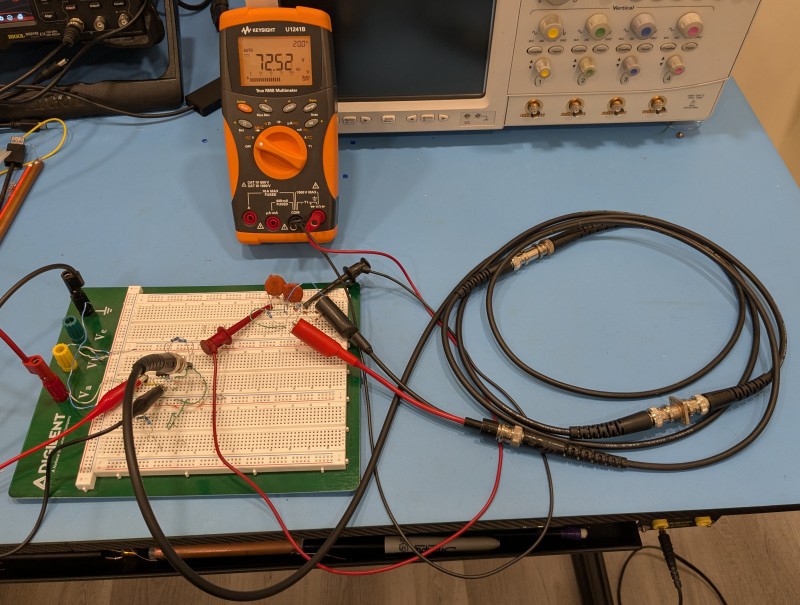
We can also use some regular coax as voltage boosting device. But we'll need an awfully long piece of it for my current frequency limited setup. Here's an example using three 1m RG-58 test cables connected together to form a 3m cable. This length should have a propagation delay of about 15.2ns, based on 0.66 velocity factor. The operating frequency should be about 1/(4*td), or 16.5MHz.
I connected the coax up to the same voltage doubler rectifier, and loaded it with a total of 5k ohms, and powered it up. I adjusted the frequency for maximum voltage, setting on 13MHz - a little lower than expected. The peak DC voltage was 72.5V, as you can see on the DMM, which works out to 1.05W across the load. This was with an input voltage to the driver of 11V. The input current was 0.35A. The input power was 3.85W, so the system is about 27% efficient.
I was going to try cranking the voltage up some more, but noticed the DMM reading slowly drifting downward. If I shut if off for a while, it would recuperate. The culprit appeared to be the poor UCC27524 dual gate driver, with its one remaining channel bearing the burden of driving the coax. It was warming up fast, as it has quite high output resistance - 5 ohms typical when pulling high, and 0.5 ohms typical when pulling low. So I didn't push the voltage farther since I'm not sure I have another working spare part.
Discussions
Become a Hackaday.io Member
Create an account to leave a comment. Already have an account? Log In.