 David Matthew Mooney
1) Another view of Sensor Gun:

The handle is made from an acrylic artist's palette.
2) My second white noise machine:

The board on the left is for signals and the board on the right is for power. It still needs an automatic gain control circuit.
3) Chord keyset
Shown is an end view of four identical modules, one to a finger. Each module has two paddles operated as an analyzing linkage. All eight paddles and their respective bearings are in a sandwich structure stacked on a common axle and held together by a pair of compression screws on the end. The bearing shown can be simplified: all but the outermost ring of ball bearings and its retaining ring can be replaced with a thick washer. Another, larger washer is used to adjust the paddle spacing along the axle. Suggested along-axle distances: ball bearings, 3/32”; paddle thickness, 1/8”, axial spacer, 1/4”; radial spacer, 1/16”.
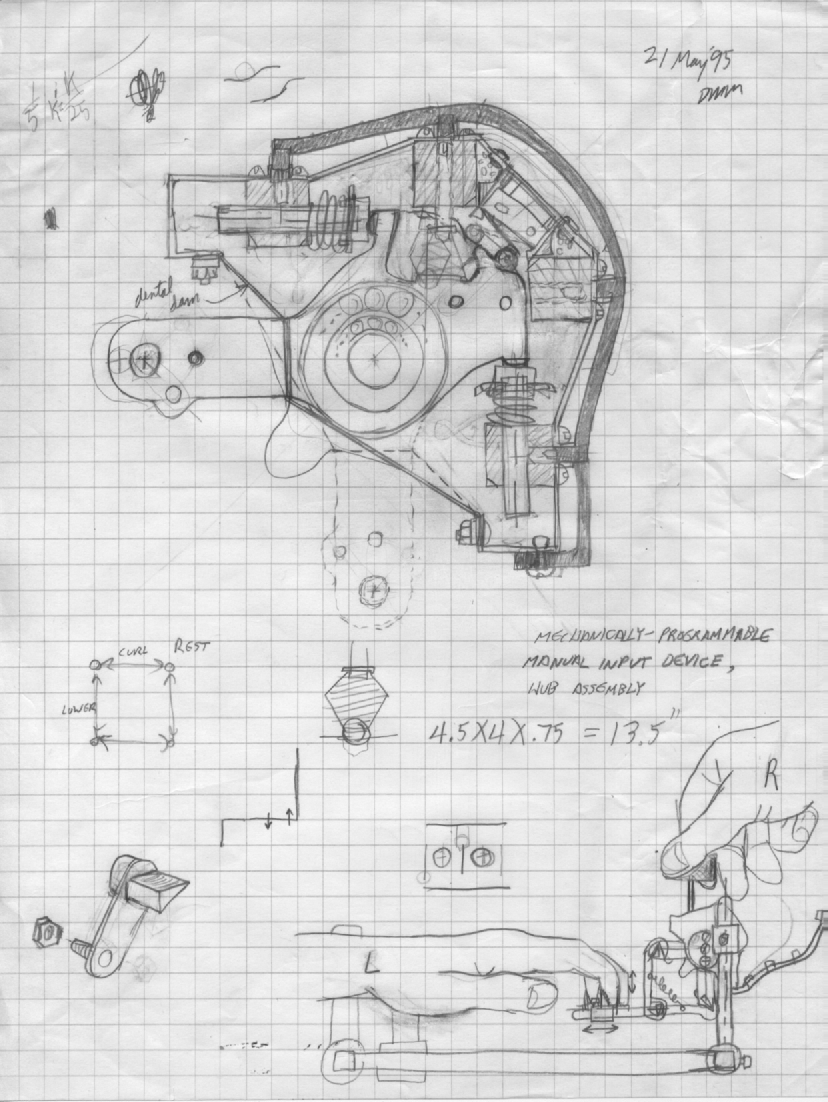
Can probably also be used as a one-handed MIDI controller if the thumb is used to cut in virtual black keys. Some chromatic concert harmonicas are set up this way. Suggested name: a MIDI-ola. If the depress finger movements play ABCD going from pinky to index, and the curl movements play EFGA, then each finger can play a perfect fifth by itself. Most cords contain a perfect fifth.
A MIDI book mark recently published on Hackaday used capacitative touch sensors, so I am inclined to do the same so I can just copy the electronic part of that project. The MIDIola version would have a moving conductive plate on the paddle and two edgewise-adjacent plates on a stator with a narrow gap between. The capacitance seen between the two stator plates would rise suddenly as the nearby paddle plate rotates over the gap. The basic idea is like a simplified butterfly capacitor.
The three joints in each analyzing linkage not in the paddle sandwich assembly could be more simply implemented as Chicago screws in holes with LOCKTITE Purple threadlocker.
The paddle assembly, capacitor stators, circuit boards, jacks, return springs, and motion stops must all be integrated into some supporting superstructure concept. At this point I have to decide what the overall look should be. Maybe a nice little hardwood cabinet set up on a percussion table would be the right touch for a musical instrument, maybe made of 5/8” birch with a fancy veneer, maybe walnut burl.
Discussions
Become a Hackaday.io Member
Create an account to leave a comment. Already have an account? Log In.