Trying to build a 6502-compatible CPU on breadboards, using as few chips as possible.
To make the experience fit your profile, pick a username and tell us what interests you.
We found and based on your interests.
The first module I decided to build for the project was the ALU, combined with the A and B registers. I found the ALU simpler to build because it doesn't hold any state.
I designed an 8-bit ALU that has 2 8-bit inputs (A and B), as well as a carry-in input and an opcode of 4 bits (therefore supporting 16 operations). It outputs an 8-bit result as well as 4 flags (N, V, C, Z).
Here is a description of the 16 supported operations:
#define ALU_ADC 0 // Add with carry, for ADC instruction
#define ALU_AND 1 // Logical AND, for AND instruction
#define ALU_BIT 2 // BIT instruction
#define ALU_CMP 3 // CMP, for CMP instructions
#define ALU_DEC 4 // Decrement B
#define ALU_EOR 5 // Logical XOR, for EOR instruction
#define ALU_INC 6 // Increment B
#define ALU_LSR 7 // Logical Shift Right B
#define ALU_ORA 8 // Logial OR, for ORA instruction
#define ALU_ROL 9 // Rotate Left
#define ALU_ROR 10 // Rotate Left
#define ALU_SBC 11 // Subtract with carry, for SBC instruction
#define ALU_PASS 12 // Passthru B. Can be used to set the N and Z flags
#define ALU_ADD 13 // Add without carry, used in addressing modes
#define ALU_SXT 14 // Sign extend, used in relative addressing
#define ALU_ASL 15 // Arithmetic Shift Left
All of the data-related 6502 flags (i.e N, Z, V, C) are output by the ALU, so in some cases it is necessary to use the ALU_PASS op to get some flags set, even though there is not really a need for an arithmetic or logic operation. I made this design choice to keep things simple and the chip count low.
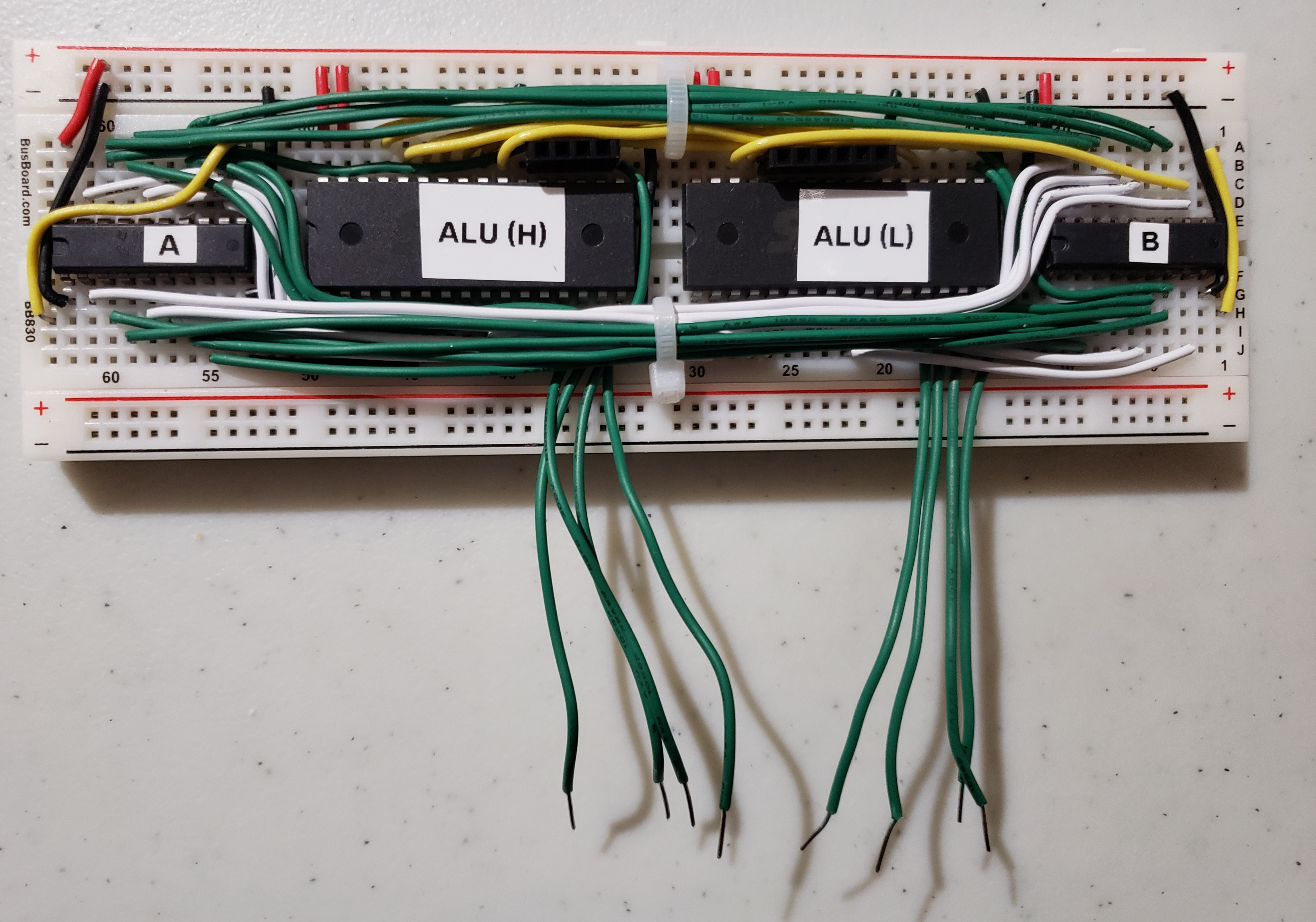
To implement the ALU I used 2 SST39SF020A Flash memory chips, that each have 18 address inputs and 8 data outputs. One Flash memory computes the low 4 bits of the result, the other one the high 4 bits. There a few control signals between both of them, to propagate the carry and other data useful for the flags. For example, the low part has a Z output that indicates if the lower 4 bits are zero, which the high part uses, in addition to its own 4-bt result, to compute the real Z flag.
Here is a picture of the completed assembly:
The controls signals and flag outputs are on top using the black connectors, and the green wires at the bottom will connect to the data bus.
Create an account to leave a comment. Already have an account? Log In.
Become a member to follow this project and never miss any updates