 Florian Wilhelm Dirnberger

0. Outline
The concept of this radio frequency detector is anything but new, and schematics with the LM1458 op amp have been shared in books about electronic circuitry and on the internet since I think the 80's and 90's.
Yet barely anyone ever seem to have actually built and tested such a "Radar Detector", so I wanted to know whether it is a viable design (it is, sort of).
1. Schematic
Capacitor C1 is the determining part. Capacitive coupling takes place and the op amp rectifies the radio-frequency interference / RFI (this rectification is normally undesired, here desired). Clipping the capacitor wires connected to op amp Pins 2 / 3 will influence the overall performance and the picked-up frequency quite drastically. The value itself seems not so very important (should be in the nF range though).
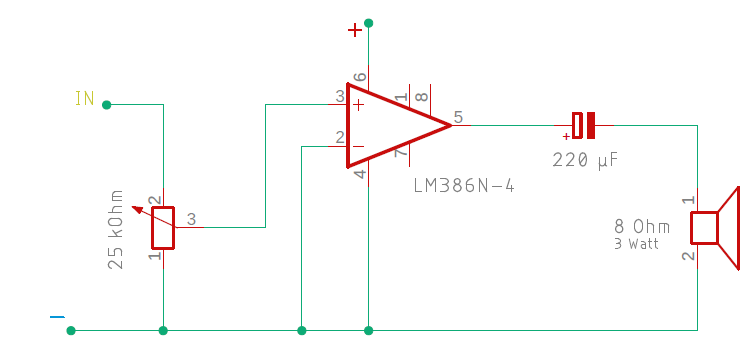
You can connect a LM386 amplifier and a Speaker to the OUT Pin for an immediate feedback (below a further schematic).
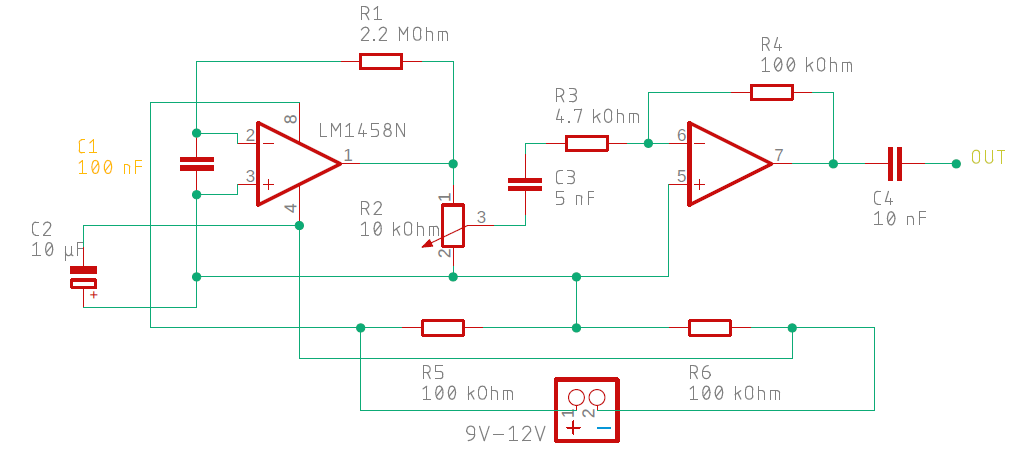
The first op amp stage together with the two 100k resistors R5/R6 resemble a supply splitter (what makes sense since I supply the detector with a 9V battery, not with a symmetrical voltage), the second op amp stage poses as an inverting amplifier.
C3 and C4 provide capacitive coupling.
2. Demo video
Tests with various radio frequency emitting devices, such as a Raspberry Pi Pico W, a Bluetooth Low Energy module, a WiFi router, and a mobile phone.
3. Radar (Radio Detection And Ranging) Detector
Military and civil radar operates (or used to operate) in the lower GHz regions (L-Band, S-Band, etc.). Example: Airport Surface Detection (X-Band).
So in principle it would be possible to detect these high frequency sources with this RF detector.
4. Sound generator
For the Speaker variant, the following set-up with one LM386 IC is applicable. The generated sound doesn't have to be pleasant, just loud enough to be heard, so we can ignore most of the design guidelines regarding the LM386.

 bherd
bherd
 Darrel Heckendorf
 mihai.cuciuc
 Maxim Fyodorov
Schematic around the power supply circuit could use some work !