 RobG
RobGThe new feeder is built and briefly tested:
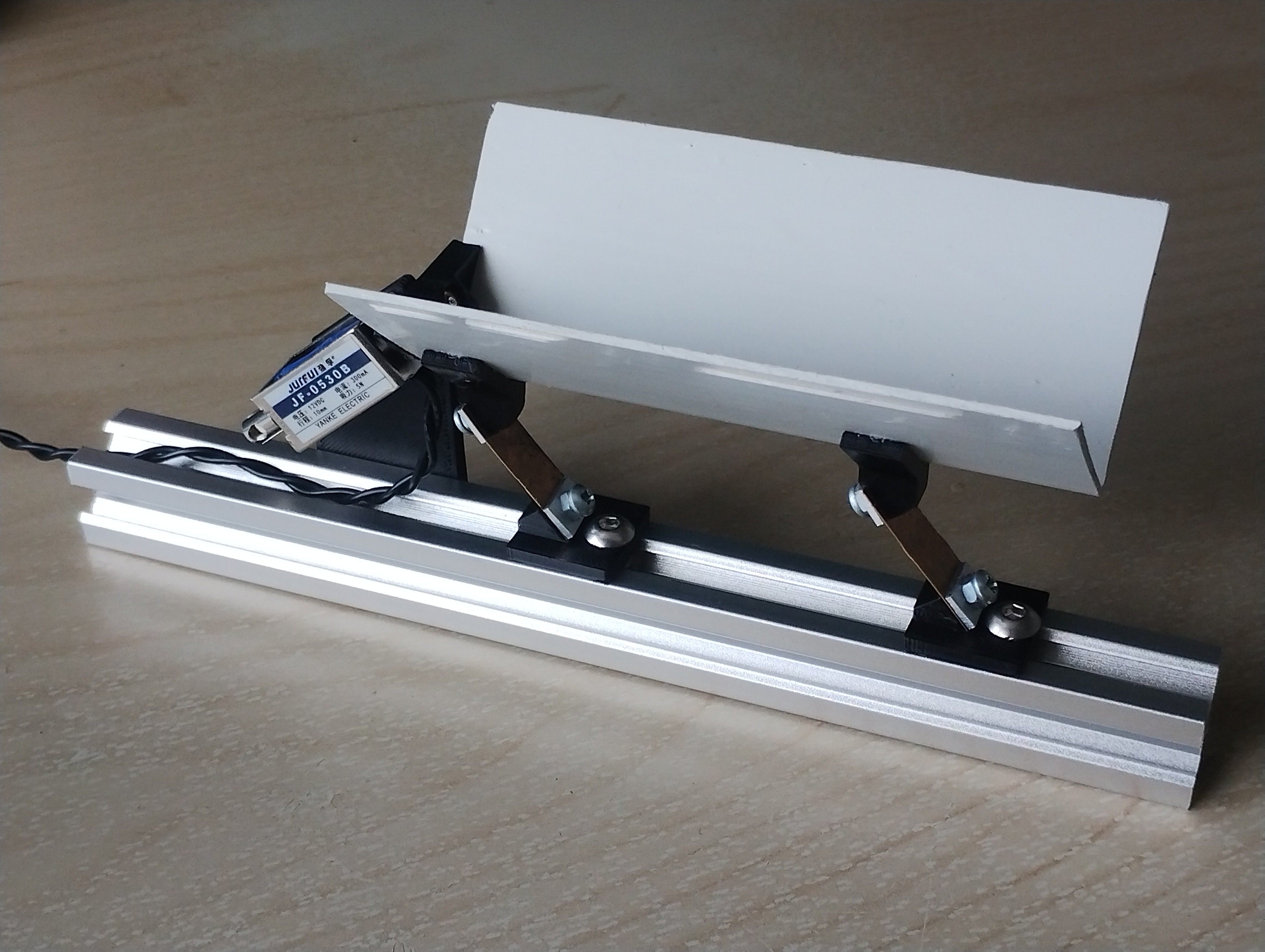
It works ok:
- resonant frequency is just about where I wanted it - about 60Hz - right off the bat, which was handy.
- the DRV8871-based H-bridge motor driver and solenoid combination work nicely as a voice coil actuator. Current limit was set at about 250mA which seems to give plenty of displacement without getting the coil too warm from 12V. Adjusting the pulse width (zero up to about 5msec/30% duty) allows good control of the amplitude.
- items on the Vee tray progress along it nicely, but quite slowly. If the amplitude is increased they end up bouncing along rather than moving faster. So I need to do something about that. For a target of 2 bricks per second, assuming a mean brick length of about 30mm (4 studs), that means 60mm/s minimum.
I think there are two options for faster transport: i) increase the spring stiffness so that the frequency can be increased (more hops per second), and/or ii) increase the 'inclination angle' of the springs so that the hops are directed forwards more, and less upwards.
The resonant frequency of a spring-mass system is calculated by:
f = (1/2*pi) * sqrt(k / m)
The spring constant k is for a flat strip constrained at one end:
k = (E * w * t^3) / (4 * L^3)
m = mass
w = width
L = length
t = thickness
E = Youngs modulus
(This isn't a great model, of course, because the real springs are constrained from rotation too - the brass strip doesn't form a simple bend but more of an 'S' shape. I expect the real k will be a lot higher as a result).
So for a 10mm wide, 30mm long strip of 0.8mm brass (E=100x10^9 N/m), supporting 50g mass, the frequency is 50Hz - not far off the 60 I measured.
To double that, k must be 4x higher. I can either make the springs 4x wider (!) or 59% thicker (1.3mm), or 63% of their current length, i.e. 19mm. Or some combination of the above.
I can't easily increase the thickness, except in multiples of 0.8mm. I can increase the width, but perhaps only to 20mm before they're impractical. I can't really make them much shorter either or else there isn't room for the solenoid.
Let's try changing the angle instead...
Yeah that seems to work and, in conjunction with slightly shorter, wider springs, the frequency is up to about 140Hz. The video shows it easily achieves the target of 60mm/sec. Take away the drive signal and the pieces stop dead.
Discussions
Become a Hackaday.io Member
Create an account to leave a comment. Already have an account? Log In.