 Will
WillWith its first glimmer of life, I pondered how to boot my Interak? I believed I had a working FDC-1 card, complete with ribbon cable, but no Interak floppy drive or boot disk. Could I use a Gotek FDD emulator plugged into my Interak FDC-1 card? The emulator would simply be taking the place of a floppy drive, allowing a USB stick to be plugged into it and read as the removable media instead of a floppy disk, whilst outputting the same data stream to the FDC-1 that a floppy disk would.
It seemed reasonable, the rationale being that it is very easy to write to a USB stick (with standard FAT formatting) from almost anything, whereas an Interak format floppy disk would be much trickier, needing both a floppy drive and suitable software to write “Interak-format”. Other benefits are that flash memory should be much more reliable than old magnetic media, and many floppies-worth of data can be written to a single USB stick. (The required floppy image is simply dialled into the emulator using the knob on the front panel).
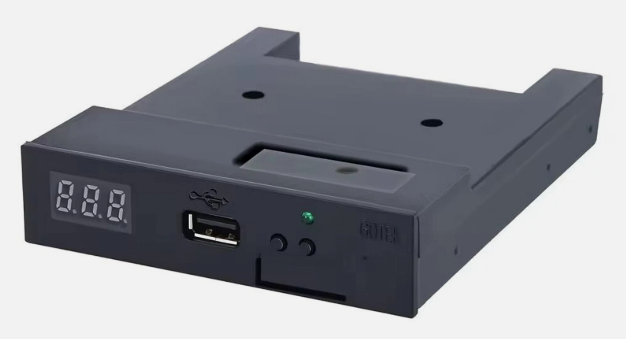
I therefore purchased a GOTEK FDD emulator, to attach to the original FDC-1 card. To give greater flexibility, the GOTEK firmware was replaced with the opensource Flash Floppy: https://github.com/keirf/flashfloppy
Now I just needed a CP/M boot image, but unfortunately, that’s not as straightforward as you’d hope. Even writing a Flash Floppy config file to enable it to support the Interak format is more complex than I was expecting it to be, as there are numerous disk parameters to set.
Fortunately, I managed to find one other person who has experimented in using Flash Floppy with their Interak, and he provided some useful pointers, not least to a simple GUI tool that allows management of floppy images on CP/M.
http://star.gmobb.jp/koji/cgi/wiki.cgi?page=CpmtoolsGUI
Unfortunately, the website is in Japanese, but you can translate.
I downloaded and extracted "CpmToolsGUI" and found the folder named "CPMTG(English)".
I then replaced the diskdefs file with one provided by my newfound Flash Floppy guru, copying both a “blank disk” image file and a “bootable disk” image file that he provided to a FAT32 formatted USB memory stick. He also provided me with a Flash Floppy config file (FF.CFG) that worked on his system, to copy into the FlashFloppy FF folder on the root of the USB stick.
Sadly, it didn’t work! Although I did get as far as a “Blank Track 00 suspected” error message.
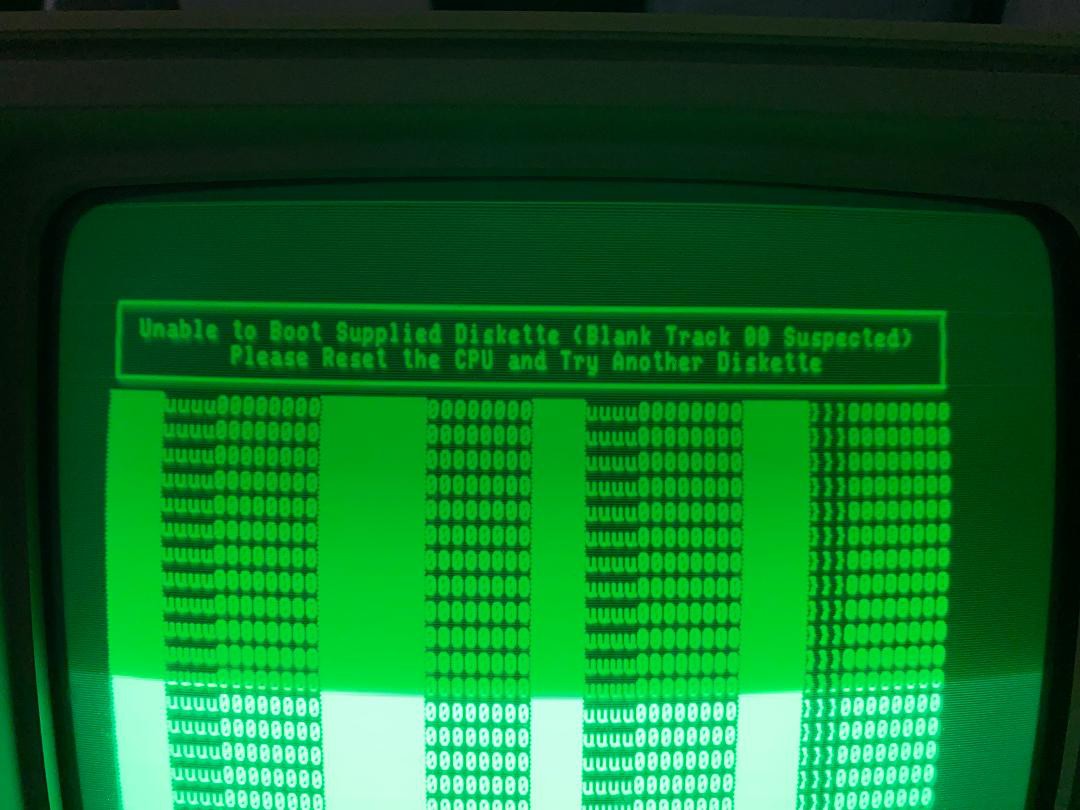
Unsure where the error lay – with my FDC-1 controller card, the ribbon cable, the Gotek emulator, my Flash Floppy configuration, or even something else entirely – I decided to try a floppy drive first, in order to prove some of the hardware at least.
Back to the “Interaktion Group”, and I managed to source an original Interak 1 MB floppy disk drive, together with a CP/M Boot Disk.
The only (minor) issue in installing the floppy drive, was that the power cable that I fitted to power my Gotek emulator provided only 5V. The Interak floppy drive, being much older, additionally needed 12V. I’m unsure why my system came with no FDD power cables installed, but it was relatively quick to add one, or indeed two. Later, when I came to install the FDD in the rack, I found too that the FDD mounting plate I had comprised a front with a cut-out for a larger drive, but fortunately I had a spare front that I could replace it with. Again an easy task, although the front panels are more robust than you’d expect!
Once connected, the Interak booted first time. There was a display issue, described in a separate log, but the disk drive itself worked perfectly. I now had an Interak running CP/M.
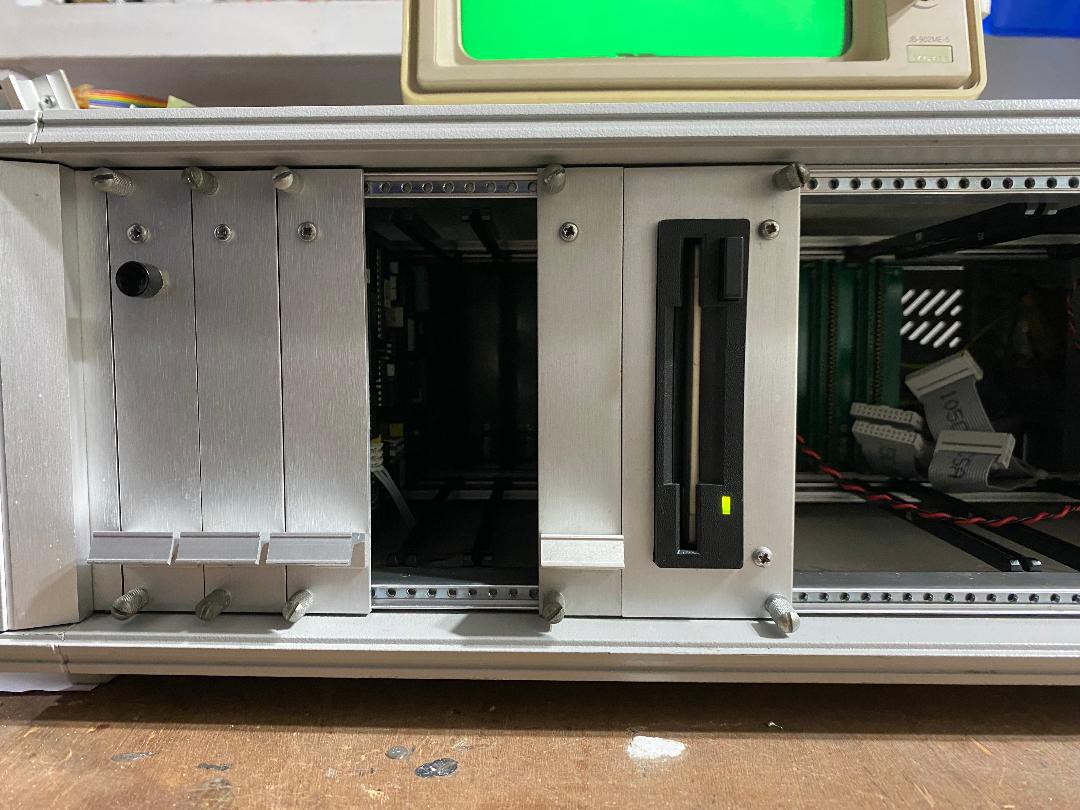
I still intend to revisit the Gotek drive, and at least now knowing the FDC-1 and cable are good.
TBC…/
Discussions
Become a Hackaday.io Member
Create an account to leave a comment. Already have an account? Log In.