 Ayu
AyuLet me introduce you to the new revision — Canta CC!

Among friends who have received the last batch (Rev. 2), there is this recurring curiosity that one day the user will be able to customize the instrument as they like. In this revision, I hope to bring that into reality.
The updated set of components were selected for USB connectivity and improved performance, while still maintaining a decently low cost. The microcontroller here is the CH591, a lightweight wireless RISC-V MCU by Nanjing Qinheng Microelectronics (also known as WCH). The audio amplifier is now the hobbyists' staple MAX98357, but in its tiniest WLP package.

The inner workings stayed the same. Touch pads are still sensed with the RC network despite our new MCU integrating a touch-key peripheral, as I hope to keep the code and hardware construction widely portable with minimal changes (in case of further reincarnations, right? >_^). The digital audio bus (I2S) is still emulated with SPI lines with a timer output nudged into lockstep by a string of nop's.
Probing I2S signals into such a tiny chip is impossible (almost), so there is a switch in the code that re-routes I2S to the exposed touch pads. The 16-bit 0x0105 pattern is a good one when wrapping my head around the timings.

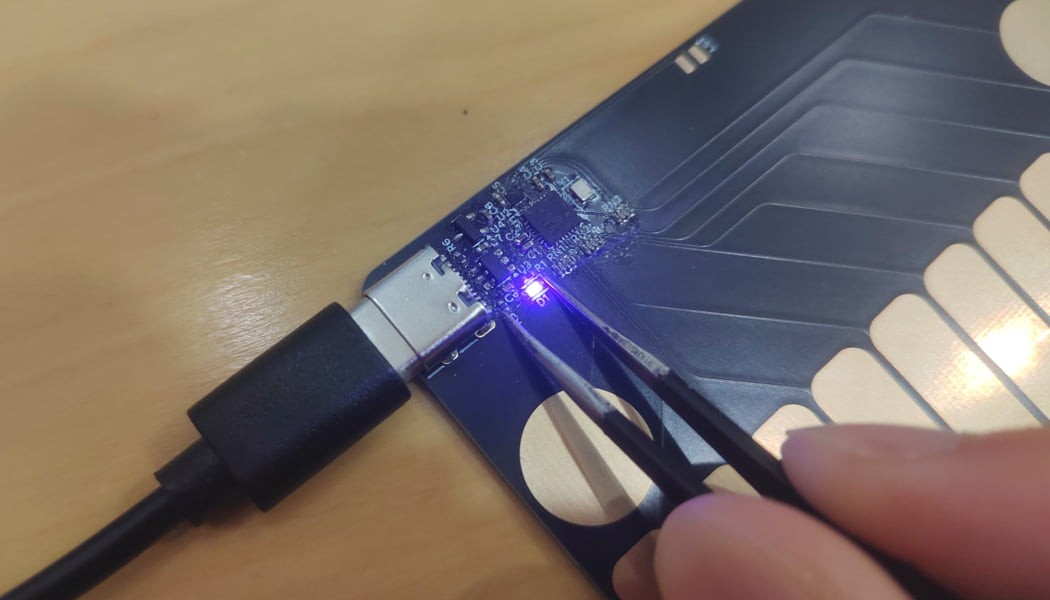
Now that the MCU carries USB, we no longer need a separate debug connector. When a specific pin (PB22) is shorted to ground at boot, the device enters the factory bootloader which allows program upload through USB. Here, during normal operation, PB22 functions as the activity LED's cathode, so entering bootloader is as simple as clipping specific points on the board with a tweezer.
Now, what is CC, you may ask? It stands for anything — from Control Change to "Creative Customization", you name it. Canta stays the title, and the codename CC I leave up to the user to interpret. I'd like to see the USB customization working soon, whether by some simple parameter knobs or by full-on RISC-V code upload — the possibilities are endless, as I might conclude from my curious-minded friends.
For now, the music comes back alive. Until next time, have a fabulous late-season!
This revision's work-in-progress is at the cc branch.
Discussions
Become a Hackaday.io Member
Create an account to leave a comment. Already have an account? Log In.