 EEEngineer4Ever
Project Introduction
The BenchVolt PD is more than just another power supply – it’s a compact, versatile, and open-source tool built for makers, engineers, and professionals who need flexibility at their bench or on the go.
Sometimes a single power supply simply isn’t enough. With BenchVolt PD, your everyday USB Type-C adapter or even a power bank can be transformed into a flexible, multi-channel power supply. That means you can safely power different voltage levels from a single device, all while keeping full control and protection.
Wouldn’t it make sense to replace multiple bulky supplies with one smart, portable box?
With support for USB Power Delivery (USB-PD) up to 100 W, the Power Box offers five independent output channels: three fixed outputs for common voltages(1.8V, 2.5V, 3.3V) and two adjustable channels(0.5V to 5V and 2.5V to 32V) capable of both precise voltage/current control and arbitrary waveform generation. With current protection, you can safely power multiple evaluation boards, test circuits, and development setups simultaneously – without worrying about overloading your supply.
A bright TFT display keeps you informed with live voltage, current, and power readings per channel, while SCPI control support makes integration with test scripts and automated setups effortless. Pair it with a power bank and you suddenly have a portable power supply in your backpack.
Imagine dialing in 0–32 V straight from a USB port, setting current limits for sensitive prototypes, or generating custom waveforms on the fly – all from a single, pocket-sized device. For example, you no longer need a bulky 220 V supply just to power your hard drive at 12 V – if you’ve got USB with you, all the voltages you need are right there.
The BenchVolt PD is a complete development and testing companion for anyone working with electronics.
Features & Specifications
Power & Outputs
- Five independent output channels with adjustable voltage and current
- Fixed outputs: 3.3 V, 2.5 V, 1.8 V (up to 3 A each)
- Adjustable Output 1: 0.5V – 5 V @ 3 A
- Adjustable Output 2: 2.5V – 32 V @ 3A
- Current protection & safe operation
- 2.54 mm (100 mil) pin headers for powering multiple evaluation boards
- Arbitrary waveform generation and predefined waveforms (Square, Sine, Triangle, Ramp) available on adjustable channels
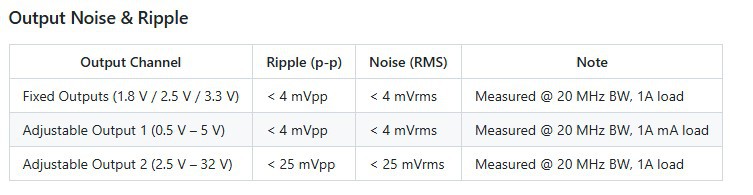
Note: The fixed outputs and Adjustable Output 1 are LDO-driven, providing very low noise
performance.
Arbitrary Function
- Number of Points: 1024
- Resolution: 12-bit
- Point Parameters: Dwell time and Voltage
- Dwell Time Range: 4 ms to 16,384 ms
USB Power Delivery
- USB-C input supporting PD sink mode
- Up to 100 W USB-PD power
Control & Interface
- 1.9" TFT display (170 × 320) for real-time voltage, current, and PD mode
- Rotary encoder for fast menu navigation and 5 mV step adjustments
- SCPI command support for remote programming
- Python GUI for desktop control
Electronics & Firmware
- Microcontroller: STM32F070
- USB-PD controller: STUSB4500 (sink mode)
- Configurable LDOs and boost converters for fine-tuned outputs
- Overcurrent protection on all channels
- Firmware upgradable via USB through the Python interface (no ST-LINK or external dongle required)
Physical
- Dimensions: 160 × 75 × 40 mm (6.3 × 3.0 × 1.6 in)
- Weight: ~500 g (17.6 oz)
Open Source
- Python UI
- Firmware
- Schematics
Block Diagram
How It Works;
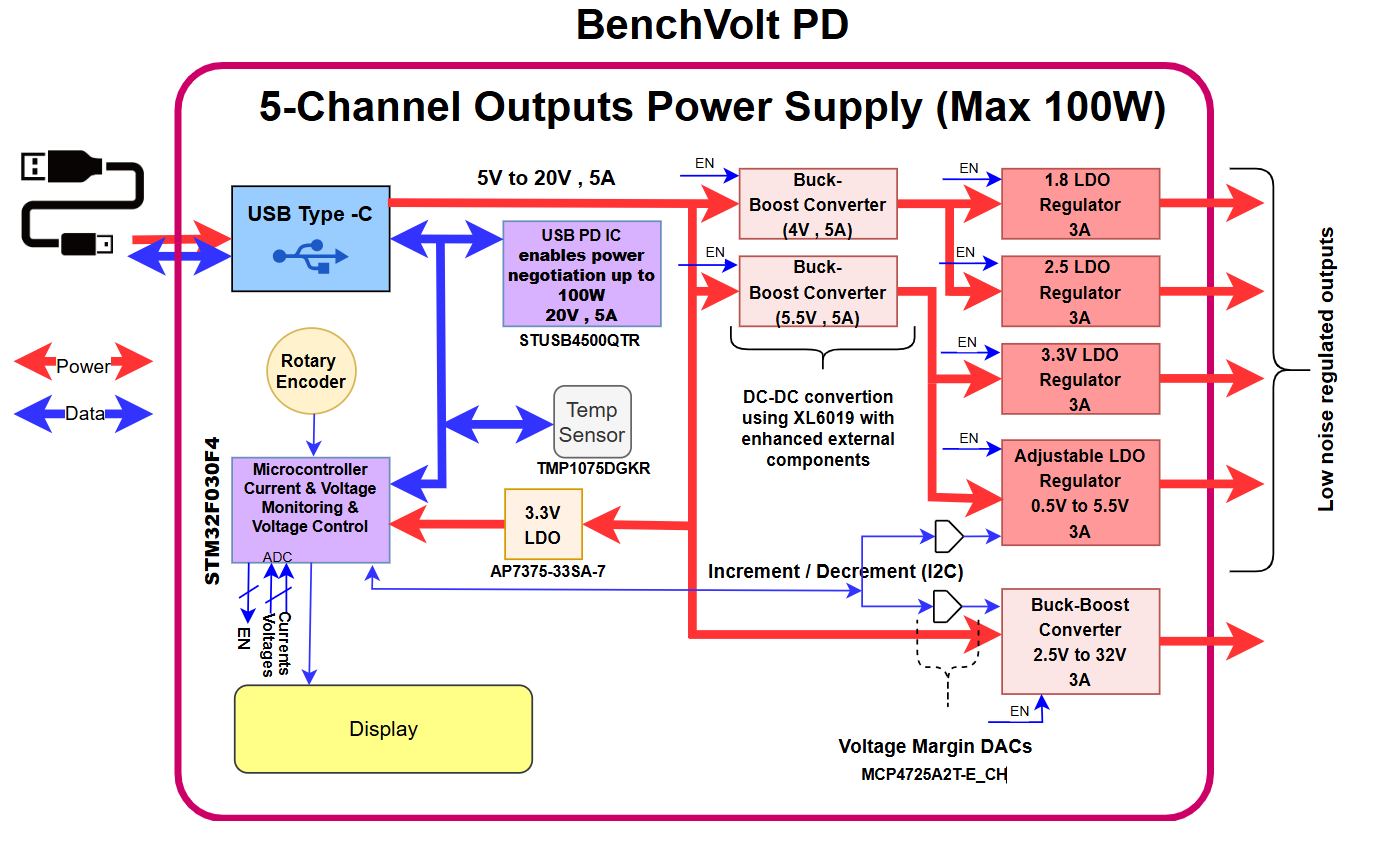
When BenchVolt PD powered on, all regulators and converters start in the disabled state. The STM32 microcontroller first powers up and performs safety checks by monitoring temperature, current, and voltage. It then enables the DC-DC converters, followed by the linear regulators in sequence.
Throughout operation, the MCU continuously monitors system all parameters to maintain safe operating conditions.
An additional safety layer can be used by setting a power limit through the USB PD interface, ensuring the system never exceeds the predefined power threshold. This limit can be configured either from the device’s on-screen menu / rotary encoder or through the Python control interface.
Each DC-DC converter is monitored to ensure no more than 5 A is drawn from its output. The 1.8 V and 2.5 V LDO regulators share the same 4 V / 5 A pre-regulator rail, while the 3.3 V and Adjustable (0.5 V – 5.5 V) LDOs share the 5.5 V / 5 A rail. Therefore, when both LDOs on the same rail are heavily loaded, their combined output current should not exceed 5 A total (typically below 3 A per channel).
The third buck-boost output (2.5 V – 32 V) operates independently and is designed to deliver up to 3 A. At higher load levels, minor voltage variation may occur due to the compact power stage design, but overall stability and performance remain excellent for most applications. Meanwhile, the other outputs — regulated through LDOs — provide exceptionally low ripple and clean voltages ideal for sensitive circuits.
The third buck-boost output (2.5 V – 32 V) operates independently and is designed to deliver up to 3 A. At higher load levels, minor voltage variation may occur due to the compact power stage design, but overall stability and performance remain excellent for most applications. Meanwhile, the other outputs — regulated through LDOs — provide exceptionally low ripple and clean voltages ideal for sensitive circuits.The third buck-boost output (2.5 V – 32 V) operates independently and is designed to deliver up to 3 A. At higher load levels, minor voltage variation may occur due to the compact power stage design, but overall stability and performance remain excellent for most applications. Meanwhile, the other outputs — regulated through LDOs — provide exceptionally low ripple and clean voltages ideal for sensitive circuits.
Note:
- In theory, the system is capable of delivering up to 100 W of total power. However, due to conversion and regulation losses within the DC-DC converters and LDOs, the full 100 W cannot be drawn simultaneously from all outputs. The design goal of this project is to provide a compact, portable, multi-channel power source that delivers sufficient power for a wide range of applications.
- The maximum achievable power depends on the connected USB PD adapter — for example, a 65 W charger will cap the system power at 65 W.
Note:
- In theory, the system is capable of delivering up to 100 W of total power. However, due to conversion and regulation losses within the DC-DC converters and LDOs, the full 100 W cannot be drawn simultaneously from all outputs. The design goal of this project is to provide a compact, portable, multi-channel power source that delivers sufficient power for a wide range of applications.
- The maximum achievable power depends on the connected USB PD adapter — for example, a 65 W charger will cap the system power at 65 W.
Project is live on Crowd Supply now.