 glgorman
Well, time doesn't go sideways, but I can turn my 3-D perspective view of the Euclid style renderings on its side, just because it is possible to do. Of course, there is the idea of Feynman's sum-over-all histories approach to quantum electrodynamics, where one interpretation might be to allow for time to act, perhaps like it has multiple dimensions, which converge, usually, to a single path chosen. Yet, that is not what this post is about. What then is this post about? Well, keep reading.
I saw the other day how someone got an LLM to run TinyStories260K on a C64 with 2MB of RAM expansion, of course, and that looks interesting, obviously - especially if LLAMA2 can be reduced to just 700 lines of C. So, I think that I am on track as far as eventually doing a better AI based on some of my log entries from Hackaday, among other things. Thus, this log entry, like many others, will eventually, all in due time of course, go into the training file for a small LLM, as it were, or else I should perhaps say, as it will be. So that is part of the method for the madness.
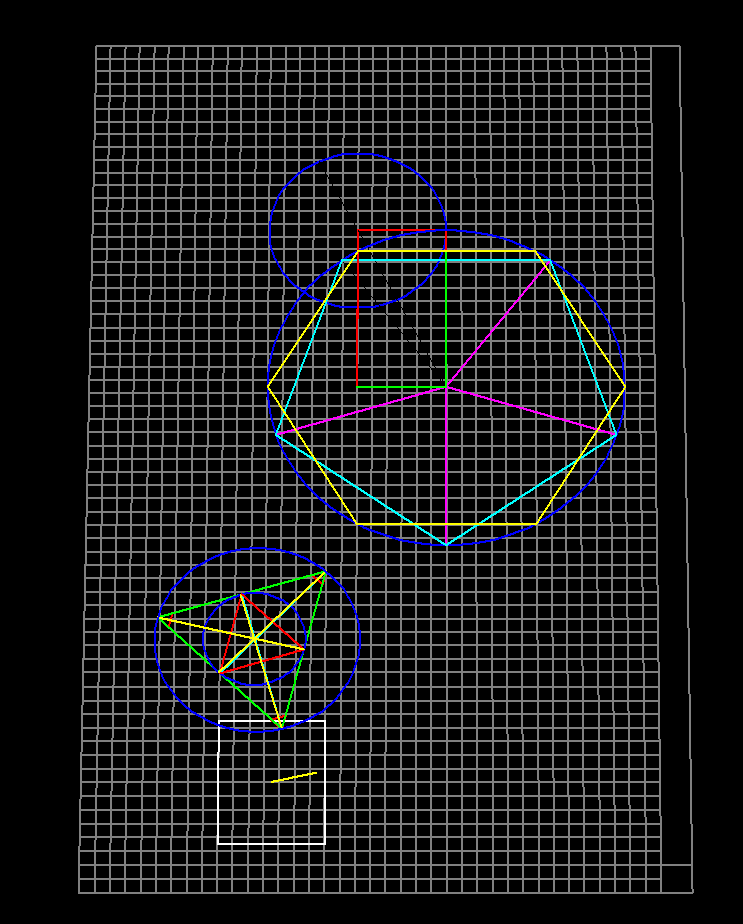
Other than that, I realized something while finally rendering the hexagon. Something quite interesting, that is. Here is a simple question. Is it better to draw five hexagons, according to the vertices of the pentagon, and thereby obtain, hopefully, a set of 30 points that can be further used to construct the 60-minute marks, as well as the hour marks for a clock face? Or is it better to construct one reference hexagon and then construct six pentagons, even though that would obviously be more work computationally? The definition of "better," of course, might depend on such things as the accumulation of roundoff error, for example, and maybe compute time doesn't matter so much, if the calculations, all being done without trig calls of course, only need to be done once, as in the constructor for a master set of points when a module is instantiated.
Then I realized that there might be a third approach. Draw a simple equilateral triangle inside a circle. Then construct at least one pentagon, sharing a vertex, and then, according to the points of the pentagon, construct a couple of hexagons, acting as if kind of random, in effect, just doing whatever, so as to get more points.
This could get messy, since some sets of vertices might get constructed more than once, and maybe some comparisons and sorting operations would need to be performed, even though that would probably involve branches, and it would also really mess with things as far as the meanings of words like "proof" and "rigor" are concerned, especially insofar as trying to prove the equivalence of the results of an analytic construction vs. a real world compass and straight edge construction are concerned.
Fortunately, I don't think that would involve an infinite regression, just some kind of tree search that could include redundancy checking, as a part of a larger equivalence testing regimen.
Discussions
Become a Hackaday.io Member
Create an account to leave a comment. Already have an account? Log In.