 Lars Friedrich
After the successful verification of the synchronized dual camera shown in the last log entry, I will finish the highrate_longexp project and integrate the dual camera into my other project lalelu_drums. The following video shows a preview. In the foreground, the new dual camera can be seen, that is used to capture the gestures of the player. The percussion sounds are triggered from the gestures in real time. Due to the longer exposure times that are now possible, the illumination of the scene can be reduced compared to the arrangement with a single camera. I will cover the details of the integration in an upcoming log entry for lalelu_drums.
Outlook
While the camera is already well usable, there are three points that have potential for improvements.
1) Integrate trigger generation into camera housing
In the current implementation, the two trigger signals are generated by a raspberry pi outside of the camera housing and are transmitted to the two camera PCBs via 5m cables. This arrangement allows to flexibly reconfigure the trigger signals since the raspberry pi computer can be reprogrammed for example via ethernet connection.
If the frame rate is fixed, it should be possible to generate the trigger signals with a microcontroller (e. g. raspberry pi pico) that could be placed inside the camera housing. The microcontroller could be powered from the 5V USB supply of the cameras. This arrangement would reduce complexity and make the cabeling more lightweight.
2) Bring camera objective lenses closer together
The lower the distance of the camera lenses, the less compensation of the parallax and offset is necessary. If the camera PCBs are rotated as shown in figure 1, the distance can be reduced compared to the current implementation. However, it would be necessary to check how much latency the rotation correction in software creates.
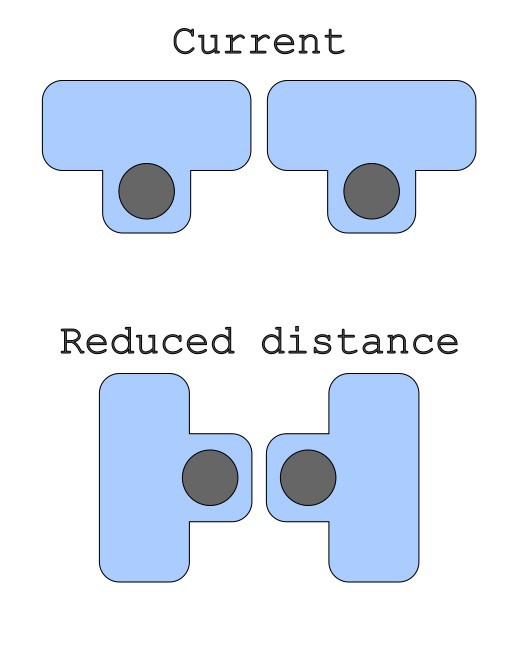
Figure 1
3) Add sheath wave filters
Very rarely, the cameras show frame drops during live acquisition, that I could not observe in the single camera case. I assume these are related to the longer cables. It is hard to test since the rate at which the drops occur is in the order of one in six hours of streaming. I observed that the original cable has a sheath wave filter at the end of the connector. It would be easy to add one to the longer cables (e. g. this one).
Discussions
Become a Hackaday.io Member
Create an account to leave a comment. Already have an account? Log In.