 typecad
Like the introduction said, AI can't do anything from within Altium or KiCAD. Perhaps if they ever develop an MCP server, it will be possible. Another possibility might be plugins that provide a create/move/route functionality.
As for right now, the typeCAD (or atopile) method of schematic-as-code is a promising approach to hardware design. It very clearly is a large jump from what is traditionally done, and there is 0 support for this from the major hardware providers, so gaining any traction will be difficult.
But I do think this small experiment showed that AI can do parts of the job. There were many ways to accomplish this particular task, and I was told by multiple LLMs several times, that the multi-IC approach was not the simplest way. I'll leave the results to the community to evaluate, though.
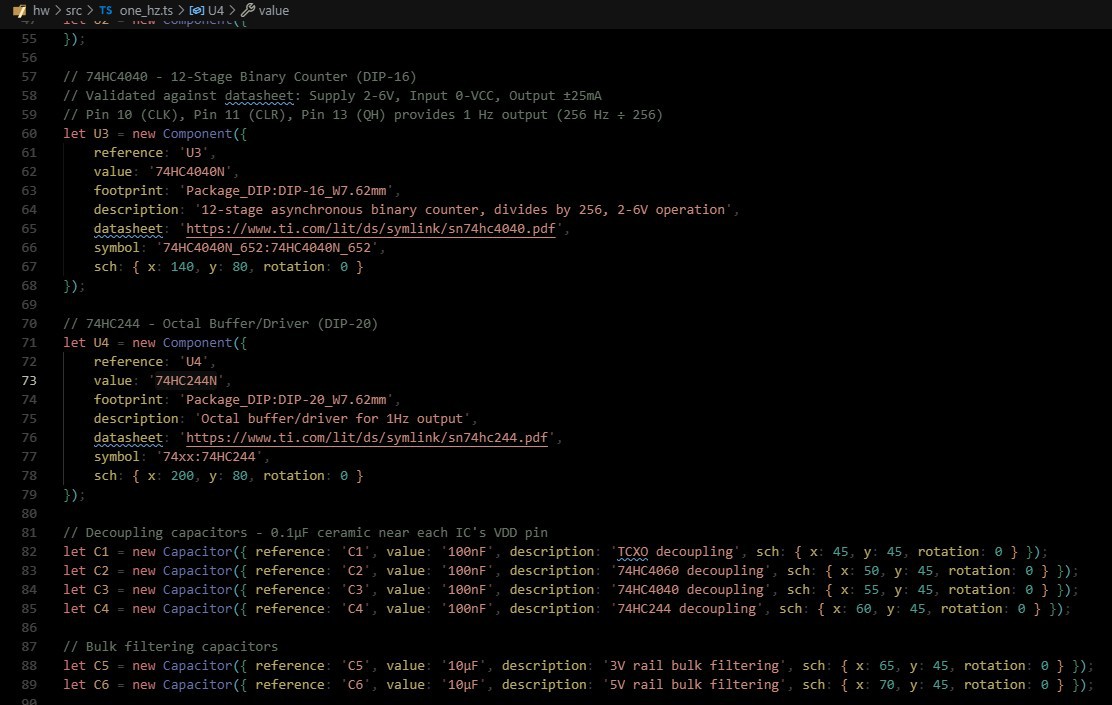
Some people will find this much more comfortable, others will hate it. More options are always better, though. Using code, all the typical tools become available: git, version control, and easy review. AI can deal with and understand it far better. This code will create an entire KiCAD project on each run, the PCB, and schematic, a BOM, run ERC, and write documentation. It can also do power analysis for you every time, much like a CI/CD pipeline might check a repo on every commit. There are plugins that will package the project for JLCPCB and run spice simulations.
From within VS Code, Cursor, or Kiro, you can take advantage of easy access to vast information. All the LLMs can search through all the information of a project, all the datasheets (with limitations), and come up with answers. You can simply ask it to find where in the datasheet it says x or y, or ask it to implement the entire reference design. Then, implement another IC's reference design and connect the two together.
Discussions
Become a Hackaday.io Member
Create an account to leave a comment. Already have an account? Log In.
I agree with your assessment that AI integration into EDA tools is still in its early stages. But schematic as code is a strong direction. The real bottleneck is ecosystem support and tool maturity, not just modeling capabilities. Companies like ai automation agency https://artjoker.net that focus on custom software development and AI-based solutions are already showing how quickly custom toolchains can evolve beyond traditional vendor stacks. What you describe most closely resembles a CI/CD-style hardware pipeline, and once plugin ecosystems mature, this workflow could become mainstream for complex PCB design.
Are you sure? yes | no