 Pierre-Loup M.
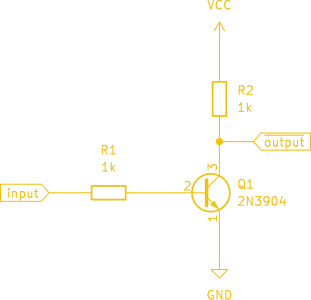
A NOT gate is quite easy to make with discrete components : a transistor and two resistors are enough. The transistor is used as a switch : it conduct current, or not.
- When a low level is applied on the transistor base (the input), it blocks current from flowing though it. The output is then pulled up to VCC by the R2 resistor.
- When a high level is applied on the transistor base, it conduct current, so its collector becomes "connected" to its emitter. The output is then almost GND (on this specific transistor, Vcesat is 0.2V, so that's the output low level.
Discussions
Become a Hackaday.io Member
Create an account to leave a comment. Already have an account? Log In.