Close
0%
0%

WebScreen - ESP32-S3 AMOLED Display for Gamers

AMOLED display powered by ESP32-S3, designed to enhance gaming setups with live stats, alerts, and customizable overlays.

Similar projects worth following
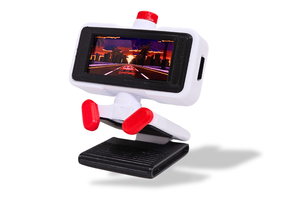
WebScreen is a compact secondary display for gamers and makers. It features a 240×536 AMOLED screen powered by an ESP32-S3, perfect for showing system stats, alerts, or custom dashboards.
Designed from scratch for performance, it includes Wi-Fi/BLE, 128 MB flash, microSD slot, and USB-C. Its 3D-printed mount fits cleanly on your monitor and supports accessories like lights or webcams.
At only 53g, WebScreen blends into your setup without adding clutter. It can even run JavaScript widgets directly from SD—making it the smartest little screen on your desk.

What is WebScreen?

WebScreen is a compact secondary display designed for gamers, makers, and creative builders who want useful, real-time information right on their desk. Whether it’s system stats, stream alerts, Discord notifications, or a Twitch timer—WebScreen keeps you focused on what matters without adding clutter.

Technical Specifications

  • Microcontroller: ESP32-S3 with Wi-Fi + BLE
  • Display: 2.1" 240×536 AMOLED, 16.7M colors
  • Storage: microSD slot (up to 32 GB FAT32), 128 MB flash
  • Power: USB-C, 5V, low-power mode supported
  • Connectivity: WebSocket, OTA, and serial USB
  • Mounting: Monitor clamp + standard ¼‑inch screw (top and bottom)
  • Weight: 53 g

Hardware Design

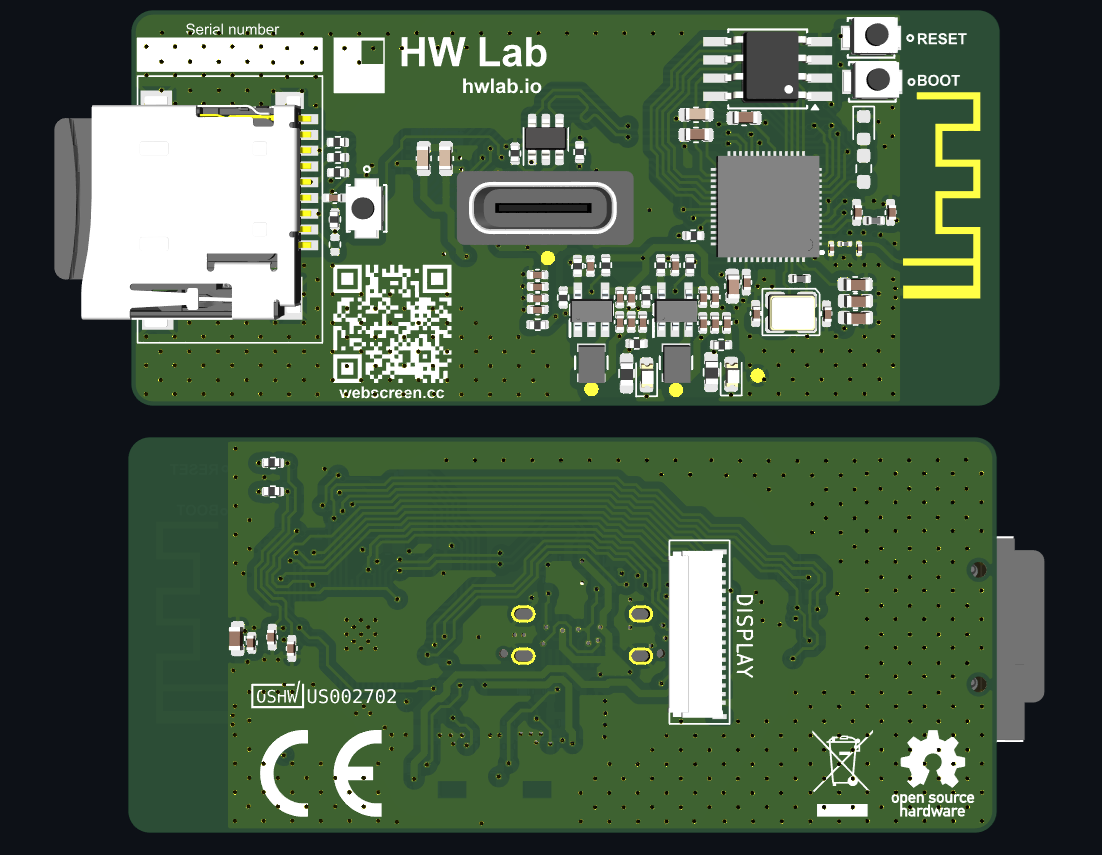
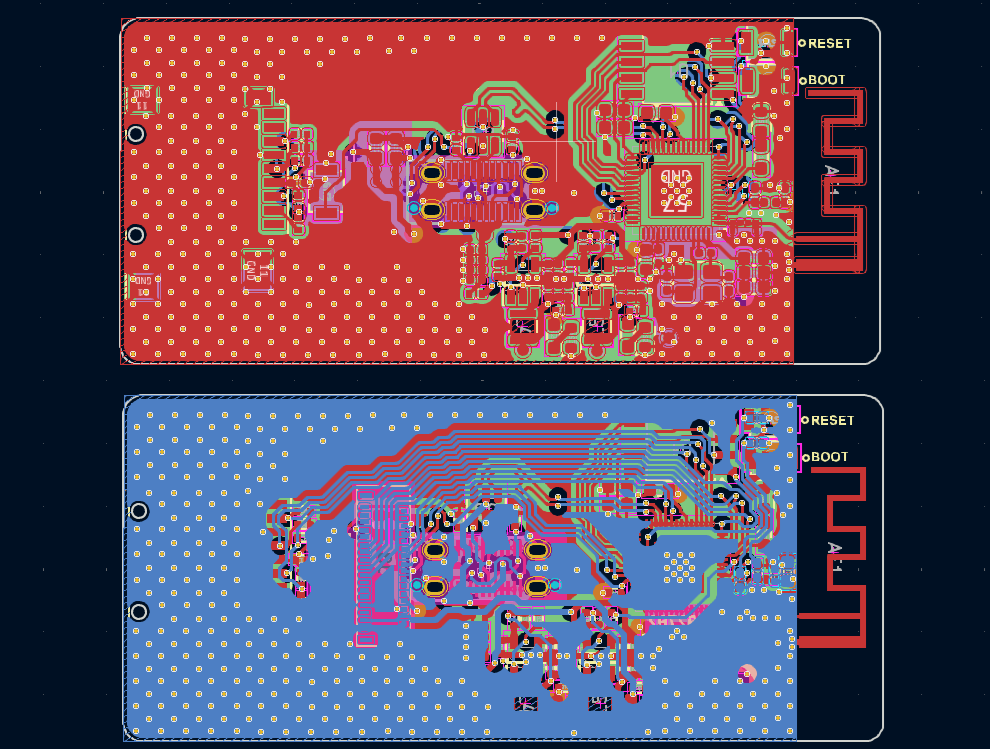
We designed the PCB from scratch using KiCAD. Signal integrity for the SPI bus was a top priority, ensuring stable communication at high speeds with the display and SD card sharing the same bus. The board includes all necessary decoupling capacitors, series resistors, and thermal considerations. The USB-C port is used for both power and serial programming.

Mechanical Design

The case is 3D printable and requires no screws or glue. It's designed to clip cleanly on the top edge of most monitors, with optional bottom or top tripod screw mounts. The enclosure was modeled in FreeCAD and optimized for PLA or ABS. Variants can be remixed to include holes for LEDs, ventilation, or alternative mounting strategies.

Firmware and Control

WebScreen runs custom firmware built on ESP32 Arduino core. Users can write widgets in JavaScript and store them on the SD card. These scripts are executed at runtime, meaning no flashing is required. The firmware supports OTA, config via serial or Wi-Fi, and file uploads from a desktop companion app (Windows/macOS/Linux).

Use Cases

  • Streaming dashboards (Twitch chat overlay, countdown, alerts)
  • System monitor (CPU/RAM usage, temperature, FPS)
  • Smart home status display
  • Habit tracker or Pomodoro timer
  • DIY productivity tool
  • Visual assistant for AI/LLM workflows

Open Source & Community

WebScreen is fully open source. All hardware files, firmware, and software are published on GitHub under the MIT license. Contributions are welcome.

PCB design: WebScreen PCB GitHub

Enclosure: WebScreen Enclosure GitHub
  • Engineering WebScreen: A Technical Deep Dive into a Compact ESP32‑S3 AMOLED Display

    Pedro Manuel Martín08/05/2025 at 18:33 0 comments

    From day one, WebScreen was conceived not as a mere second screen, but as a finely engineered embedded display, built with precision and intent. It houses a powerful ESP32‑S3 microcontroller at its core, fluidly handling connectivity, processing, and control. Driving a vibrant 240 × 536 pixel AMOLED panel capable of rendering 16.7 million colors, WebScreen delivers sharp visual feedback with minimal lag and high contrast, making it ideal for notifications, IoT dashboards, and user-defined widgets.

    The electronics were meticulously designed with signal integrity in mind. All high-speed traces are routed with matched lengths and series termination resistors, while ground pours and decoupling capacitors help reduce RF noise generated by the ESP32‑S3. A 128 MB serial flash memory module ensures ample room to store firmware, configurations or custom JavaScript applications loaded via the microSD slot.

    Power and configuration are handled via a USB‑C port, which also supports WebSocket-based configuration, allowing users to push updates or change settings over Wi‑Fi while maintaining a clean, reversible connector interface. Connectivity through Wi‑Fi and BLE is baked directly into the ESP32‑S3 module, facilitating seamless integration with smart home systems, desktop apps, or notification bots.

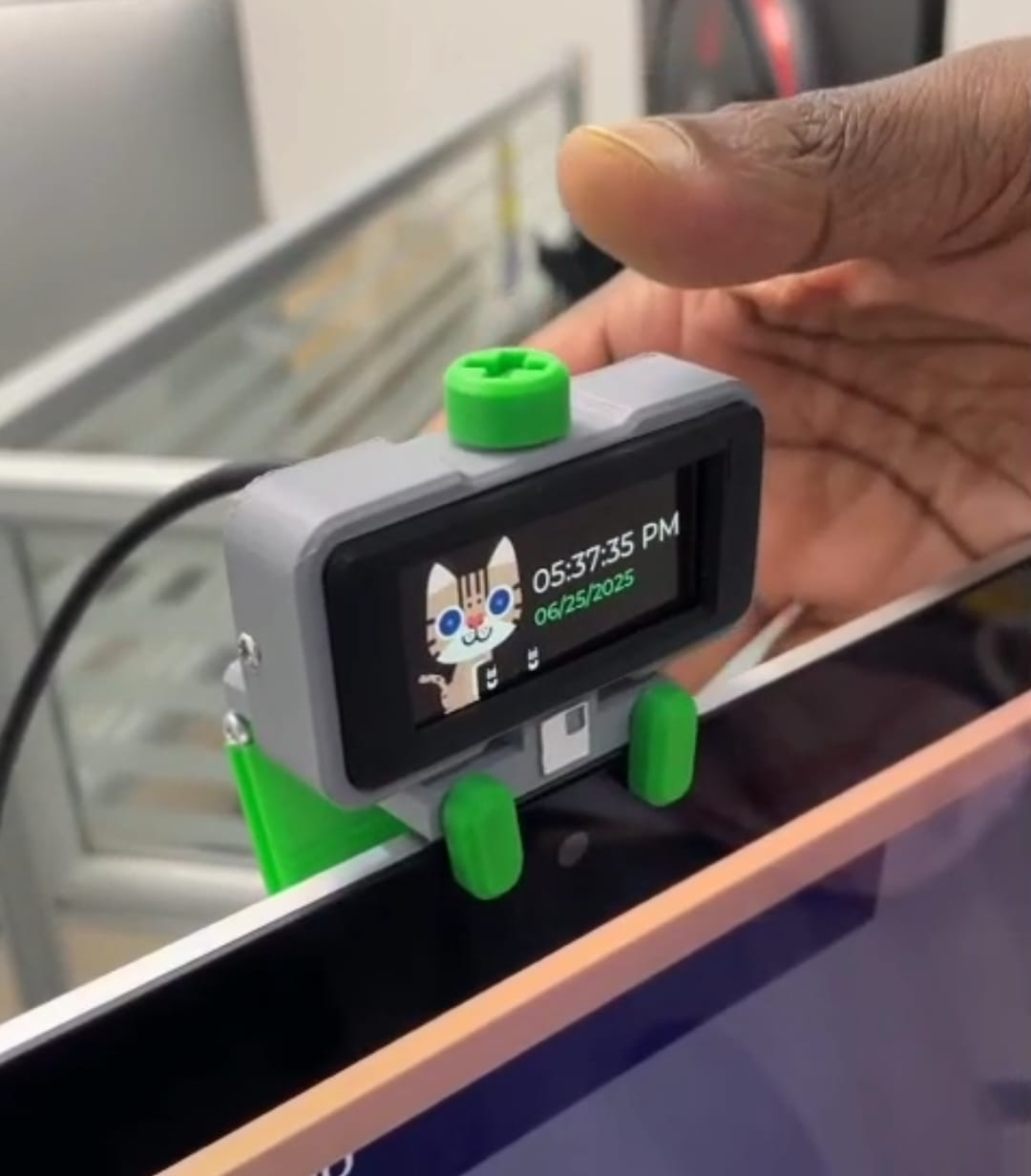
    Mechanically, WebScreen measures just 74 × 80 × 53 mm and weighs a mere 53 g, reflecting a purposeful minimalist design. It snaps securely onto the top of monitors using internal clamps, and includes standard ¼‑inch threaded holes on both top and bottom surfaces—perfect for mounting a webcam or stacking multiple units.

    WebScreen embraces true open source philosophy. All its design artifacts—including PCB schematics, gerbers, bill of materials, 3D-printable files, desktop companion app, and firmware—are released under MIT license, and the hardware is certified by OSHWA. This transparency enables anyone to inspect, modify, or fork the design to suit their own project vision.

    Software architecture is equally flexible: scripts written in JavaScript can be placed on a microSD card and executed directly on the device—no complicated toolchain required. This lets users prototype custom dashboards, habit trackers, crypto tickers, or even minimal assistant UIs. Setup is simplified with a companion application compatible with Windows, macOS, and Linux, enabling dynamic customization without flashing firmware.

    WebScreen operates reliably in environments ranging from 0 °C to 35 °C, and can withstand storage conditions between –20 °C and 45 °C. ABS enclosure materials were selected to strike a balance between durability and manufacturability, ensuring resistance to splashes and dust while allowing optional PLA-based prototyping.

    This project is intended to be more than a product: it is a robust platform for community-tailored interfaces and automation. In upcoming logs, we will demonstrate use cases like connecting WebScreen to Home Assistant as a micro-dashboard node, displaying system statistics from a desktop app over WebSocket, and building a minimal streaming companion for Discord or Twitch notifications.

    We invite you to inspect the GitHub repository (WebScreen PCB), (WebScreen Software), (WebScreen Enclosure), remix the hardware, craft your own JavaScript modules, and contribute improvements. Build your version or join us as we progress toward a Crowd Supply campaign. Let us know what you’d build with WebScreen.

    — Pedro, HW Lab

View project log

Enjoy this project?

Share

Discussions

Similar Projects

Does this project spark your interest?

Become a member to follow this project and never miss any updates