 Ayu
AyuI was in the middle of a Linux kernel craze when I opened Hackaday and bumped into the One Hertz Challenge. I was suddenly struck by a notion — and the night passed sleepless, sleepless even with the kernel already in oblivion.
I was late to the scene, but not quite — there were still two full weeks ahead. That would be at least enough for something.
The basic idea builds on the frequency drift phenomenon: periodic events whose periods are supposedly identical, but actually slightly different and varying, gradually become out of sync (and back into sync again). Normally we would consider this a nuisance and immediately switch to an accurate time source, but as some have demonstrated, it can actually be an artistic artefact. From mitxela's blinking badges to bitluni's blinking superclusters, the desynchronising lights effect has been explored and demonstrated in full detail.
This project follows this line of thought — if lights can drift, why not sound? For sure, Steve Reich has realized a similar idea in the piece Violin Phase where musical patterns go out of sync to form complex relations. In contrast to Reich's entire phrases interleaving, what if the individual tones themselves drift apart? As each tone moves back and forth in time, the musical phrase itself morphs and evolves. For an interactive installation, I consider a bunch of desynchronising repeated notes: together, they form a short loop that slowly, automatically changes as time passes. In this way, we stress more on the concept of an ever-changing musical short phrase, and harness indeterminacy from the transient physical world.
In this first incarnation in the series, the physical construction is straightforward: a desktop lamp that "pulses" once per second. Each pulse comprises sound as well as light, yielding a rich and easily observable output. As a simple form of interaction, in response to nudges or pats, the lamp switches to a different tone and colour, and resets its phase (time of pulse). When multiple such lamps are put together, they form a looping musical phrase that spans one second, with each lamp contributing a single note within. These devices are set to run on microcontrollers' imprecise internal RC oscillators, so their clocks naturally drift apart even without external interference, resulting in constant variations in the looping phrase.

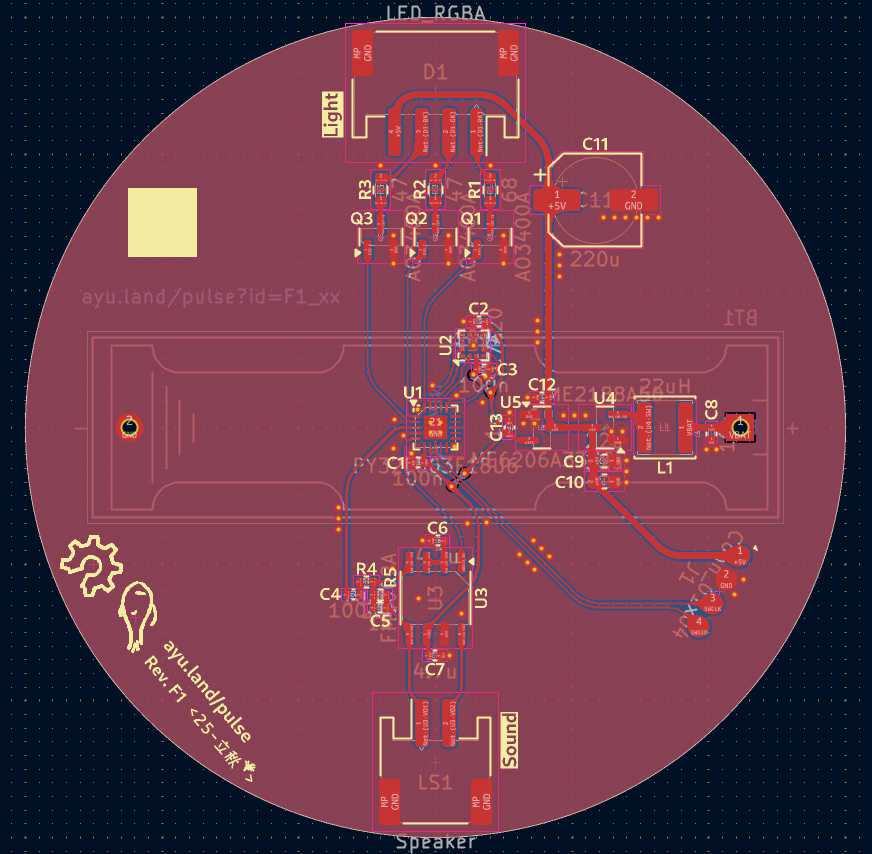
The first revision of the circuit board has been designed and is now on its way from the fabrication house. It will be powered by a NiMH battery; interaction will be sensed by an accelerometer IMU. Let's see how this will turn out.
Discussions
Become a Hackaday.io Member
Create an account to leave a comment. Already have an account? Log In.