 Tim
TimCandlelight is a curious thing. Candles seem to have a life of their own: the brightness wanders, they flicker, and they react to the faintest motion of air.
There has always been an innate curiosity in understanding how candle flames work and behave. In recent years, people have also extensively sought to emulate this behavior with electronic light sources. I have also been fascinated by this and tried to understand real candles and how artificial candles work.
Now, it's a curious thing that we try to emulate the imperfections of candles. What if I told you that candle makers have worked for centuries (and millennia) on optimizing candles NOT to flicker?
In essence: The trick is that there is a very delicate balance in how much fuel (the molten candle wax) is fed into the flame. If there is too much, the candle starts to flicker even when undisturbed. This is controlled by how the wick is made.
There is a particularly fascinating effect that has more recently been the subject of publications in high-profile scientific journals[1] [2]: When several candles are brought close to each other, they start to "communicate" and their behavior synchronizes.
The simplest way is to bundle three candles together - they will behave like a single large flame, as shown below.
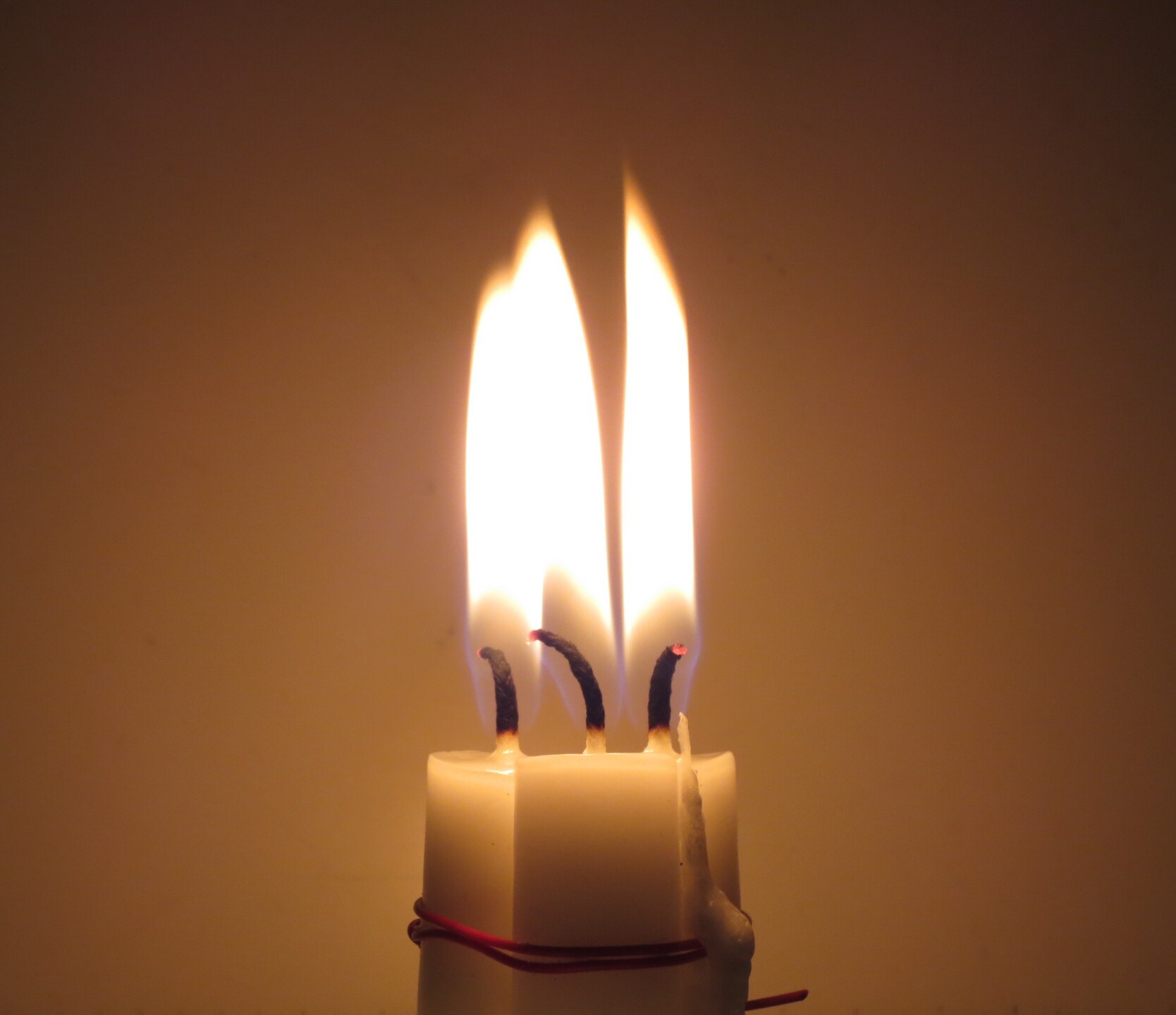
[1] Okamoto, K., Kijima, A., Umeno, Y. & Shima, H. "Synchronization in flickering of three-coupled candle flames." Scientific Reports 6, 36145 (2016).
[2] Chen, T., Guo, X., Jia, J. & Xiao, J. "Frequency and Phase Characteristics of Candle Flame Oscillation." Scientific Reports 9, 342 (2019).
Discussions
Become a Hackaday.io Member
Create an account to leave a comment. Already have an account? Log In.