Ildar Rakhmatulin

Hi, I’m Ildar, the founder of PiEEG. I’ve been fascinated with brain-computer interfaces (BCIs) for years—the idea that we can read brain activity and use it to interact with electronics feels like pure science fiction. But when I started digging into the world of EEG (electroencephalography), I quickly ran into a problem:
Most EEG gear was either too expensive or locked behind proprietary software. Unless you had access to a lab, BCI experiments weren’t exactly within reach for a student, hobbyist, or indie developer.
So I decided to change that.
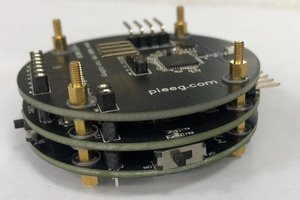
That’s how MicroBCI was born: a low-cost, open-source EEG/BCI shield built around the STM32 NUCLEO-WB55 board.
Why STM32?
I’ve worked with a lot of microcontrollers, but STM32 just clicked for me. It’s affordable, flexible, and has one of the most active communities around. There’s something satisfying about building on hardware that so many people already know and love.
I wanted MicroBCI to feel like a natural extension of the STM32 ecosystem—so that anyone with a NUCLEO board could suddenly step into the world of brain signals without needing expensive lab hardware.
What MicroBCI Can Do
At its core, MicroBCI is a biosignal shield. It plugs into STM32 NUCLEO boards and gives you access to EEG (brain), EMG (muscle), and ECG (heart) signals.
Some quick specs:
-
8 input channels (wet or dry electrodes)
-
Data transfer via SPI at 250 SPS
-
Programmable gain (1–24)
-
Compatible with Raspberry Pi & STM32 boards
Hook up a few electrodes, run the software, and you’ll see your own biosignals right on the screen.
It’s Not Just Hardware
One of the biggest mistakes I see in DIY neuroscience is focusing only on hardware. That’s why I built MicroBCI as part of a bigger open-source framework.
-
Python SDK – acquire, visualize, and analyze signals. Great for prototyping and research.
-
Mobile SDK (Flutter) – build cross-platform apps (Android/iOS) that talk to your brain.
-
STM32 firmware – handle real-time processing directly on the MCU.
With these tools, you can go from electrode → STM32 → real-time data → app → project in a very short time.
The Bigger Picture
When I founded PiEEG, my mission was simple:
👉 Make neuroscience tools accessible to everyone.
EEG shouldn’t be locked inside labs or priced beyond reach. Artists, gamers, makers, students—they should all be able to experiment with biosignals and come up with their own creative applications.
MicroBCI is one step in that direction.
What You Can Build
MicroBCI opens the door to all sorts of fun (and sometimes weird) experiments:
-
Brain-controlled robots & drones
-
DIY meditation & focus trackers
-
EEG-powered gaming interfaces
-
Biofeedback for sports & performance
-
Classroom neuroscience demos
It’s not a medical device—but it’s a great way to learn, experiment, and push the boundaries of what’s possible with low-cost EEG.
Where It’s Going
This is just the beginning. I see MicroBCI as part of a larger ecosystem of tools that lower the barrier for BCI research and development. With more makers experimenting, more students learning, and more researchers prototyping, innovation in this space will accelerate.
If you want to experiment with EEG on STM32, check out PiEEG Shop
. And if you end up building something with MicroBCI—whether it’s a brain-controlled rover or just a cool visualization—I’d love to hear your story.
Details
 Pavel Zhovner
 Aleksandar Bradic