 Joseph Eoff
Back when my Dad made the first one of these, he didn't have an oscilloscope. I always wondered what the clock really looked like, since the LM3909 doesn't really have a power supply in this circuit. Somehow, in later years I never had a working oscilloscope and a working diode tester in my hands at the same time.
I had the chance once in high school, when I built one as a project in an electronics class. The teacher was kind of surprised at how it worked, but we didn't get around to hooking up the clock to the scope.
As it turns out, the LM3909 has good grounds to be picky. It is powered by the leakage current through the clock input of the 7473. That current is so low, that with the load of the LM3909, the clock input voltage stays way below 1 volt. The LM3909 oscillates with a peak to peak voltage of about 0.7 volts:
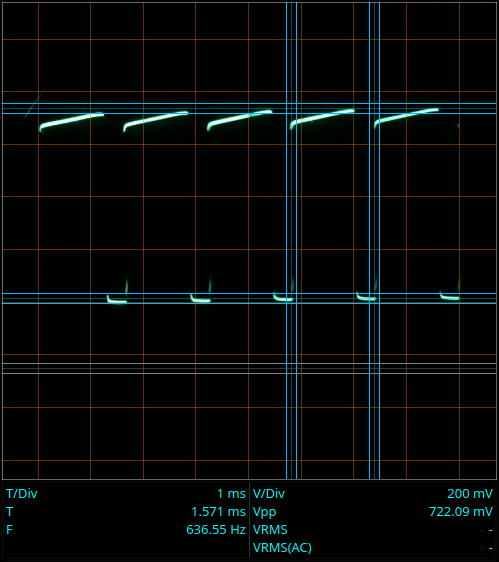
The signal it generates isn't really very good:
- The duty cycle is very far from 50 percent.
- The edges are not especially fast.
- The top is still rising across the whole "high" period.
Scuzzy as it is, it does run - but only if you use a 7473.
Discussions
Become a Hackaday.io Member
Create an account to leave a comment. Already have an account? Log In.