 Joseph Eoff
I've finally gotten back to a state where I can reach my workbench in the attic. Pro tip: avoid breaking your leg if at all possible.
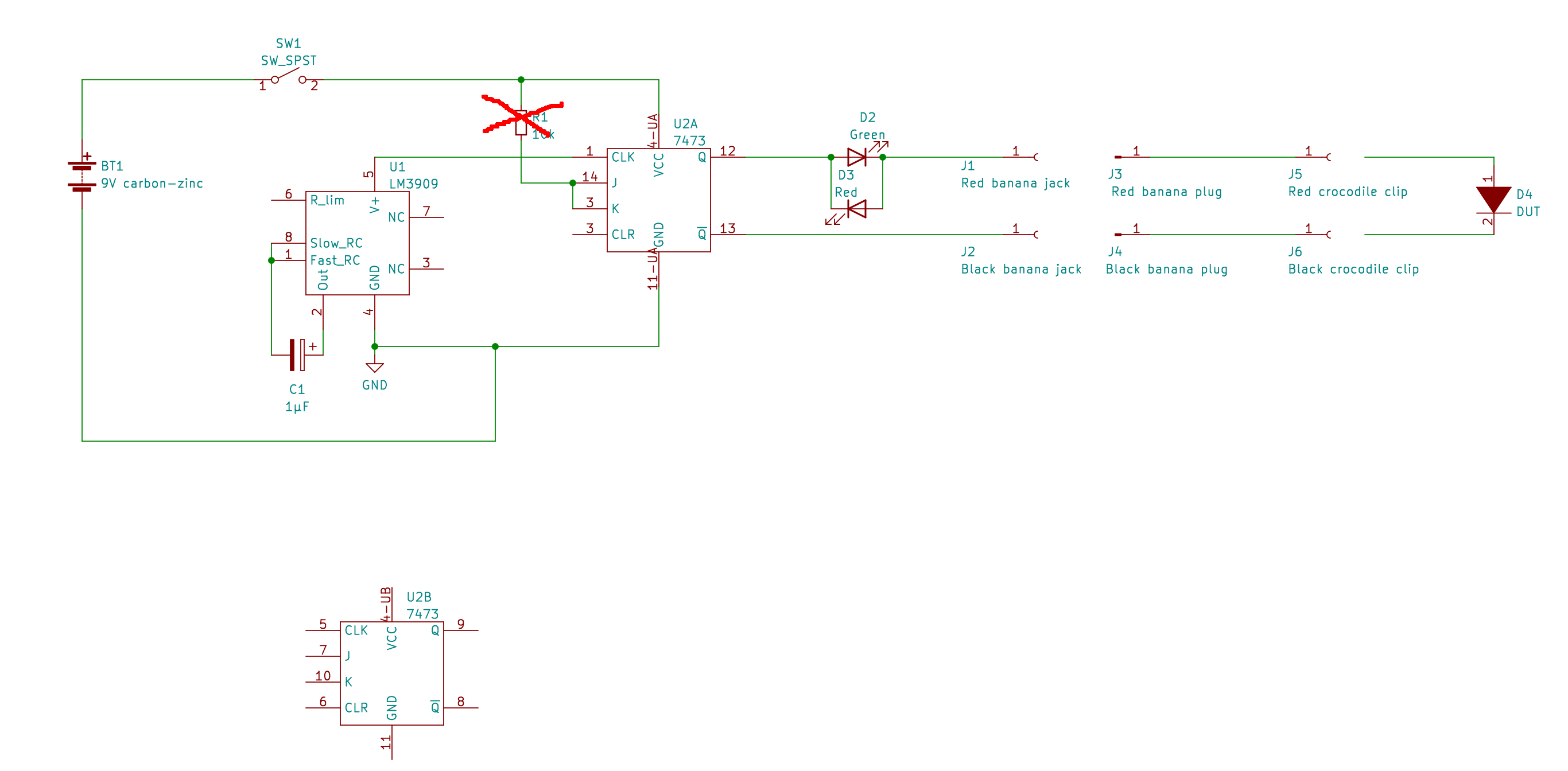
I was going to do something else entirely this afternoon, but that fell through so I ended up with time to look at the diode tester again.
There were several things I wanted to do with it, so I did a couple of them.
First off, I was pretty sure that the pull up resistor was not needed. I took it out, and the diode tester kept working.
Here's a picture of the clock signal I made today:

The upper trace is the 3909 power pin /7473 clock input.
The lower horizontal cursor marks the zero volt level. That puts the lower part of the clock signal at a smidge under 0.7V and the upper part at about 1.4V.
According to the 7473 datasheet (https://www.ti.com/lit/ds/symlink/sn54ls73a.pdf?ts=1768011311799) it takes a signal below 0.8V to register as a low and a voltage of 2V to register as a high.
It's getting the low OK, but is still out of specification on the high.
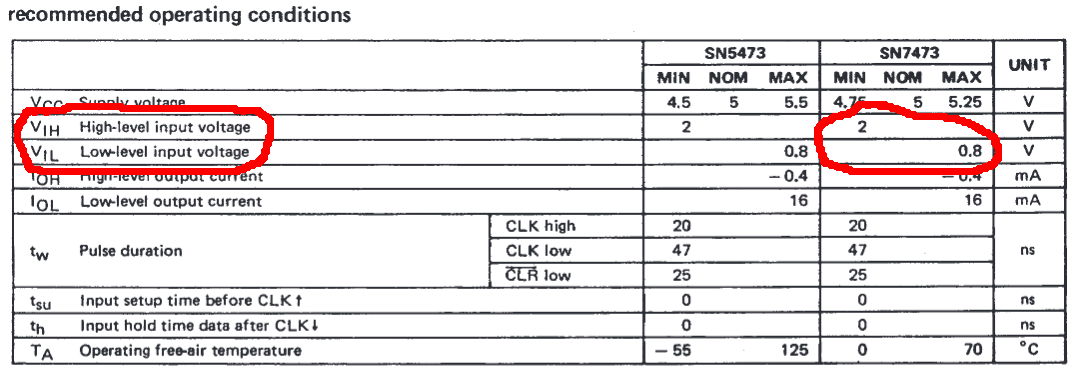 I had expected to find the clock signal waffling around higher than 0V, but I expected it to at least cross the official high and low voltage levels. It is waffling around at neither properly low nor properly high as expected, but it isn't even crossing both levels.
I mean, I know this thing is abusing the ICs all over the place, but I had hoped that it would al least meet some of the specifications.
While writing this up, I left the diode tester connected to the oscilloscope and running. That took a while, and that drained the (half dead) battery I was using. It turns out that the 7473 will keep ruinning all the way down to 2.75V from the battery. Since the clock input is still "high," the 3909 keeps running as long as the battery voltage is above 1V.
The LEDs no longer longer light at that voltage, of course.
Here's the 7473, clocking along with a battery voltage under 3V:

The lower trace is the 7473. The trace is on 2V per division rather than 1V per division for the upper trace. At that point, the LED was still blinking.
That makes me wonder if you could run an old fashioned 7473 on 3.3V, and whether it would still meet its specifications. Hmmm. A project for another day.
Discussions
Become a Hackaday.io Member
Create an account to leave a comment. Already have an account? Log In.