 Bertrand Selva
I’ve uploaded the new version of the RNS-based FIR filter, now extended to 64 TAPS (see PROGRAMME16BITS_FIRCOMPLET64TAPS.zip in project files) .
Everything is OK !
FIR Coefficients
The implemented coefficients are:
h_int =

Columns 1 through 29
  0   0   0   0   1   1   2   2   3   3   2   1  -1  -3  -6  -9 -11 -13 -14 -13  -9  -4   4  15  27  40  54  68  81

Columns 30 through 58
 91  98 102 102  98  91  81  68  54  40  27  15   4  -4  -9 -13 -14 -13 -11  -9  -6  -3  -1   1   2   3   3   2   2

Columns 59 through 64
  1   1   0   0   0   0
These coefficients come from a windowed sinc with a normalized cutoff frequency of 0.1.
They were scaled so that the sum of all taps equals 1024 (2¹⁰), allowing normalization after CRT reconstruction by a simple 10-bit right shift, with no hardware divider required.
All multiplication LUTs were completely rewritten to match these coefficients. The updated code is available in lut_verilog_64TAPS.v.
Implementation results
Target: Cyclone IV GX EP4CGX22BF14C6
Tool: Quartus Prime 22.1std.2 (Lite Edition)
| Metric | Value |
|---|---|
| Logic elements | 16 007 / 21 280 (75 %) |
| Registers | 7 982 |
| Embedded multipliers | 0 / 80 (0 %) |
| Memory bits | 0 / 774 144 (0 %) |
| PLLs | 0 / 3 (0 %) |
| Max frequency (Slow 1200 mV 85 °C) | 96.9 MHz |
This confirms that the 64-tap RNS FIR is entirely built from logic elements only, with no DSP usage : a fully LUT-based architecture.
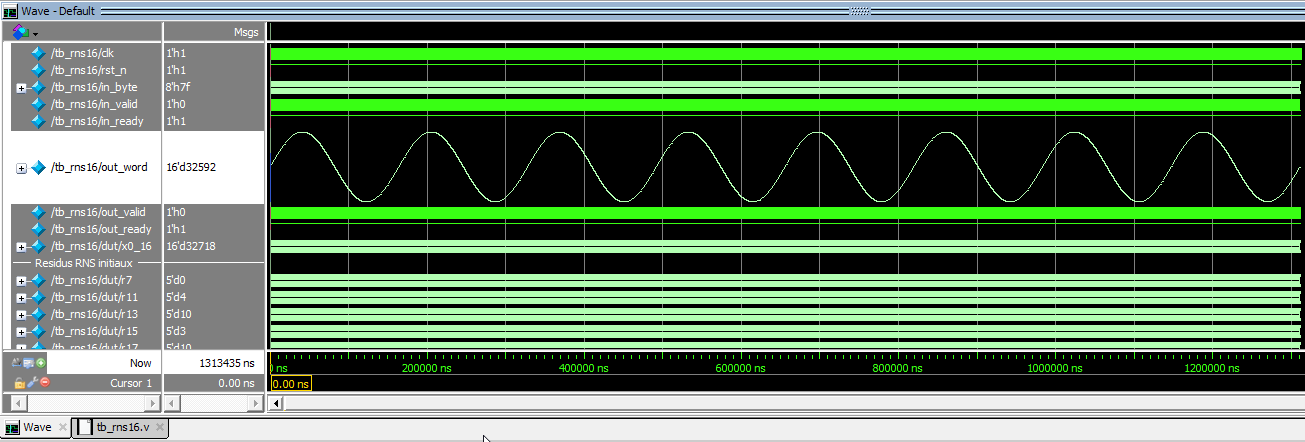
Next step — Now that everything works:
Decouple the input data rate from the FPGA clock so that the 64-tap pipeline can handle inputs slower than clk without any data loss or misalignment, and simulate the full chain to verify correct behavior.
Then move on to the hardware implementation of the FIR.
Discussions
Become a Hackaday.io Member
Create an account to leave a comment. Already have an account? Log In.