 Hiroyuki OYAMA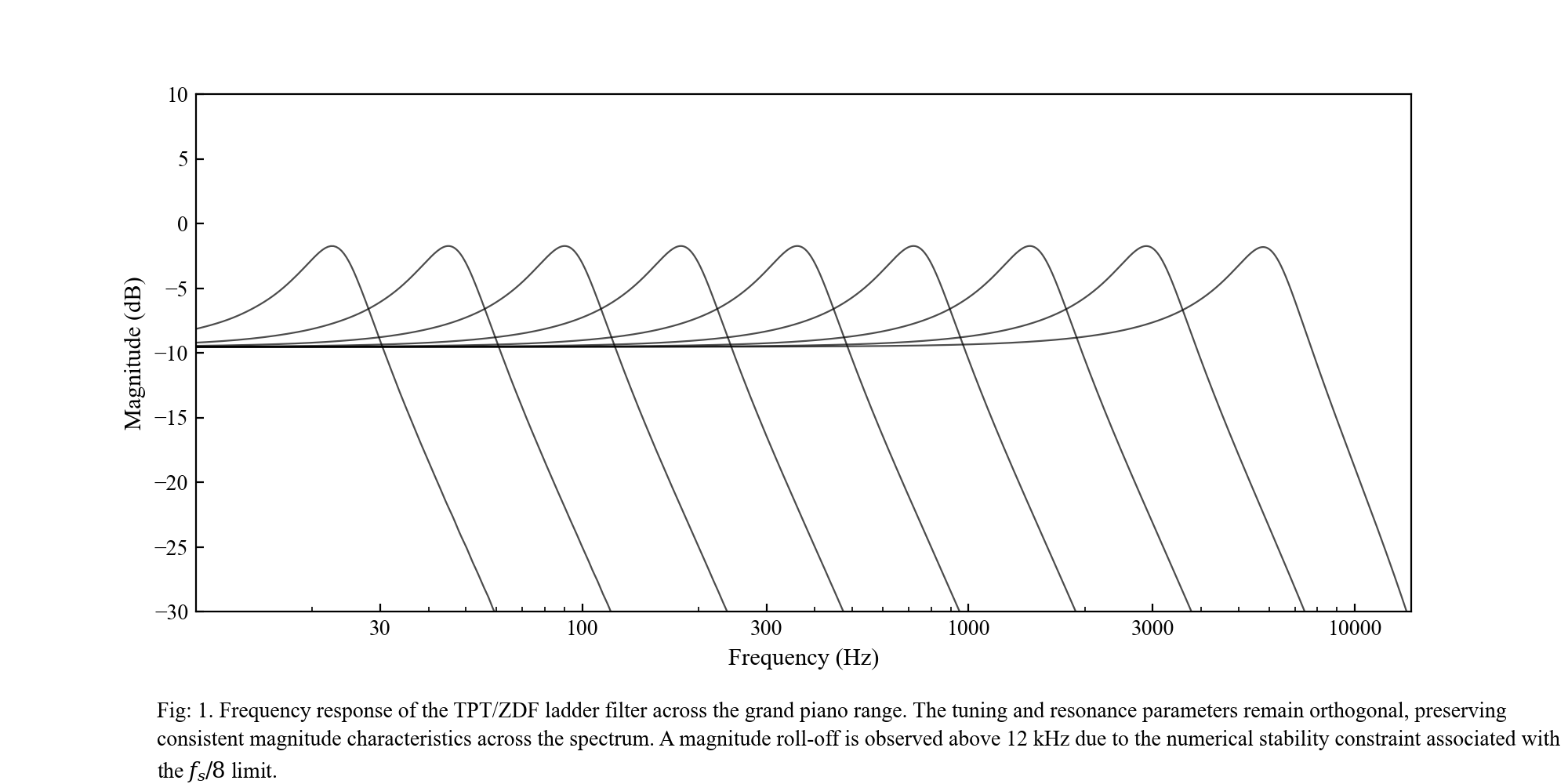
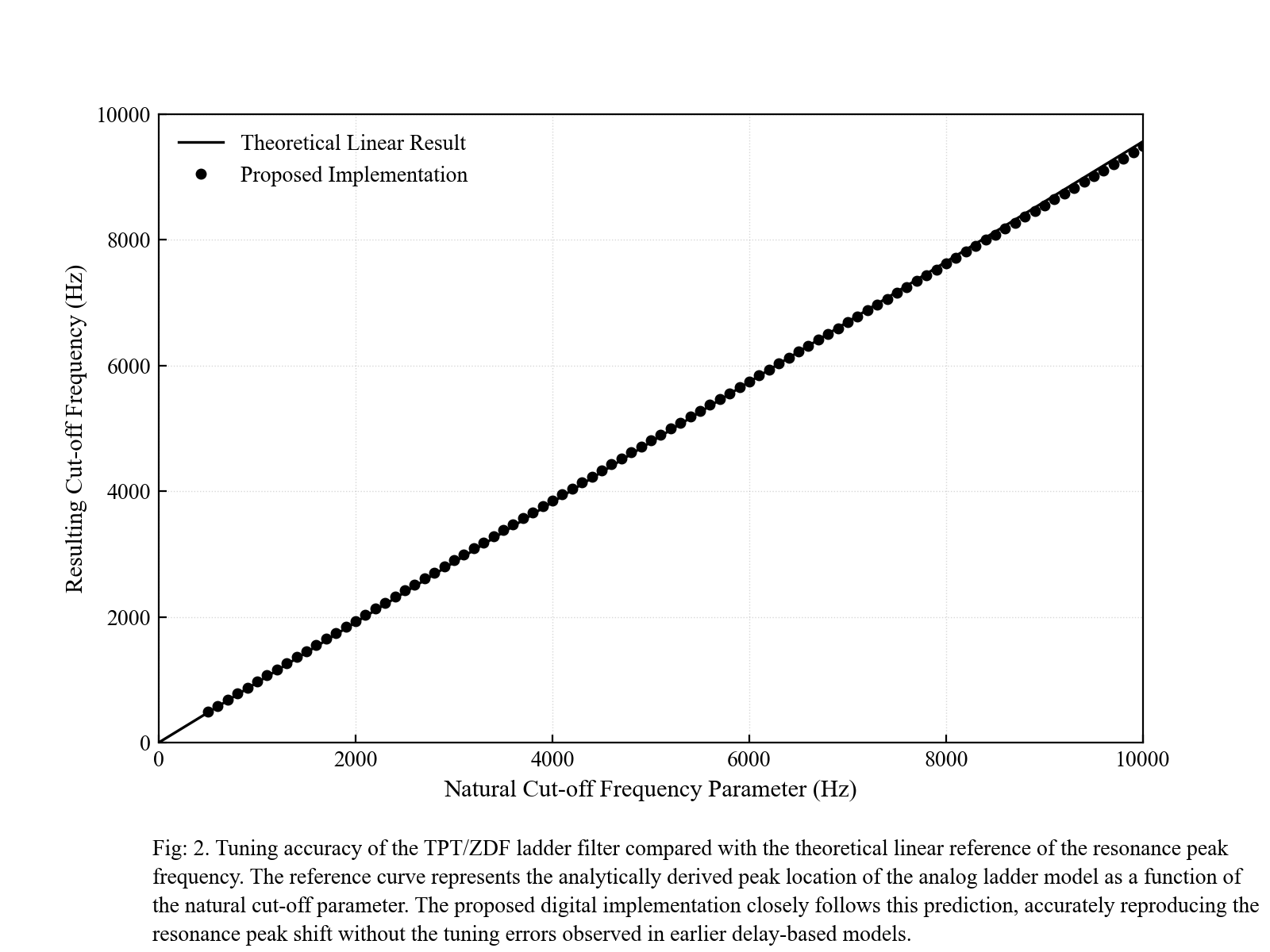
I ran a detailed frequency response measurement of the ladder filter implemented in my synth, focusing on two specific properties.
First, the resonance magnitude remains consistent across the entire frequency range.
Increasing resonance does not introduce frequency-dependent gain variation, the peak height stays uniform as the cutoff moves. This confirms that cutoff and resonance are effectively orthogonal.
Second, the resonance peak frequency closely matches the theoretical prediction derived from the linear analog ladder model. The measured peak shift aligns almost perfectly with the analytical reference curve.
In other words, the digital TPT/ZDF implementation reproduces both:
- constant resonance magnitude behavior
- correct analog peak frequency shift
Above roughly 12 kHz, minor roll-off and deviation appear due to numerical stability limits (fs/8 constraint), but within the practical audio range the behavior remains consistent and predictable.
With these results, I can confidently rely on this filter design, not only musically, but also from a physical and analytical standpoint.
Discussions
Become a Hackaday.io Member
Create an account to leave a comment. Already have an account? Log In.