 Nikola
To expand the T.I. quote,
Experimental data has shown that any of National's process 21 transistors
which have been selected for low reverse beta (βR <.25) can be used quite satisfactorily as a zero T.C. Zener. When connected as shown in Figure 37, the T.C. of the base-emitter Zener voltage is exactly cancelled by the T.C. of the forward biased base-collector junction if biased at 1.5 mA.
This makes a lot of sense. Zener diodes were among the first stable reference components used (preceded by neon gas-discharge tubes), and selected parts such as the 1N829 can achieve very low temperature coefficients when operated at the right current. Generally, zener diodes have a positive temperature coefficient of 1-2 mV/K, and this can be cancelled out neatly by the similar, but negative tempco of a normal PN junction, such as a silicon diode or the base-emitter junction in a bipolar transistor. This was quite common in linear discrete power supplies, and is the technique of choice for even the "highest precision" voltage reference ICs, such as the LTZ1000:
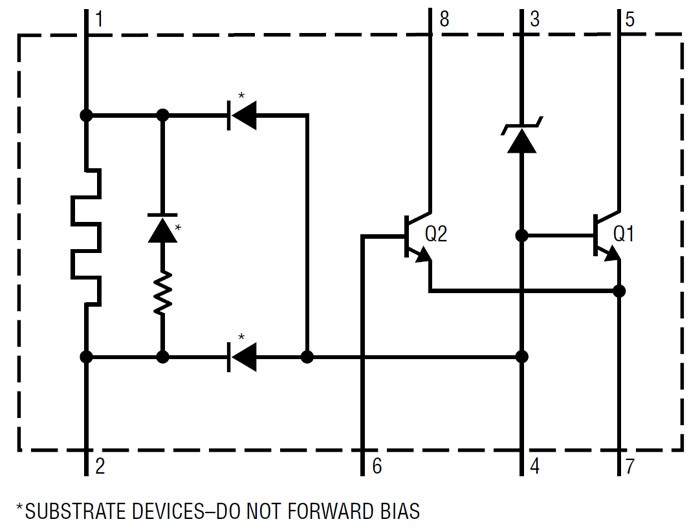
Skipping over the components to the left, which form the basis of a very stable heater with feedback, Q1 and the zener diode on its base are used to derive the "ultrastable" low-noise reference voltage of about 7 volts. By tweaking the current through the zener and Q1, sub-ppm/K tempcos can be achieved.
Bipolar transistors can be used as zeners, by reverse-biasing the E-B or C-B junctions. This is often used in clamp circuits, or other applications, where the exact voltage is not critical. The C-B junction, when reverse biased, will break down and avalanche anywhere from 15 to 1500 volts, depending on the transistor type. The E-B junction is "better-behaved" and almost always breaks down in the 5-6V region. And indeed, most often, when a BJT is used as a diode, forward-biased or as a zener, it is shown with the base and collector shorted, for example in this current source from Bob Widlar:

However, in reviewing the structure of a BJT, it is evident that we are afforded two junctions, and fortuitously, we can reverse bias one and forward bias the other:
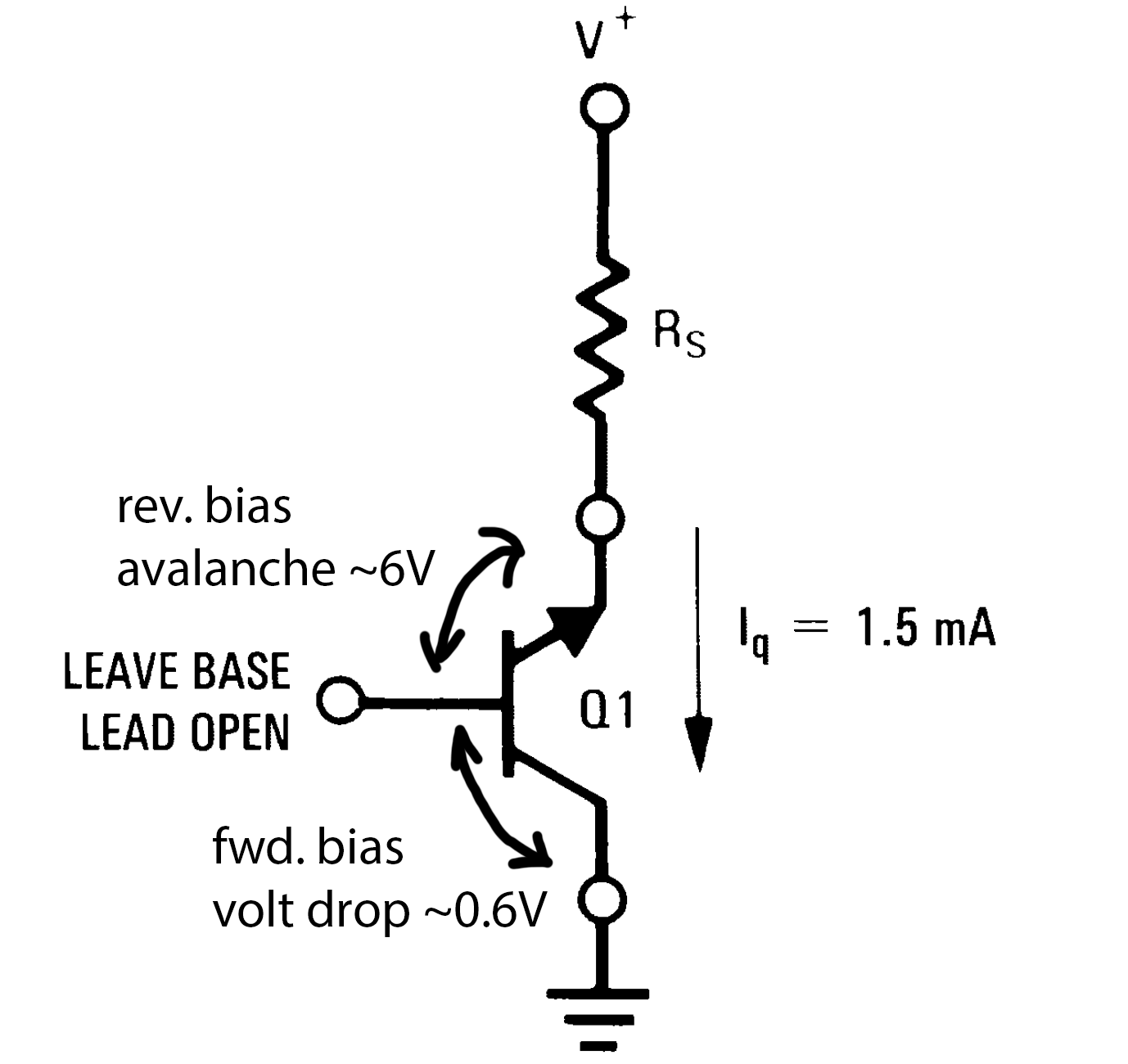
The resulting sum has the fortuitous negation of the two temperature coefficients, and the potential to have a very low overall temperature dependence at the right current.
Of course, a BJT is not intended to operate in this region, so we cannot expect the performance to match an LTZ1000, in terms of noise and ultimate stability. But, if we were looking to generate a voltage that is stable to a millivolt or so over a wide temperature range, a reversed bipolar seems like a good candidate.
For what it's worth, there is not much information online about this configuration. I have only seen it officially suggested once, outside of AN-74, at the end of an application by Jim Williams in LT's AN9:
Two NPN transistors here are used to derive the +/- 7V supply for an opamp from the available bipolar 15V rails.
Process 21
So, is there a secret to National's Process 21 that it would make better "zeners" than any other transistor? AN-74 explicitly states that the transistor should be selected for a low reverse beta. In my mind, the lower the reverse beta (i.e. the current gain when the emitter voltage is higher than the collector voltage, as would be in the zener configuration), the closer the BJT approximates two discrete diodes in series. Another clue comes from the die image in the National Transistor Databook:
These are nominally RF switching transistors, used in high-speed applications at relatively low voltages, which would be a hint when I look for purchaseable equivalents.
But for now, let's test one.
Discussions
Become a Hackaday.io Member
Create an account to leave a comment. Already have an account? Log In.