 Aleksei Tertychnyi
The Sensor
A notable characteristic of a silicon diode is its temperature sensitivity: the forward voltage decreases by approximately 2 mV for each 1 °C increase in temperature, exhibiting fairly linear behavior over the range of roughly 0 to 100 °C. Since the base-emitter junction of a transistor behaves like a diode, individual transistors can be conveniently used as simple and reliable temperature sensors.
Okay, let’s write an Arduino sketch that reads values from the ADC first. Since our XIAO board uses the SAMD21G18 MCU, it has a built-in 1.0 V reference, which we will use because it has about 1% tolerance and can provide reasonably precise measurements.
We also added a 1-Wire temperature sensor to calibrate our transistor-based sensor. The Arduino code is shown below:
#include <arduino.h>

#define OW_PIN 2
#define D0_PIN 0
#define A1_PIN A1

#define SAMPLE_INTERVAL_MS 200
#define PRINT_INTERVAL_MS 10000  // 10 sec

// Bus control
void    ow_low()  { pinMode(OW_PIN, OUTPUT); digitalWrite(OW_PIN, LOW); }
void    ow_rel()  { pinMode(OW_PIN, INPUT); }
int     ow_rd()   { return digitalRead(OW_PIN); }

bool ow_reset() {
    ow_low(); delayMicroseconds(480);
    ow_rel(); delayMicroseconds(70);
    bool p = !ow_rd();
    delayMicroseconds(410);
    return p;
}

void ow_write_bit(uint8_t b) {
    ow_low(); delayMicroseconds(b ? 6 : 60);
    ow_rel(); delayMicroseconds(b ? 64 : 10);
}

uint8_t ow_read_bit() {
    ow_low(); delayMicroseconds(6);
    ow_rel(); delayMicroseconds(9);
    uint8_t b = ow_rd();
    delayMicroseconds(55);
    return b;
}

void    ow_write(uint8_t v)  { for(int i=0;i<8;i++) ow_write_bit((v>>i)&1); }

uint8_t ow_read_byte()       { uint8_t v=0; for(int i=0;i<8;i++) v|=ow_read_bit()<<i; return="" v;="" }="" uint8_t="" crc8(uint8_t="" *d,="" len)="" {="" crc="0;" for(uint8_t="" i="0;i<len;i++)" b="d[i];" j="0;j<8;j++)" m="(crc^b)&1;">>=1; if(m) crc^=0x8C; b>>=1; }
    }
    return crc;
}

// Accumulators
float voltageAccum = 0;
float tempAccum = 0;
int sampleCount = 0;
unsigned long startTime = 0;
unsigned long nextPrintTime = 0;

float readTemperature() {
    uint8_t rom[8], scratch[9];

    if(!ow_reset()) return NAN;

    ow_write(0x33);
    for(int i=0;i<8;i++) rom[i]=ow_read_byte();
    if(crc8(rom,8) != 0 || rom[0] != 0x28) return NAN;

    ow_reset();
    ow_write(0xCC); ow_write(0x44);
    pinMode(OW_PIN, OUTPUT); digitalWrite(OW_PIN, HIGH);
    delay(750);
    ow_rel();

    ow_reset();
    ow_write(0xCC); ow_write(0xBE);
    for(int i=0;i<9;i++) scratch[i]=ow_read_byte();
    if(crc8(scratch,9) != 0) return NAN;

    int16_t raw = (scratch[1]<<8)|scratch[0];
    return raw / 16.0f;
}

void printTime(unsigned long elapsedSec) {
    unsigned int minutes = elapsedSec / 60;
    unsigned int seconds = elapsedSec % 60;
    if (minutes < 10) Serial.print("0");
    Serial.print(minutes);
    Serial.print(":");
    if (seconds < 10) Serial.print("0");
    Serial.print(seconds);
}

void setup() {
    Serial.begin(115200);
    while(!Serial) delay(10);
    pinMode(OW_PIN, INPUT);

    pinMode(D0_PIN, OUTPUT);
    digitalWrite(D0_PIN, LOW);

    // XIAO SAMD21: MUST set 12-bit explicitly — default is 10-bit!
    analogReadResolution(12);
    analogReference(AR_INTERNAL1V0);  // 1.0V internal reference

    startTime = millis();
    nextPrintTime = startTime + PRINT_INTERVAL_MS;
    nextPrintTime = ((nextPrintTime + PRINT_INTERVAL_MS - 1) / PRINT_INTERVAL_MS) * PRINT_INTERVAL_MS;

    Serial.println("Time,Voltage[mV],Temperature[C]");
}

void loop() {
    unsigned long now = millis();

    // Sample every 200 ms
    static unsigned long lastSampleTime = 0;
    if (now - lastSampleTime >= SAMPLE_INTERVAL_MS) {
        lastSampleTime = now;

        // Read voltage: 1.0V ref, 12-bit ADC (0–4095)
        int a1_raw = analogRead(A1_PIN);
        float voltage = a1_raw * (1000.0 / 4095.0);
        voltageAccum += voltage;

        // Read temperature
        float temp = readTemperature();
        if (!isnan(temp)) {
            tempAccum += temp;
        }

        sampleCount++;
    }

    // Print every 10 seconds
    if (now >= nextPrintTime && sampleCount > 0) {

        float avgVoltage = voltageAccum / sampleCount;
        float avgTemp = tempAccum / sampleCount;
        unsigned long elapsedSec = (nextPrintTime - startTime) / 1000;

        printTime(elapsedSec);
        Serial.print(",");
        Serial.print(avgVoltage, 2);
        Serial.print(",");
        Serial.println(avgTemp, 2);

        voltageAccum = 0;
        tempAccum = 0;
        sampleCount = 0;
        nextPrintTime += PRINT_INTERVAL_MS;
    }
}
We can see clear output in the UART monitor:
Time,Voltage[mV],Temperature[C]
00:18,568.14,30.84
00:28,568.52,30.67
00:38,568.57,30.56
00:48,568.52,30.47
00:58,568.89,30.36
01:08,568.89,30.27
01:18,569.29,30.18
01:28,569.19,30.11
01:38,569.17,30.03
Now we need to calibrate the sensor, so we place both devices under the same temperature conditions. I used a setup with a Peltier module, as it is easier to control the desired temperature by adjusting the input voltage and polarity of the element.
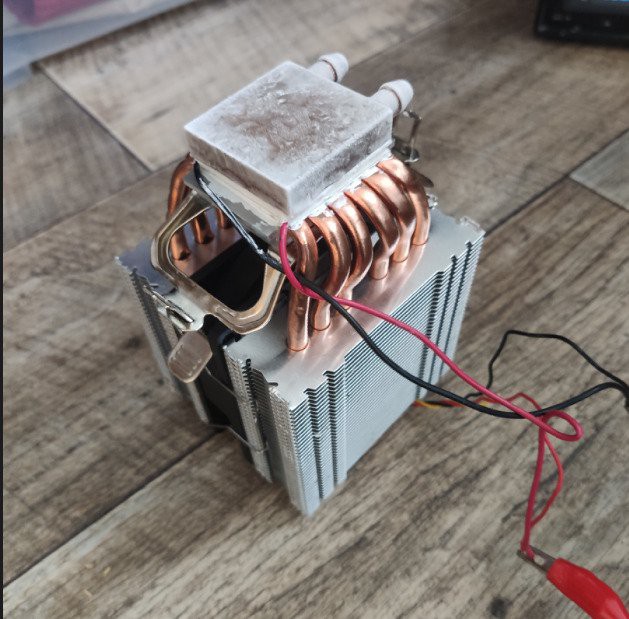
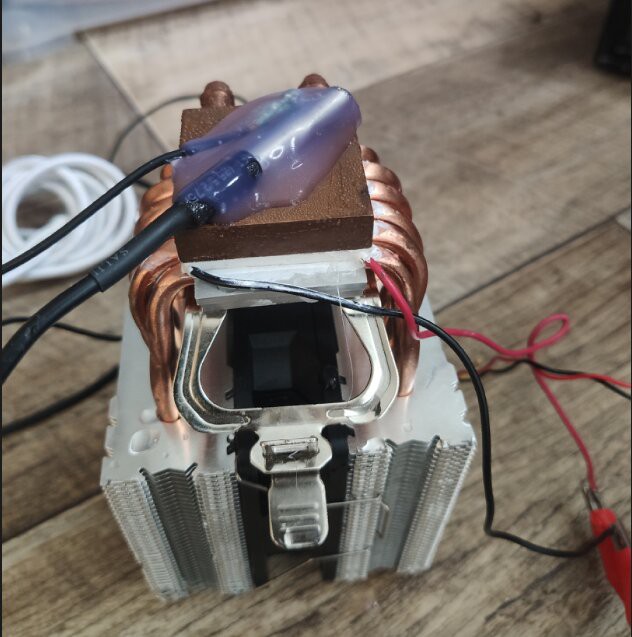
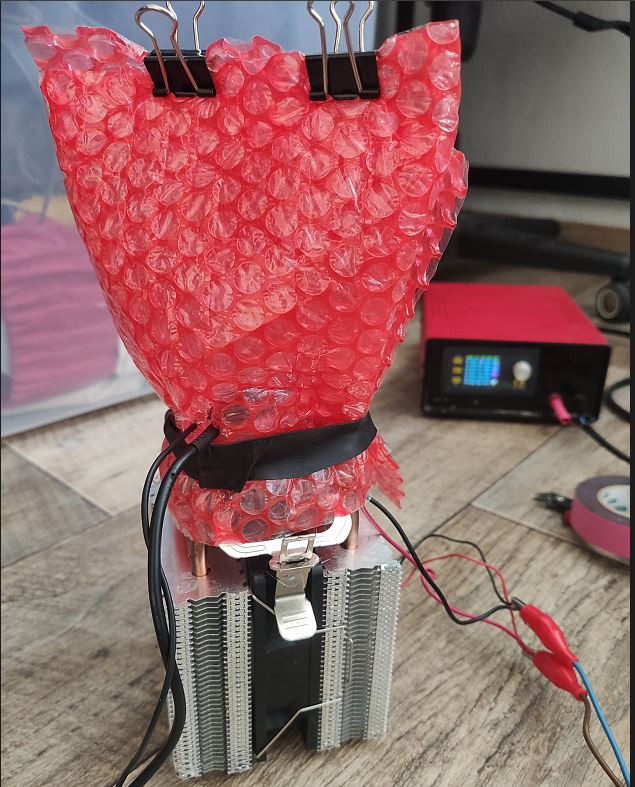
Because of imperfections in the temperature regulation (I adjusted it manually), there is a slightly non-linear region caused by temperature overshoot, where I should have waited longer for the temperature to stabilize. Apart from that, the voltage-versus-temperature (V/T) characteristic is almost perfectly linear.
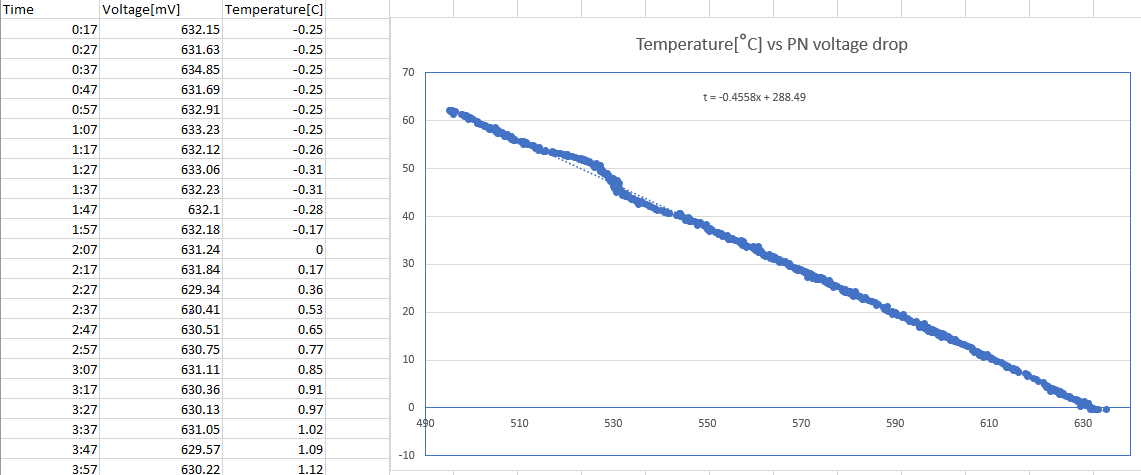
The approximation equation we obtained is:
T(V, mV) = -0.4558 × V + 288.49
or, when using volts:
T(V) = -455.8 × V + 288.49
This corresponds to a voltage decrease of approximately 2.194 mV/°C.
We can now use this estimated value in the Arduino sketch to verify how accurate our approximation is.
    Serial.println("Time, Voltage[mV], Temperature[°C], Estimated Temperature [°C]");
...
       printTime(elapsedSec);
        Serial.print(",");
        Serial.print(avgVoltage, 2);
        Serial.print(",");
        Serial.print(avgTemp, 2);
        Serial.print(",");
        Serial.println(-0.4558 * avgVoltage + 288.49, 2);

....
I have seen a maximum error of about 0.4 °C, which could also be taken into consideration for further improvement. However, it is indeed possible to measure temperature with a transistor, at least over the 0–60 °C range, with an accuracy of ±0.5 °C or even better (if needed) after calibration. This is almost as good as commercial 1-Wire temperature sensors and can be a cost-effective solution if you have enough free ADC inputs and already use the same transistors elsewhere in the circuit. In that case, no additional BOM components are required.
Con?
- Every transistor requires calibration if you want accurate absolute temperature