 WJCarpenter
I'm not planning to break much ground in the hardware design. I'll exploit what others have done before me, and I'll also make it easy on myself by using some pre-built components.
For the Wheatstone bridge, I plan to use this SparkFun Load Sensor Combinator.
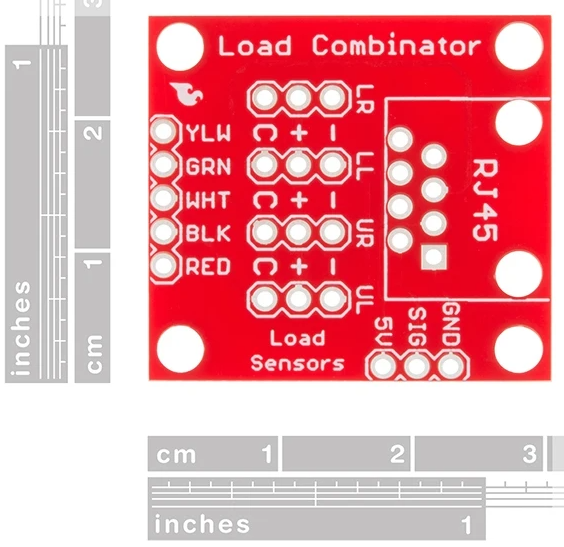
That has a footprint for an RJ45 socket, which I'll use for connecting this board to the rest of the circuitry. A couple of years ago, for an unrelated project, I bought a couple dozen PCB mount RJ45 sockets that I never got around to using. When I grabbed them to check the dimensions, I discovered that they were top insertion orientation, which is a geometry that's not going to work in this scenario. So, I've now ordered some more PCB mount RJ45 sockets, but with side-insertion orientation. With that RJ45 socket, space will be tight if I attach the board under the scale, so I will probably have to provide some load sensor foot extensions of a quarter inch or whatever for ground clearance.
The cable from that board will go to an amplifier board. For that amplifier, I'll use the SparkFun Load Cell Amplifier - HX711.
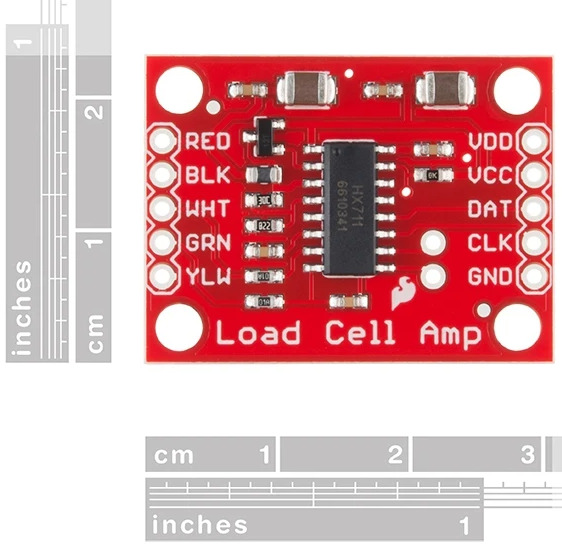
That board does not have a footprint for the RJ45 socket, but it does expect the same signals as output by the combinator board.
I want to show a local display of the gross and net weight measurements, and maybe a couple other things. I briefly considered getting one of those so-called Cheap Yellow Displays (CYD) that have an integrated ESP32. However, I've got tons of ESP8266 and ESP32 boards around here, and I've also got a few small color touchscreens. That won't make the tidiest design, but it saves me time and bother. I'm not sure yet if I'll need a power supply for some specialized voltage.
I will almost certainly design a custom PCB that acts as a carrier for the amplifier, the RJ45 socket, the ESP32, the display, and a USB socket for power. I'll wrap all that into a 3D-printed enclosure to make a nice wall-mounted unit at a comfortable reading position.
Discussions
Become a Hackaday.io Member
Create an account to leave a comment. Already have an account? Log In.