 hide-key
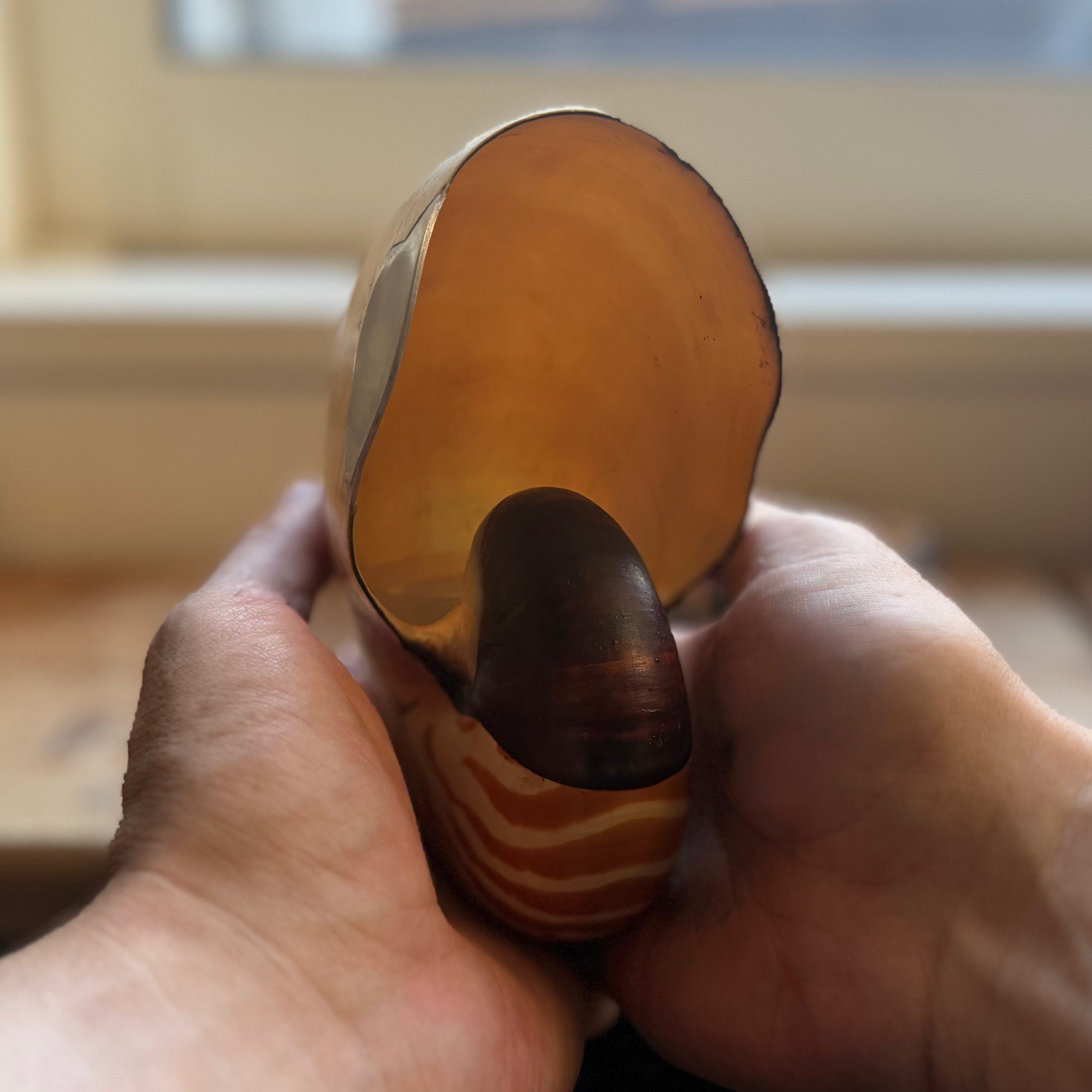
Context: A Shift From Building to Observation
This project began as a hands-on maker experiment: building a haptic speaker using a Nautilus shell.
During early testing, however, the focus shifted. Unexpected acoustic and vibrational behaviors emerged that could not be explained by conventional speaker design alone.
At that point, the project transitioned from a simple build log into an observational and analytical exploration.
— Observation —
This project began as a deliberately low-expectation experiment: to see what kind of “cheap sound” could be produced by attaching an exciter to a real Nautilus shell.
During early listening tests, however, an unexpected behavior became apparent.
When the shell was held by hand—regardless of where it was touched or gripped (inner whorl, middle region, or outer shell)—there was no clearly audible change in sound pressure, tonal balance, or perceived vibration intensity.
This was surprising. In most small speakers or resonant objects, direct hand contact strongly damps vibration, altering both loudness and frequency response. Human tissue typically acts as a strong mechanical absorber.
Yet in this case, even firm gripping did not produce an obvious acoustic change by ear.
This observation was repeated multiple times and was consistent enough to raise a question:
Why does the Nautilus shell appear unusually insensitive to external damping by touch?
At this stage, no claim is made about optimality or biological intent. This log simply documents an observation that contradicts common expectations in small-scale vibration systems and motivated further measurement and comparison tests.
Discussions
Become a Hackaday.io Member
Create an account to leave a comment. Already have an account? Log In.