 hide-key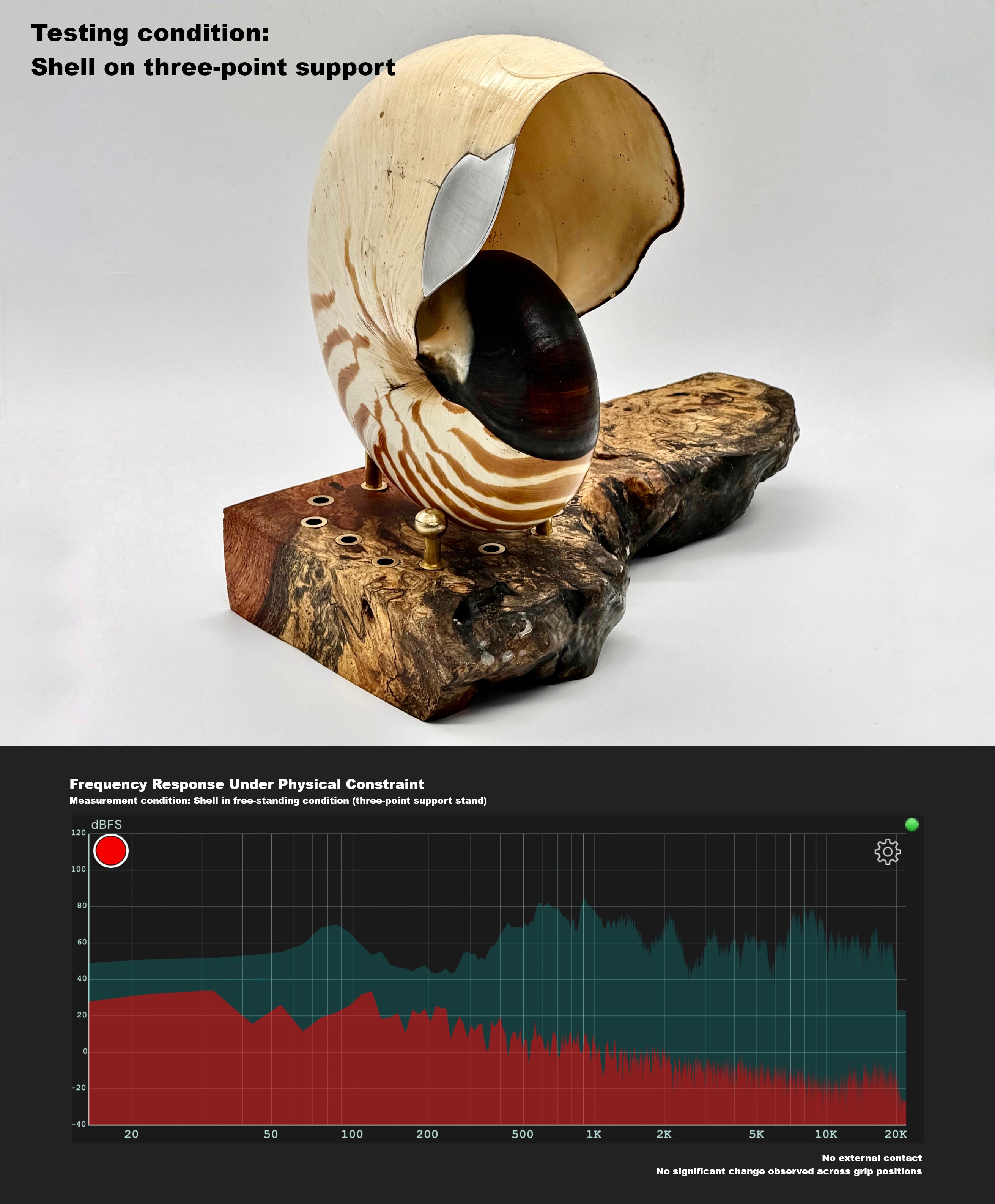
This log documents the measurement setup and reference conditions used in the following observations.
Note: In the first part of the video, the exciter itself is intentionally damped by direct finger contact.
This is shown only as a reference to demonstrate that the system still behaves like a normal exciter-driven object at the drive point.
The remainder of the video and all following observations focus on the behavior of the shell itself under different contact conditions.
Following the unexpected robustness observed during hand-held listening tests, I decided to introduce simple, repeatable measurements to establish reference conditions. The goal was not precision acoustics, but consistency: to compare relative changes under different physical constraints using the same setup.
Measurements were performed using a smartphone-based spectrum analyzer app (Sonic Tools SVM), capturing frequency response trends rather than absolute sound pressure values.
The exciter position was kept fixed throughout all tests. Only the external boundary conditions of the shell were varied.
A reference condition was first defined:
Reference: Near Free-standing Condition
The shell was supported by a custom-made minimal contact stand (three-point support), designed to approximate a free-standing state while remaining physically stable.
This reference revealed a distinct low-frequency emphasis (approximately 50-100 Hz), forming a baseline profile for comparison.
Subsequent measurements intentionally avoided changing input signal level, exciter mounting, or shell orientation, focusing solely on how external interaction affected the vibrational behavior.
At this stage, the measurements serve as qualitative evidence supporting the initial listening observations, not as laboratory-grade acoustic data.
Discussions
Become a Hackaday.io Member
Create an account to leave a comment. Already have an account? Log In.