 hide-key
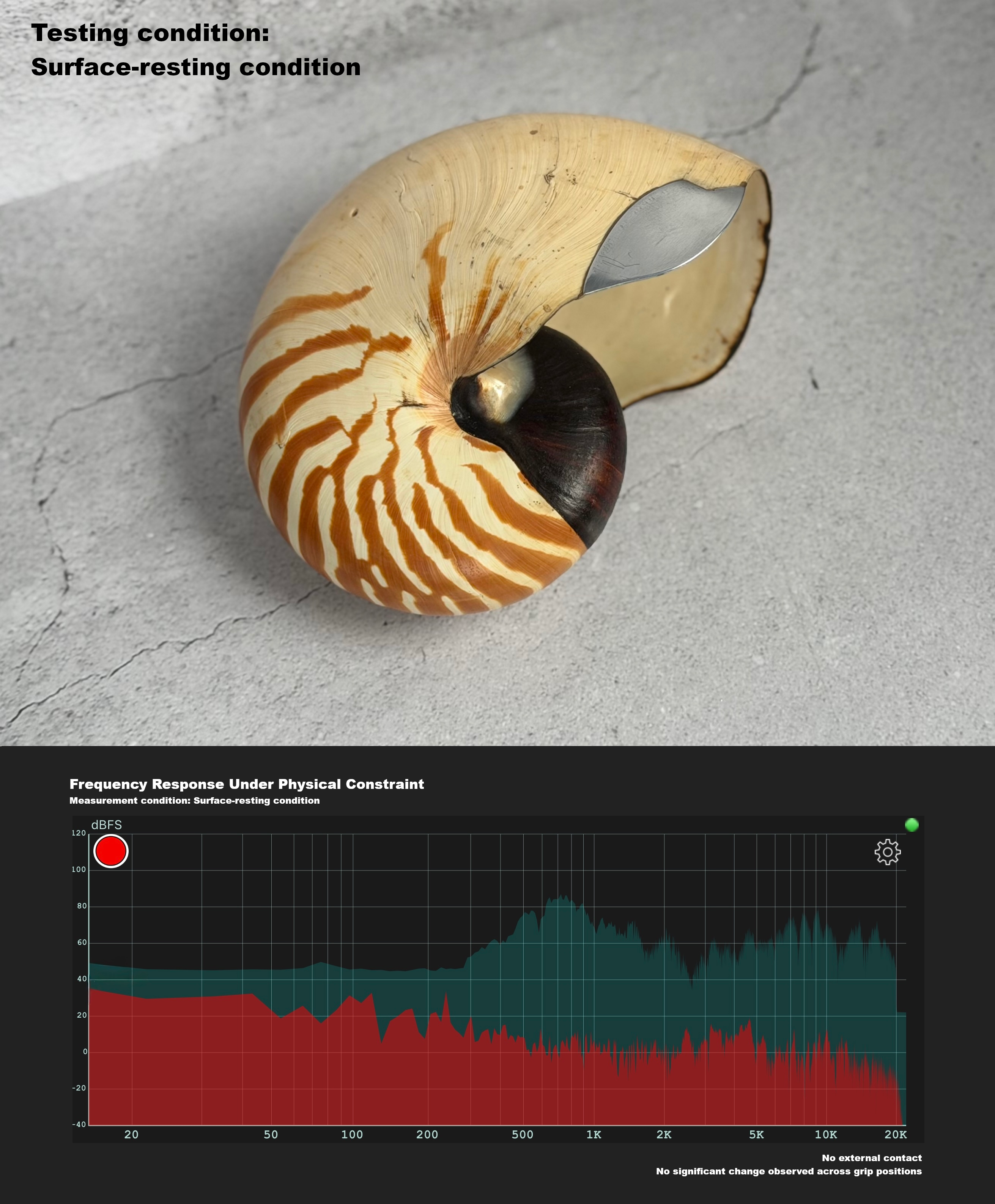
After confirming that direct hand contact (H2) produced minimal change, a contrasting condition was tested.
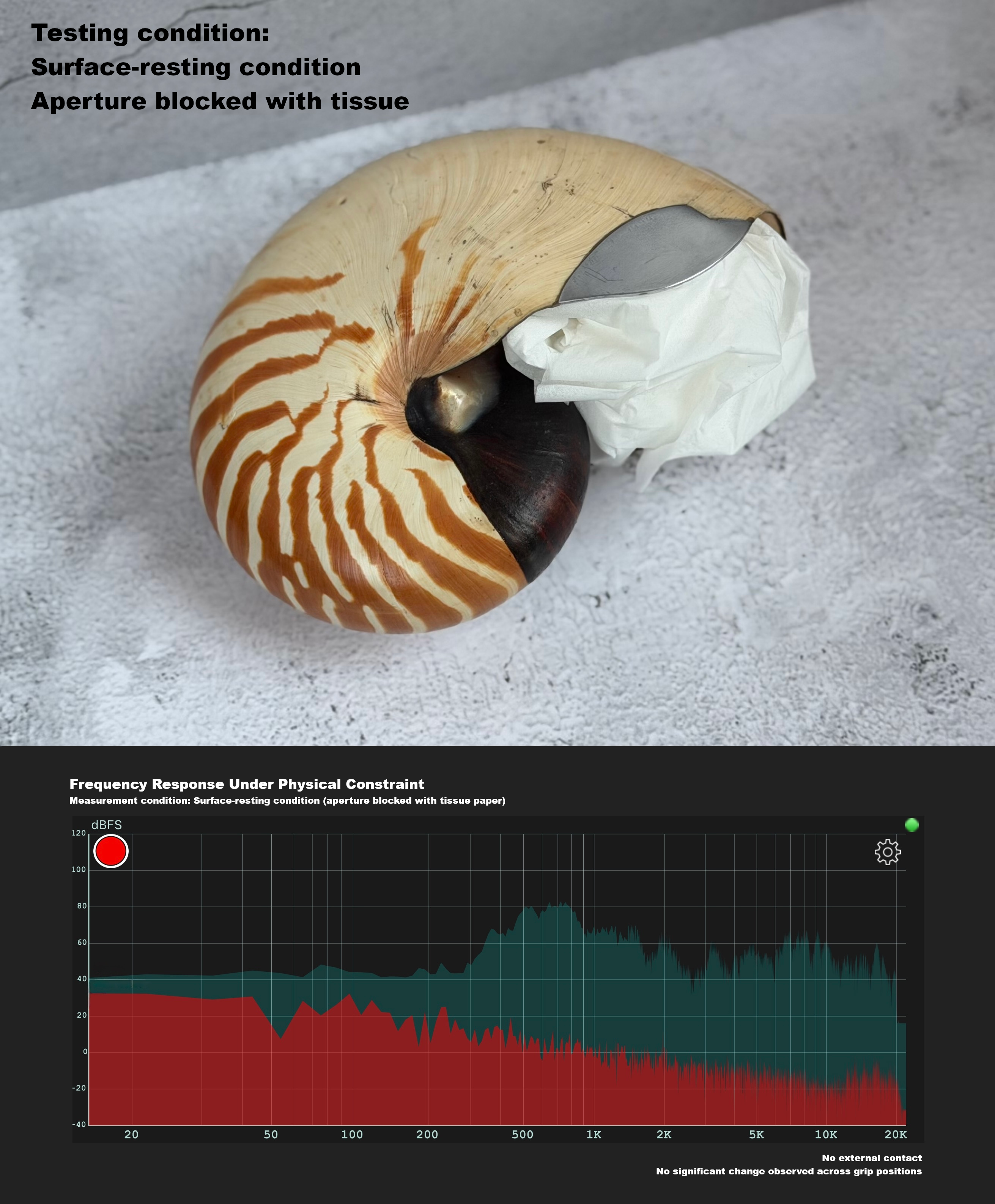
In this condition (H3), the shell itself was left untouched, but the aperture (living chamber opening) was partially filled with soft tissue paper.
This modification did not alter the exciter mounting, input signal, or external support condition. Only the internal acoustic boundary at the aperture was changed.
Unlike the H2 condition, the effect was immediately audible.
The sound became noticeably muffled, with reduced clarity and diminished high-frequency content. Measured frequency response also showed clear deviation from the reference profile, particularly in the mid-to-high frequency range.
This contrast was important. While extensive external contact with the shell body produced little change, a relatively small modification at the aperture strongly affected the acoustic output.
This suggests that the aperture plays a dominant role in acoustic radiation and pressure release, whereas the shell body primarily functions as a vibration-distributing structure rather than a simple radiating surface.
Again, no claim is made about biological intent. However, the asymmetric sensitivity between external damping (H2) and aperture modification (H3) highlights a functional separation between structural vibration and acoustic coupling.
Discussions
Become a Hackaday.io Member
Create an account to leave a comment. Already have an account? Log In.