 b.sverdlyuk
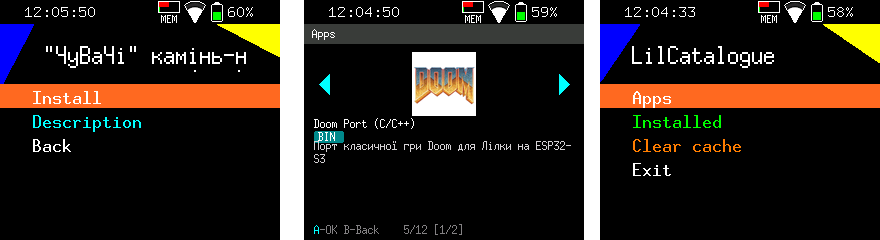
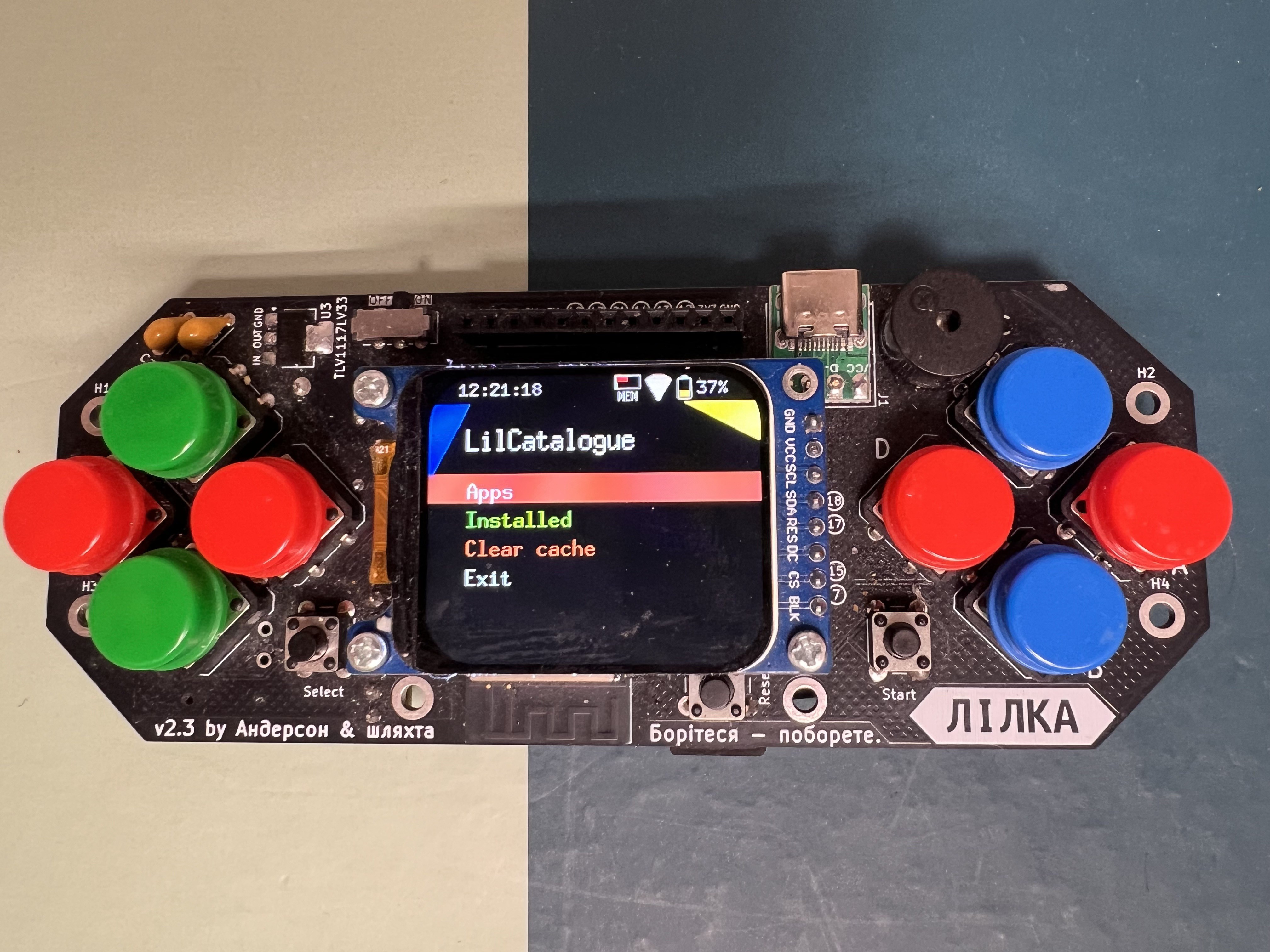
One of the most convenient features of Lilka is a full-featured app store, accessible both from a browser and directly on the console itself — no computer needed. The catalog is hosted at catalog.lilka.dev and contains two sections: Apps and Mods.
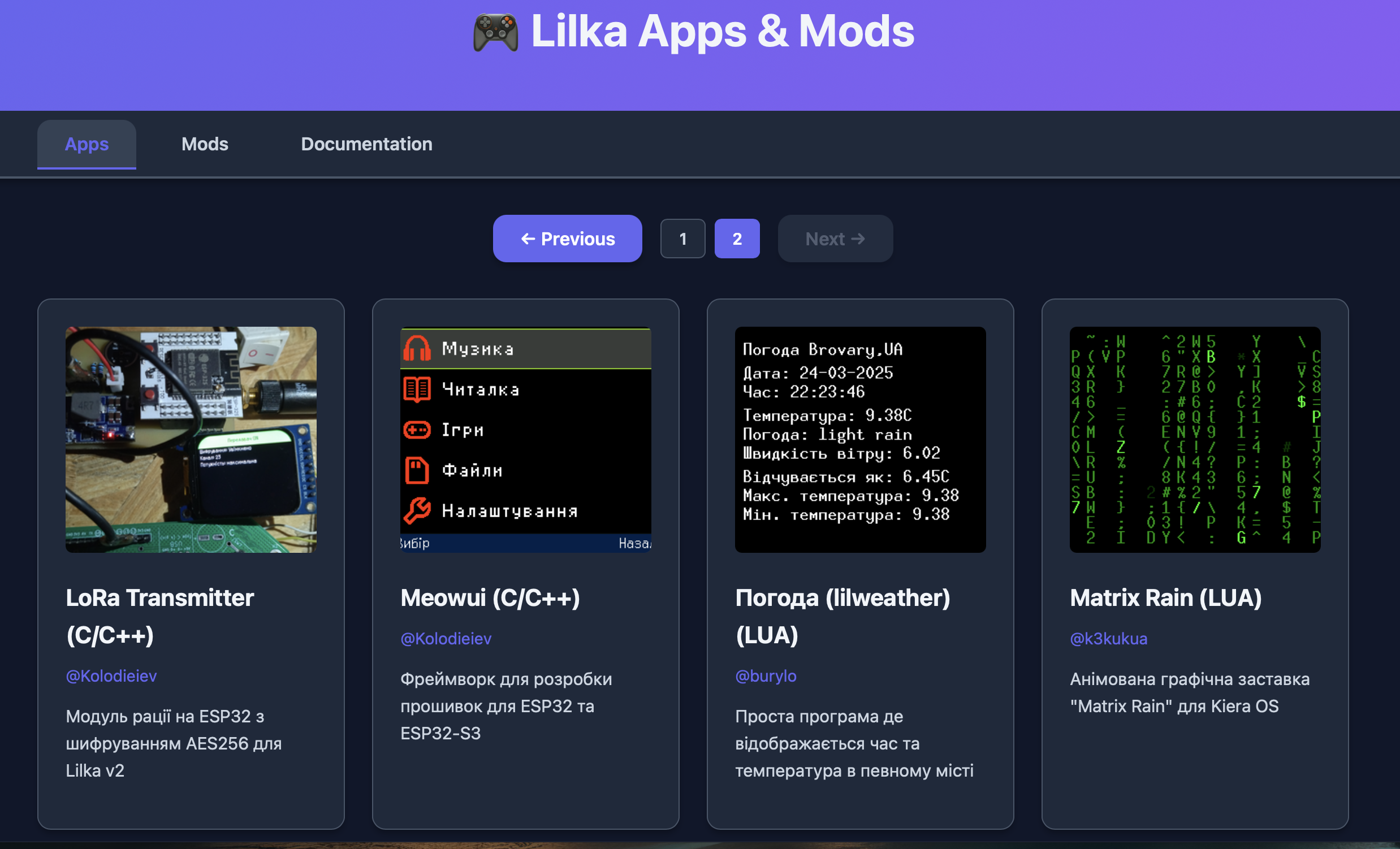
📦 Mods
The Mods section covers physical modifications for Lilka: cases, covers, and buttons. Shields to extend the console's capabilities are also planned to be added in the future. Each mod includes manufacturing files along with a description and photos.
🎮 Apps
All apps in the Apps tab are divided into three types:
Lua
Lua scripts are the most convenient way to run programs on Lilka. They require no compilation and run instantly directly from the file system. Just download the .lua file to the device — and it's ready to go. Learn more about Lua on Lilka →
Firmware (.bin)
Custom firmware also requires no compilation — it is loaded as a ready-made .bin file and runs directly on the device. The key advantage: after restarting Lilka, you automatically return to the standard Keira OS operating system — so an alternative firmware doesn't replace the system permanently. This opens up interesting possibilities: firmware can be used as fully standalone programs or as part of applications within Keira OS. Learn more about custom firmware →
C++
C++ applications are also present in the catalog — for reference and as examples for developers. However, they require compilation and cannot be run directly on the console without a prior build. Learn more about creating C++ apps →
➕ How to Add Your App
The process is straightforward even for beginners. Each app's catalog entry consists of just a few elements:
DESCRIPTION.md— a text description in Markdown formaticon.pngand screenshotsmanifest.yml— the main file with app metadata
To publish your app:
- Fork the lilka-dev/catalog repository
- Create a directory
apps/yourapp.app/inside theapps/folder — this can be done online directly in GitHub or via GitHub Desktop - Add the files:
manifest.yml,icon.png, andDESCRIPTION.md - Submit a Pull Request — GitHub Actions will automatically build the catalog and deploy it to GitHub Pages
Here is an example manifest.yml from a real app — the "ChuVaChi" rock-paper-scissors game:
name: Game "ChuVaChi" rock-paper-scissors (LUA)
sources:
  type: git
  location:
    origin: https://github.com/andrijpv/LIlkaChuVaChi
entryfile:
  type: lua
  location:
    origin: https://raw.githubusercontent.com/andrijpv/LIlkaChuVaChi/refs/heads/main/filegame/lilkachuvachi.lua
files:
  - type: image
    location:
      origin: https://raw.githubusercontent.com/andrijpv/LIlkaChuVaChi/refs/heads/main/filegame/paper.bmp
    description: Paper image
  - type: image
    location:
      origin: https://raw.githubusercontent.com/andrijpv/LIlkaChuVaChi/refs/heads/main/filegame/scissors.bmp
    description: Scissors image
  - type: image
    location:
      origin: https://raw.githubusercontent.com/andrijpv/LIlkaChuVaChi/refs/heads/main/filegame/stone.bmp
    description: Stone image
short_description: Classic "ChuVaChi" rock-paper-scissors game for Keira OS
description: "@DESCRIPTION.md"
author: "@andrijpv"
license: NONE
keira_version: 1.0.0
icon: image.png
screenshots:
  - image.png
The manifest structure is intuitive: entryfile points to the executable file (.lua, .bin, etc.), files lists additional app resources (images, sounds), and description can reference a separate DESCRIPTION.md file with the full description.
Discussions
Become a Hackaday.io Member
Create an account to leave a comment. Already have an account? Log In.