 21cncstudio
Why Project Aura Exists
We live in amazing times. We use smartwatches to count steps and monitor heart rates. We scan barcodes at the grocery store to check calories. We filter our water. But why do we completely ignore the air?
We take about 20,000 breaths a day. Air is the "fuel" that enters our bodies 24/7 — yet most people have no idea what they're actually breathing.
The Problem with Commercial Air Quality Monitors
Most consumer air quality monitors are closed black boxes. You cannot verify:
- How data is processed
- Where it's being sent
- How sensors are calibrated
- Whether the device will keep working after the company shuts down their cloud
Project Aura takes a different approach: you build it yourself, the firmware is fully open source, and all data stays inside your local network.
What Does It Monitor?
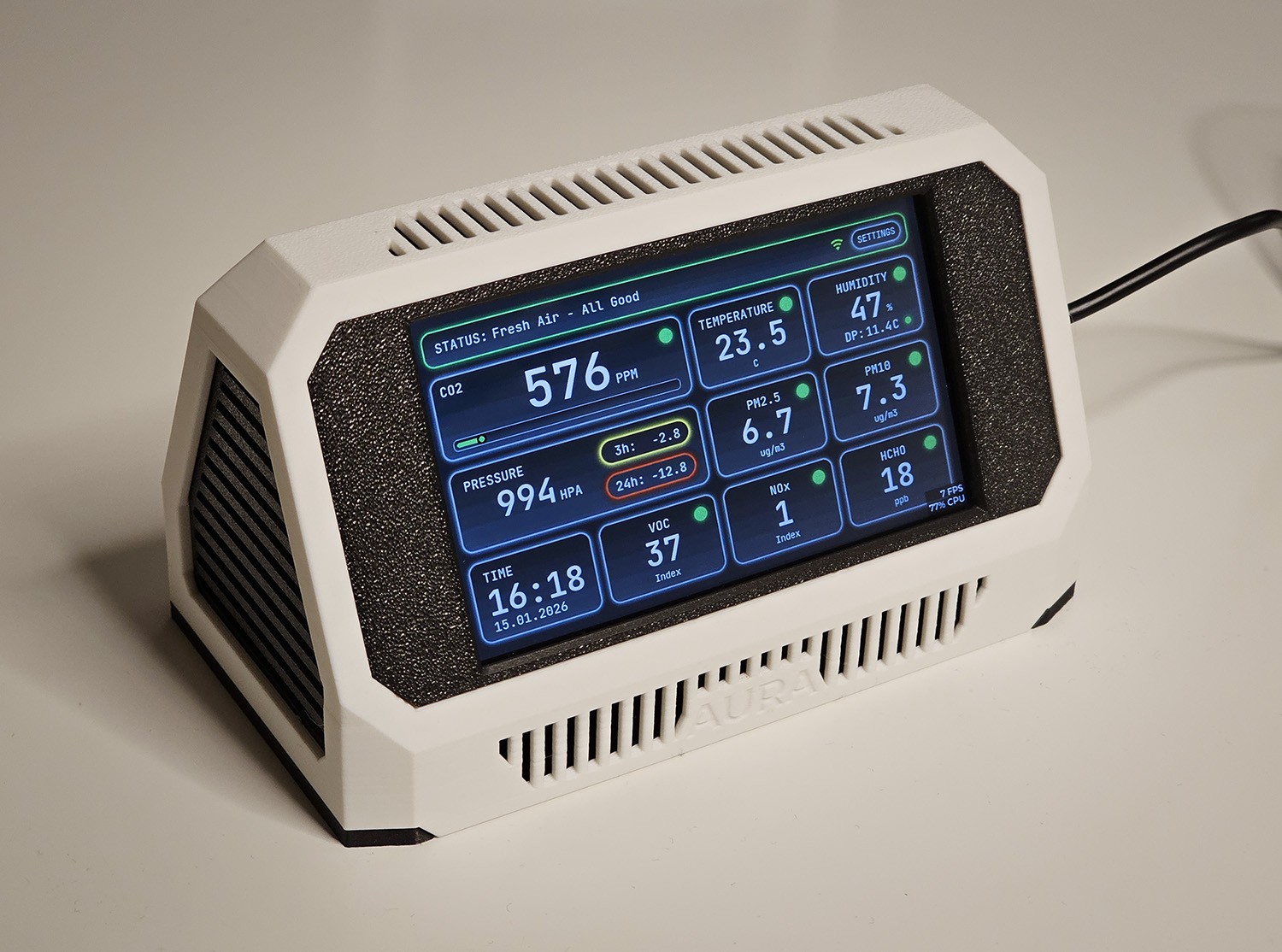
Project Aura measures everything that matters for indoor air quality:
Particulate Matter (PM1 / PM2.5 / PM4 / PM10)
These aren't the dust bunnies under your sofa. PM2.5 particles are so small (2.5 micrometers) they pass through your body's protective barriers directly into the bloodstream, causing inflammation. PM10 includes larger particles like pollen and mold spores — critical for allergy sufferers.
Carbon Dioxide (CO₂)
Ever noticed your head getting heavy by midday? At CO₂ levels above 1000-1200 ppm, your brain starts to "suffocate." At concentrations above 1400 ppm, cognitive capacity drops by 50% (confirmed by Harvard studies). Aura tells you when it's time to open a window.
Volatile Organic Compounds (VOC) & Nitrogen Oxides (NOx)
VOCs come from cleaning products, paints, furniture, and even cooking. NOx primarily comes from gas stoves and vehicle exhaust. Both irritate respiratory tracts and can trigger asthma.
Formaldehyde (HCHO) - Optional
That "new car smell" or fresh renovation scent? Budget particleboard furniture, laminate flooring, and adhesives can release formaldehyde — a known carcinogen — for years. The optional SFA30 sensor detects this invisible threat directly.
Temperature, Humidity & Absolute Humidity
In winter, heaters dry indoor air to desert levels (<20% RH). Dry mucous membranes can't protect your body from viruses effectively. Aura calculates Absolute Humidity (g/m³), giving you a more accurate health risk assessment than relative humidity alone.
Barometric Pressure with Trend Analysis
Many people feel migraines or joint pain before weather changes. Aura doesn't just show current pressure — it calculates Delta trends over 3 hours and 24 hours. A sharp pressure drop is your early warning system.
Hardware: No Compromises
Main Controller
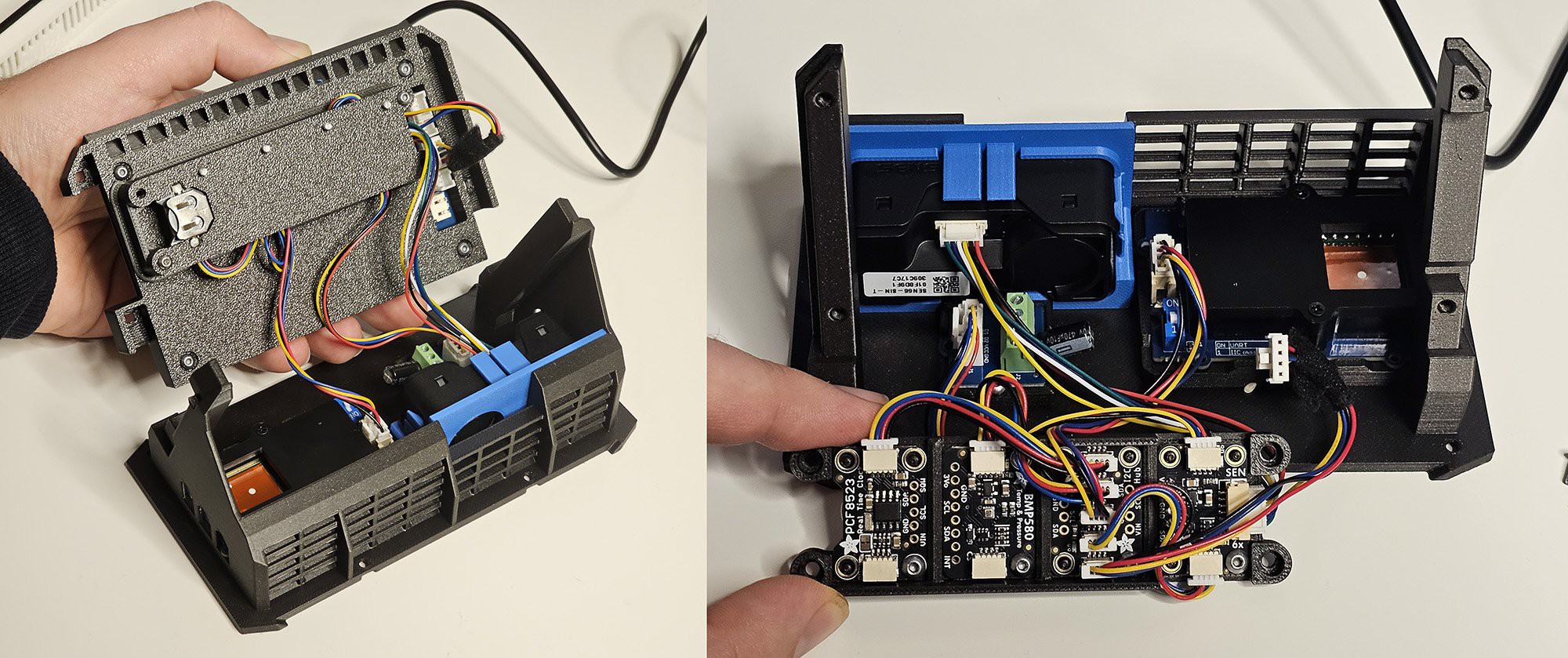
Waveshare ESP32-S3-Touch-LCD-4.3 — An all-in-one board featuring:
- Dual-core ESP32-S3 processor
- 16MB Flash memory
- Gorgeous 4.3" IPS capacitive touchscreen (800×480)
- The visual quality difference from cheap displays is like comparing an old TV to a modern tablet
The Sensor Suite
Sensirion SEN66 (Switzerland) — The heart of the system. This single module replaces an entire laboratory:
- PM1, PM2.5, PM4, PM10 (full particulate spectrum)
- CO₂, VOC, NOx (air freshness and chemical pollution)
- Temperature & Humidity
Sensirion SFA30 (optional) — Direct formaldehyde measurement. If you've done renovations or bought new furniture, this sensor reveals the invisible danger.
Adafruit Pressure Sensors — Support for DPS310, BMP580, or BMP581. The device auto-detects which sensor is installed and starts plotting pressure trends.
Adafruit PCF8523 RTC — Real-time clock with battery backup. Aura remembers the exact time even when powered off or working offline. When connected to WiFi, time syncs automatically every 6 hours.
Why Sensirion?
DIY air quality monitors often use a "zoo" of cheap sensors (DHT11, MQ-135, SGP30). These sensors drift over time, cross-contaminate, and provide questionable accuracy.
The Sensirion SEN66 uses Sheath Flow technology — the sensor actively draws air through a protected channel, preventing dust contamination and ensuring long-term stability. VOC and NOx aren't just raw resistance values; they're algorithmically processed indices that correlate with real human perception of air quality.
Assembly: Zero Soldering Required
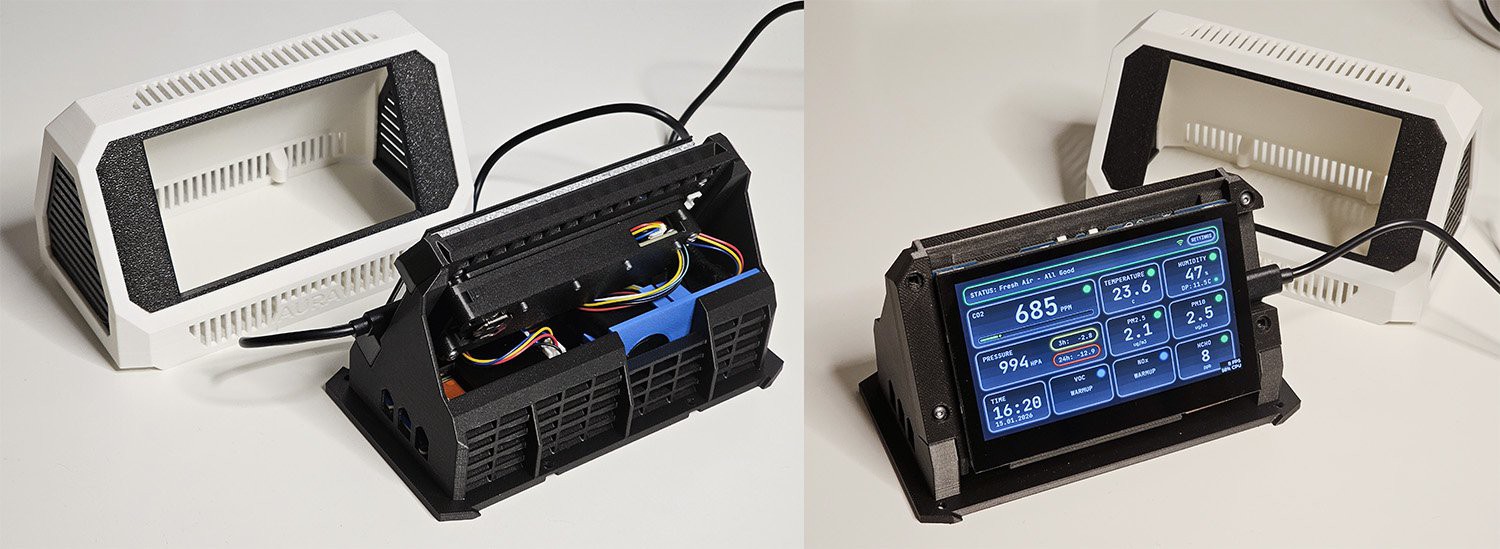
Every connection uses Grove / STEMMA QT / Qwiic standardized cables and a simple I2C hub topology. The assembly process feels like building a LEGO kit — predictable, documented, and repeatable.
One Important Detail: If you're using off-the-shelf cables, one connector requires swapping two power pins. This is clearly explained in the build guide. Skip this step, and you risk damaging expensive sensors.
Power Stabilization: An electrolytic capacitor (10V 470µF or higher) stabilizes the power supply for reliable WiFi and sensor operation. No soldering needed — just insert its legs into the Grove Screw Terminal along with power wires.
The Interface (LVGL-Based UI)
Thanks to a powerful graphics engine, the interface runs smoothly with gradient effects and animations — a far cry from typical Arduino LCD projects.

Features:
- 12 Built-in Themes — Bored with one color? Switch instantly or create custom themes via the web-based Theme Studio
- Multi-Language Support — English, German, Spanish, French, Italian, Portuguese (Brazil), Dutch, Simplified Chinese
- Auto Night Mode — Automatically dims or turns off the screen on schedule
- Auto Screen Timeout — Save display life with configurable timeouts (30s / 1m / 5m). Wake on touch.
- Real-Time Graphs — Barometric pressure trends (3h and 24h deltas)
Six Main Screens:
- Dashboard — All vital metrics on one screen with color-coded quality indicators
- Settings — Complete device control without connecting to a computer
- Themes — Theme selection and customization
- MQTT — Full Home Assistant integration setup
- Time & Date — RTC management and timezone configuration
- Display Settings — Brightness, timeout, night mode scheduling
Software Architecture: Built to Last
Embedded Theme Studio
Customizing colors in firmware is usually a nightmare. I built a Theme Studio directly into the device's web interface:
- All HTML/JS/CSS is packed into PROGMEM (no SD card required)
- Color transformation logic runs in your browser
- Styles update on-the-fly without rebooting
Safe Boot & Anti-Brick Protection
Smart devices can turn into "bricks" due to bad configs. Project Aura includes:
- Boot Policy — If the device crashes during boot multiple times, it automatically rolls back to the last known good configuration
- Factory Reset — A software factory reset button restores everything to original state
- Persistent Configuration — Settings survive firmware updates
Native Home Assistant Integration
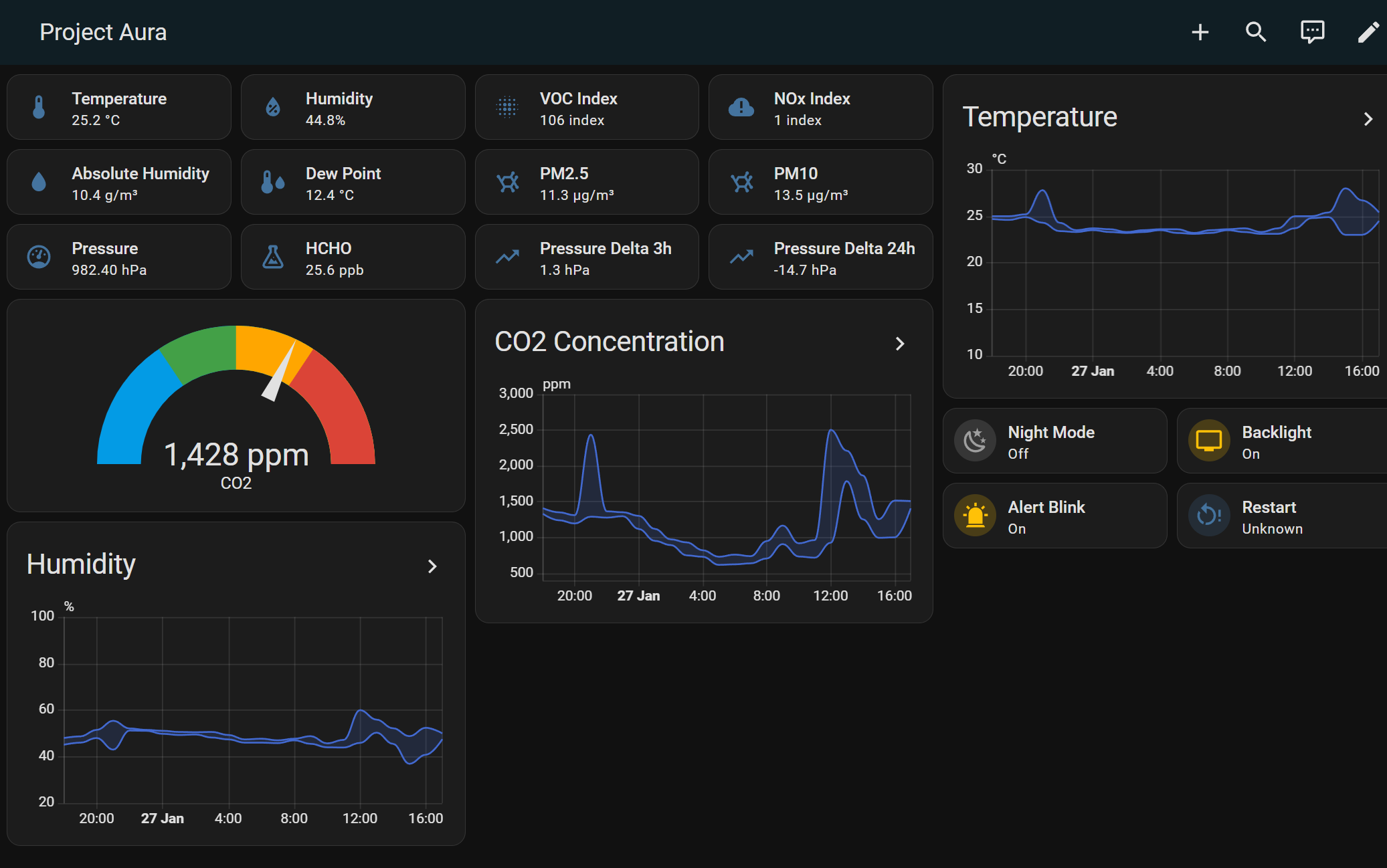
One of Aura's killer features is MQTT Auto-Discovery. Enable it once, and the device instantly appears in Home Assistant with 20+ entities:
Sensors: PM2.5, PM10, CO₂, VOC, NOx, Temperature, Humidity, Absolute Humidity, Pressure, Pressure Delta (3h/24h), HCHO, AQI
Controls: Night Mode toggle, Backlight Brightness slider, Restart button, Display Timeout selector
No YAML required. No manual entity creation. Just works.
What Backers Get
This is a crowdfunding project on MakerWorld. Backers receive:
- 3D-printable enclosure files (STL)
- Detailed PDF assembly guide (step-by-step, illustrated)
- Firmware with Web Installer (no IDE/PlatformIO required for end users)
- Access to open-source firmware repository
- Ongoing project updates and future enclosure variants
Electronics are sourced separately (full BOM provided). The project focuses on design, firmware, and documentation.
Total Cost Breakdown
Approximate component cost (including optional formaldehyde sensor): $170-200 USD
This is exclusively the market price of industrial-grade components. No consumer air quality monitor at this price point offers:
- Top-tier Sensirion SEN66 sensor
- Separate formaldehyde sensor
- Large touch IPS display
- Full local Home Assistant integration
- Complete open-source transparency
Development Status
- ✅ Fully assembled and working prototype
- ✅ Firmware feature-complete
- ✅ Final stability testing in progress
- ✅ Documentation polishing underway
If the project gains an active community, additional enclosure designs will be released for all backers.
Firmware Installation (For Developers)
The firmware is built using PlatformIO and uses LVGL for the graphical interface.
Prerequisites:
- Visual Studio Code
- PlatformIO extension
Build & Flash:
git clone https://github.com/21cncstudio/project_aura.git
cd project_aura
pio run -e project_aura -t upload
pio run -e project_aura -t uploadfs
Important: The uploadfs command is required — it uploads fonts and UI assets to the ESP32's filesystem.
First Boot Setup:
On first boot, the device creates a WiFi access point named ProjectAura-Setup. Connect and open http://192.168.4.1 to configure WiFi credentials.
WiFi is optional for basic operation — it's only needed for time sync and MQTT/Home Assistant integration.
Why Open Source Matters
Commercial air quality monitors are incentivized to:
- Lock you into subscriptions
- Harvest your data
- Become obsolete when cloud services shut down
Project Aura is transparent, inspectable, and adaptable. You own the hardware. You control the data. You can verify how everything works.
This makes Aura closer to an instrument than a black-box gadget.
Resources
- GitHub Repository: https://github.com/21cncstudio/project_aura
- MakerWorld Crowdfunding: https://makerworld.com/en/crowdfunding/159-project-aura-make-the-invisible-visible
Let's breathe clean air. Together.