 kevin.horecka

The current state of the art for this problem appears to be these heating pucks

https://www.amazon.com/dp/B00008AJH9
They tick all the requirements boxes:
- durable/long lifetime
- quick to heat (microwavable)
- bleachable/easy to clean
- get to the right heat range
Except:
5. Make it 12+ hours before cooling too much
I was going on anecdotal evidence when I started this, so I grabbed some simple Groove wifi temperature monitors and collected some data (under admittedly artificial conditions).
https://www.amazon.com/dp/B0BNPH97LM
The initial data were fairly interesting:
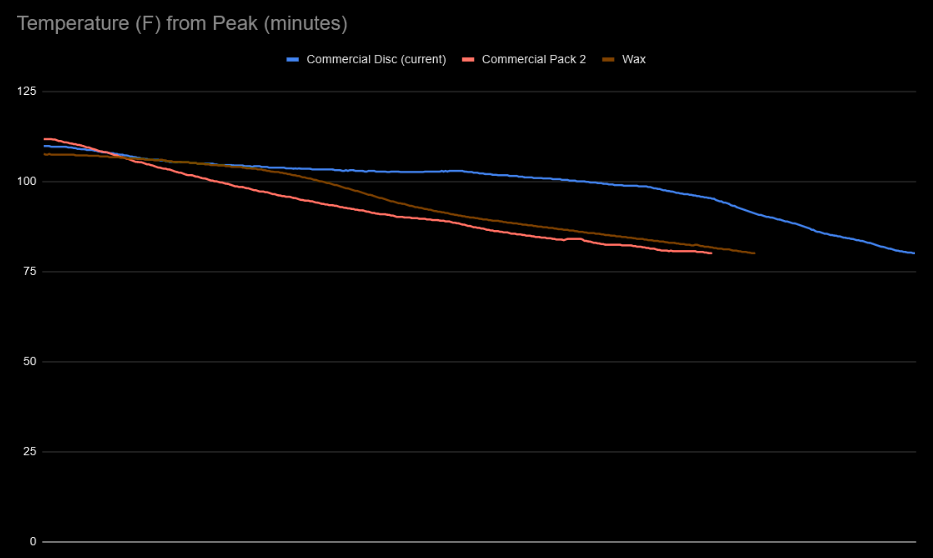 I tested an alternative heating pad https://www.amazon.com/dp/B001B16Z0G that performed the same as a paraffin wax test I had.
The first thing I noticed from the puck was that the temperature doesn't just drop linearly. After some googling, I realized it's likely because it's using what's called a Phase Change Material (PCM). These materials store a lot of energy in their phase change such that they hold near that phase change temperature for a long time before then cooling further. This means they have a nice stable max temperature associated with that phase change temperature threshold and they can hold a lot of energy. Makes sense why they'd be used!
This is what made me want to try paraffin wax as it's an easy-to-obtain phase change material. Interestingly, the second commercial heating pad seems to perform very similarly to the standard wax. I added an emulsifier to the wax to emulsify in some water so it was more microwaveable (paraffin wax is microwave transparent on its own). This ended up not working very well, so I just double-boiler heated the wax for it's comparison. I was curious later if the presence of a cat extended the lifetime, so I measured that:
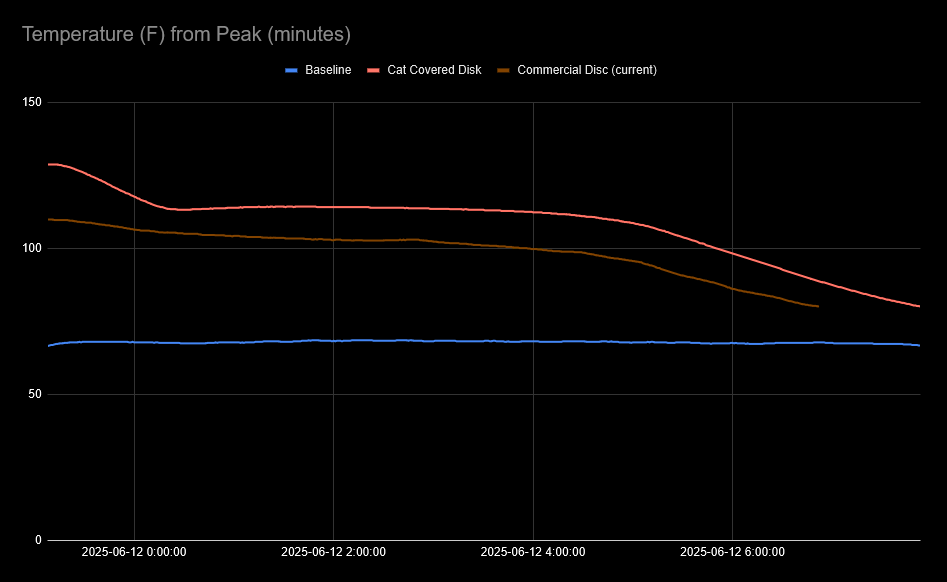 These are, admittedly, not the best data. They're just one controlled experiment when I should probably do many, but it seems clear the kitten, predictably (as it's a heat source) extends the life of a disk by an hour or 2.
 I'll note on these experiments we stopped when the temp dipped below 80F, at which point it would be generally considered useless, but we actually want it above 90-100 to be providing maximum value.
So that's where I'm at! I think phase change materials have a lot of the properties I want. I reached out to some labs in town to see if they'd analyze the material in the most successful commercial puck because maybe the simplest answer here is to just figure out what that is, make it easy to get, and have shelters make their own in 1L fluid bags (abundant waste material) sealed with hot glue (tested using rice and it works for that even when heated, who knows about heated wax though). If anyone knows what's in those heating pads, I'd love a lead!
Or perhaps this is all a silly solution - perhaps there's some heated air solution that's more efficient (they do use heaters in the room at night but it's a large cinder block and metal room that is quite hard to get above 70 - this also creates storage longevity issues for things stored in that room).
The even easier solution is to buy a bunch more of those pucks - plug in 3 microwaves on 3 different breakers, and just put multiple per kennel wrapped in blankets, but that gets expensive fast and not every shelter can afford that. What we want is a cheap material, easily obtained, that holds a lot of heat energy and is easy to charge.