 loudaslife
Mechanical
To start with, I didn't actually have a spare 3D printer lying around that would be suitable. I did, however, have the frame leftover from a Prusa MK4S to CORE One conversion, along with most of the components salvaged from an old Anet A8 and an MP Mini Delta. The final product is mostly based on Prusa MK3S+ design files (since I didn't have the 10mm rods on hand for a MK4 design), with the rest of the printed parts being modified or designed from scratch to fit the components I had on hand. None of the controller boards I had were modern enough to support sensorless homing, and I didn't want to mess with limit switches, so I bought a BTT SKR Mini E3 V2 on sale for cheap.
The entire X carriage assembly was redesigned from scratch to hold the optical components. I also had to make new housings for the PSU and controller board, since neither of those were ever meant to go on a Prusa frame. A few miscellaneous extra bits were required, like spacers to limit the X-axis travel so that the ring light wouldn't collide with the frame.
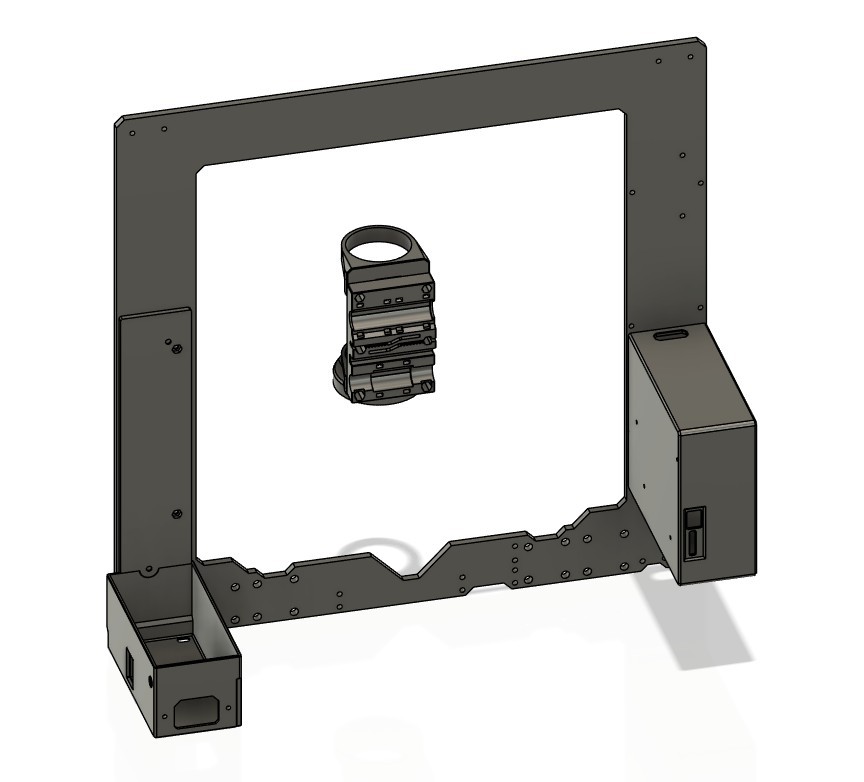
I don't think any of the printed parts I designed for this will be useful to anyone, but I'll upload them to the project page just in case. Everything was printed from colorFabb XT-CF20, mostly because it was lying around, but I also really love the smooth satin finish it gives.
Optics
I spent a lot of time agonizing over this, with questions like how much to spend on the lens vs the camera. I probably didn't make the ideal choice in the end, but it works well enough for my purposes right now.
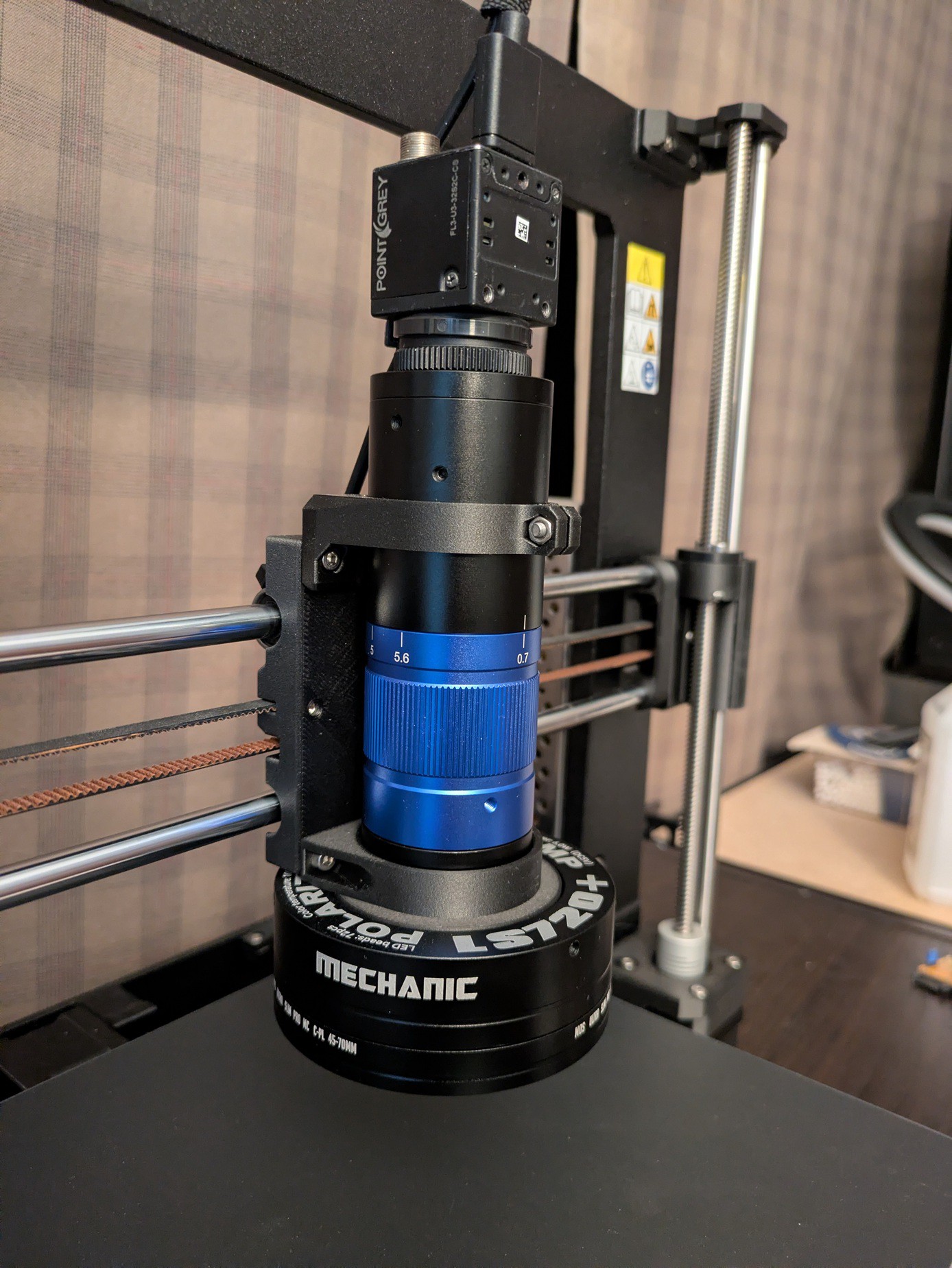 I picked the lens first, and after a lot of searching I settled on a cheap unbranded version of a ToupTek TZM0756. At least, I'm assuming what I purchased came from the same factory as the ToupTek ones. It came with zero branding, but seems absolutely identical, and I don't think the budget microscope lens industry is cutthroat enough for someone to be making perfect counterfeits of a brand like ToupTek. Anyway, this was about the cheapest option I found (within the magnification range I wanted) that actually had detailed documentation and specifications available.
The camera came next, and I ended up buying a used Flea 3 (FL3-U3-32S2C-CS) from Teledyne (formerly FLIR, and formerly formerly Point Grey Research). They still offer firmware updates and support on their website despite this product being two corporate acquisitions old, which is nice. Beyond picking something with a sensor size and mounting thread compatible with the lens, my main criteria for the camera was software support and USB 3. There's already direct software support for this family of cameras in Micro-Manager, which makes things relatively simple.
USB 3 was important to me because you can't stream uncompressed high-res video over USB 2 with a frame rate acceptable for live viewing. Sure, it might theoretically be possible for the software to preview at a lower resolution (or with compression) and then automatically switch to the full uncompressed resolution for image acquisition. But I knew the software side of this was going to be a bigger headache than the hardware, and dynamically changing camera modes introduces too many potential problems. That's also why the "bottom" of the camera is facing the front of the microscope. It would look nicer and the cable management would be slightly neater if I rotated it 180°, but rotating the image back in software is more of a pain than you would think.
The actual resolution of the camera sensor wasn't a huge factor in my selection, because the resolution for most cameras I looked at was well beyond the diffraction limit for the lens itself (assuming my math was correct, which is a big assumption.) For anyone interested, there are various guides and calculators online for doing the math and figuring out what sensor resolution you need to get the most out of a given lens.
The last component was the light source. I would've liked to have both coaxial and ring light modes, just like the microscopes I'm familiar with, but that gets complicated and expensive fast. I settled on a cheap polarized ring light designed for low magnification stereo microscopes. There are lots of these, but I chose a Mechanic LS720+ after reading this excellent review from Pedro J. Aphalo. To be clear, the review didn't suggest that this model of light was particularly exceptional, but it answered almost every question I had about it, and I figured I could put up with the limitations described. The relatively low frequency PWM dimming makes it pointless to use at anything below maximum brightness in my setup, which is neither surprising nor problematic. I've rarely had a reason to turn the illumination below max on any digital microscope I've used. It's far better to reduce the gain on the camera to get an image with the least noise possible.
Discussions
Become a Hackaday.io Member
Create an account to leave a comment. Already have an account? Log In.