 Silícios Lab
Introduction
Monitoring environmental variables is crucial for the efficiency and safety of numerous industrial processes and electronic systems. Ensuring that parameters such as atmospheric pressure and temperature remain within ideal limits is essential to maintain production quality, protect sensitive equipment, and optimize the performance of climate-controlled environments.
Many industrial processes, such as chemical synthesis, food preservation, and high-precision manufacturing, depend on strict atmospheric conditions. Deviations in pressure or unexpected temperature spikes can indicate cooling system failures, leaks in pressurized chambers, or even imminent hardware malfunctions.
Without continuous monitoring, these variations can lead to silent failures that only become apparent when the damage is already significant. Every hour of operation under inadequate thermal or pressure conditions not only risks the integrity of the equipment but also compromises the repeatability and excellence of the final product.
This lack of control can result in major impacts, such as:
- Premature Component Wear: High temperatures accelerate the degradation of electronic components and mechanical lubricants, leading to frequent and unplanned maintenance.
- Operational Losses: Inaccurate pressure readings in pneumatic or vacuum systems can cause process instability, resulting in wasted raw materials and high energy consumption.
- Product Non-Compliance: Environmental fluctuations can lead to batches that do not meet technical standards, resulting in rework, discards, and financial losses.
To address these challenges and enhance industrial sensing capabilities, we developed a specialized printed circuit board (PCB) integrating the ESP32 microcontroller with the BMP280 sensor. The ESP32 acts as the core of the system, providing the processing power and connectivity needed to read high-precision data from the BMP280 and transmit it to IoT platforms or local dashboards in real-time.
With the high-resolution data provided by the BMP280, managers and technicians can monitor environmental trends and receive instant alerts about abnormal conditions. This allows for proactive adjustments to HVAC systems, early detection of pressure drops, and a deeper understanding of the operating environment.
By implementing this solution, companies not only avoid the costs of environmental-related failures but also move towards Industry 4.0 standards, ensuring more predictable, sustainable, and profitable operations. Next, we will present the complete design of the printed circuit board presented below
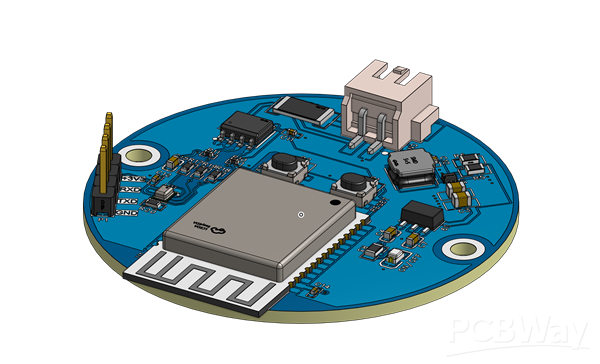
In the following sections, we will present the complete hardware design, schematic, and assembly details of this PCB.
I've just released the full project files for this ESP32 + BMP280 monitor, and you can download them for free! If you want to take your prototyping to the next level, I’ve got a gift for you: by creating a new account at PCBWay through the link, you get 5 units for free to manufacture your first project. Professional hardware has never been this accessible! Get the files and your free PCBs here!
Electronic Schematic of the Project
The electronic circuit of the printed circuit board is divided into 6 electronic blocks. All of them are presented in the figure below.
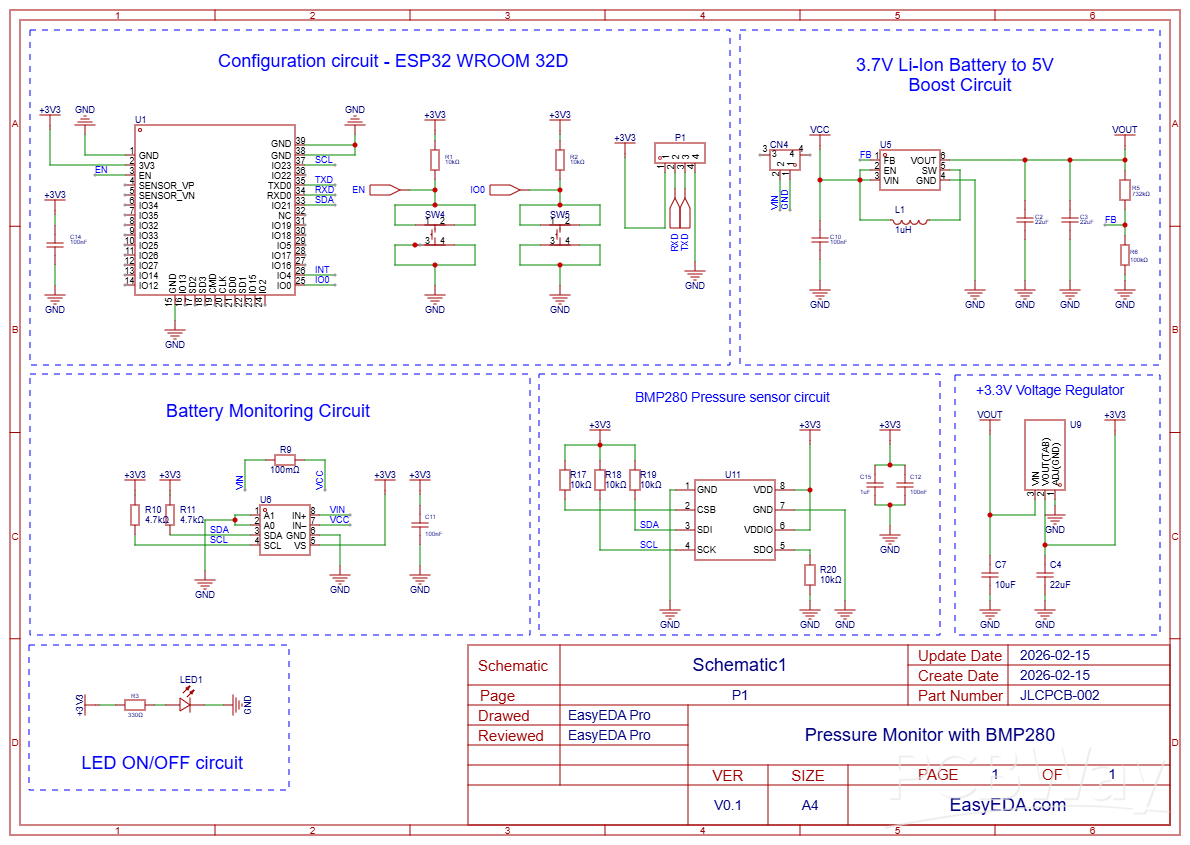
The heart of this project is the ESP32. It will be responsible for reading the signals from the BMP280 sensor and transferring this data over the internet. Its basic operating circuit is shown in the electronic schematic above. It consists of a set of buttons, decoupling capacitor and pins for code transfer (+3V3, TXD, RXD, and GND).
This electronic board aimed to be small, easy to attach anywhere and operate with low energy consumption using a Li-Ion battery. Below we have the connector for connecting a Li-Ion battery cell.
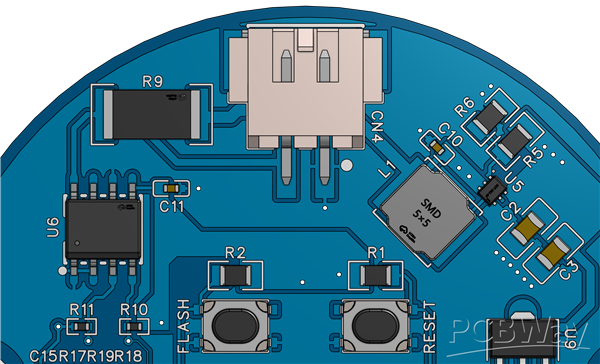
To ensure adequate power supply to the system, we used a DC-DC boost converter to raise the voltage to 5V and we used a +3V3 voltage regulator to regulate the voltage to power the ESP32. In future updates, if necessary, we will use the 5V voltage to power other circuits.
Below we present the circuit block of the DC-DC boost converter. We use the TPS61023 CHIP to supply +5V from the Li-Ion battery input voltage.

In various battery-powered electronic projects, it is essential to ensure that the battery can power the device for an extended period. This aims to provide a long operating time for the application. To ensure this, we include a circuit for monitoring the battery's voltage and current using the INA219 sensor.
I've just released the full project files for this ESP32 + BMP280 monitor, and you can download them for free! If you want to take your prototyping to the next level, I’ve got a gift for you: by creating a new account at PCBWay through the link, you get 5 units for free to manufacture your first project. Professional hardware has never been this accessible! Get the files and your free PCBs here!
What is the purpose of the INA219 sensor?
The INA219 sensor is a crucial tool for monitoring batteries and assessing current consumption in electronic circuits, especially in field applications. It measures both the battery voltage and the current flowing through it, providing essential data to evaluate system performance and efficiency. By keeping track of battery voltage, operators can effectively monitor charging and discharging status, which is key for proper energy management.
Additionally, by analyzing the current consumption of the circuit, operators can identify usage patterns, detect anomalies, and optimize energy consumption. This data is vital for extending battery life and enhancing energy efficiency in various applications, from portable devices to remote monitoring systems. The INA219 sensor circuit, shown below, communicates with the ESP32 via I2C.

Next, we have the MPU6050 gyroscope sensor circuit. This sensor will be responsible for sending vibration and vibration signals to the system.
BMP280: Precision Pressure and Temperature Sensing for Embedded Systems
In the world of embedded systems, precise measurement of environmental variables is a cornerstone for projects ranging from DIY weather stations to complex drone navigation systems. Among the various market options, the BMP280 by Bosch Sensortec stands out as a robust and refined successor to the popular BMP180, offering an ideal balance of low power consumption, small footprint, and high precision.
What is the BMP280?
The BMP280 is an absolute digital barometric pressure sensor designed specifically for mobile applications. It integrates a piezoresistive pressure sensor and a temperature sensor into a single package—typically an 8-pin metal-lid LGA measuring just $2.0 \times 2.5 \times 0.95$ mm.
Unlike analog sensors, the BMP280 delivers processed data via serial communication, making it easy to integrate with modern microcontrollers such as the ESP32, RP2040, and the STM32 line.
Technical Specifications and Advantages
The sensor operates with a supply voltage between 1.71V and 3.6V, making it natively compatible with 3.3V logic. Key technical highlights include:
- Operating Range: Pressure from 300 to 1100 hPa; Temperature from -40 to +85 °C.
- Relative Accuracy: $\pm 0.12$ hPa (equivalent to an altitude variation of only $\pm 1$ meter).
- Communication Interfaces: Supports both I2C and SPI (4-wire or 3-wire), providing flexibility in hardware design.
- Current Consumption: Only $2.7 \mu A$ at a 1Hz sampling rate, which is essential for battery-powered devices.
Practical Market Applications
The versatility of the BMP280 allows it to be applied across several technology niches:
- Indoor Navigation and Geolocation
Thanks to its high sensitivity, the sensor can detect minute pressure changes associated with moving between floors in a building. This makes it a key component for dead reckoning in environments where GPS signals are non-existent or unstable.
- Drone and UAV Stabilization
In flight control systems, the BMP280 acts as a barometric altimeter. It provides the necessary feedback for firmware to maintain a stable altitude autonomously, compensating for real-time atmospheric variations.
- IoT Weather Stations
Due to its ability to measure pressure and temperature with low noise, it is ideal for forecasting local weather changes. A sudden drop in barometric pressure, for instance, is a classic indicator of approaching storms.
- Power Management Optimization
In wearable devices, the sensor can be used to identify physical activities (such as climbing stairs or hiking), allowing the system to adjust processing and the use of other sensors (like GPS) to save energy.
Developer Considerations
When integrating the BMP280 into your project, it is important to note that while it measures temperature, the primary purpose of this reading is for the thermal compensation of the pressure data. If your project requires highly accurate ambient temperature measurement isolated from PCB heat sources, strategic component placement or a dedicated thermal sensor may be necessary.
Additionally, for altitude calculations, remember that sea-level atmospheric pressure varies daily. To obtain an exact real-world altitude, you must calibrate the sensor with the current local pressure (QNH).
BMP280 Electronic Circuit with ESP32
For the integration of the BMP280 with the ESP32 via I2C, the circuit is minimalist but requires careful attention to operating voltages. The sensor must be powered by 3.3V from the ESP32's regulator, and the communication pins—SDA (Serial Data) and SCL (Serial Clock)—are connected to the corresponding GPIO pins on the microcontroller (commonly GPIO 21 and 22, respectively).
It is essential to include pull-up resistors (typically between $4.7k\Omega$ and $10k\Omega$) on both signal lines to ensure data integrity and a high logic state when the bus is idle. Furthermore, the sensor's SDO pin defines the I2C address: if connected to GND, the address will be 0x76; if connected to VCC, it will be 0x77.
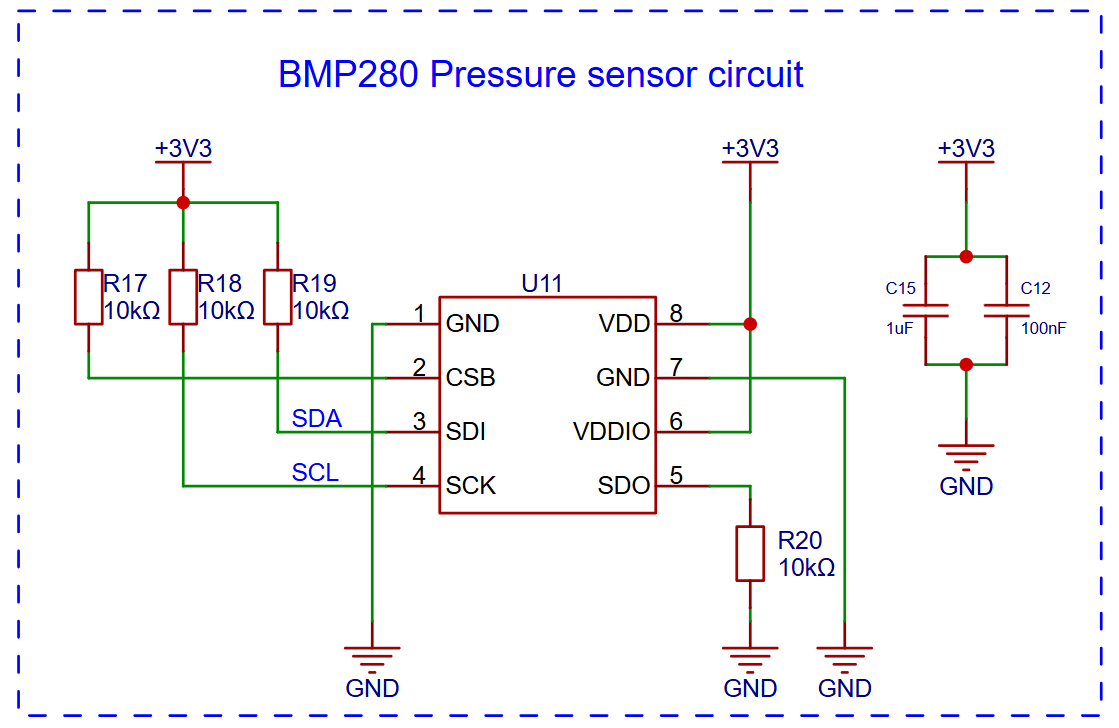
This hardware configuration allows the ESP32 to act as the master, requesting pressure and temperature readings through write and read commands to the sensor's internal registers.
Acknowledgments
We would like to thank PCBWAY for supportting the creation of this project and made some units available for you to earn for free and receive 5 units at your home.
To receive them, access this link, create an account on the website and receive coupons for you to win right now.
I've just released the full project files for this ESP32 + BMP280 monitor, and you can download them for free! If you want to take your prototyping to the next level, I’ve got a gift for you: by creating a new account at PCBWay through the link, you get 5 units for free to manufacture your first project. Professional hardware has never been this accessible! Get the files and your free PCBs here!