An experiment in turning aerodynamic theory into a practical, 3D-printed aircraft that can actually take to the sky
To make the experience fit your profile, pick a username and tell us what interests you.
We found and based on your interests.

The project began by defining how the wing would be built, since weight is one of the four forces acting on an aircraft and is crucial to determining whether the airplane was actually functional or just a cool-looking model with no other purpose than to look at it. With that in mind, I researched several wing-construction methods commonly used in commercially available and other scratch-built model aircraft.
I chose to base the wing's design on the classic 'balsa-wood spar-and-rib' structure, known for being lightweight, structurally efficient, and modular. However, instead of balsa wood, my version would be 3D-printed entirely from PLA+. While PLA+ offers great strength and durability, it is unfortunately also significantly heavier, creating an interesting challenge that would require further refinement as the project progressed.
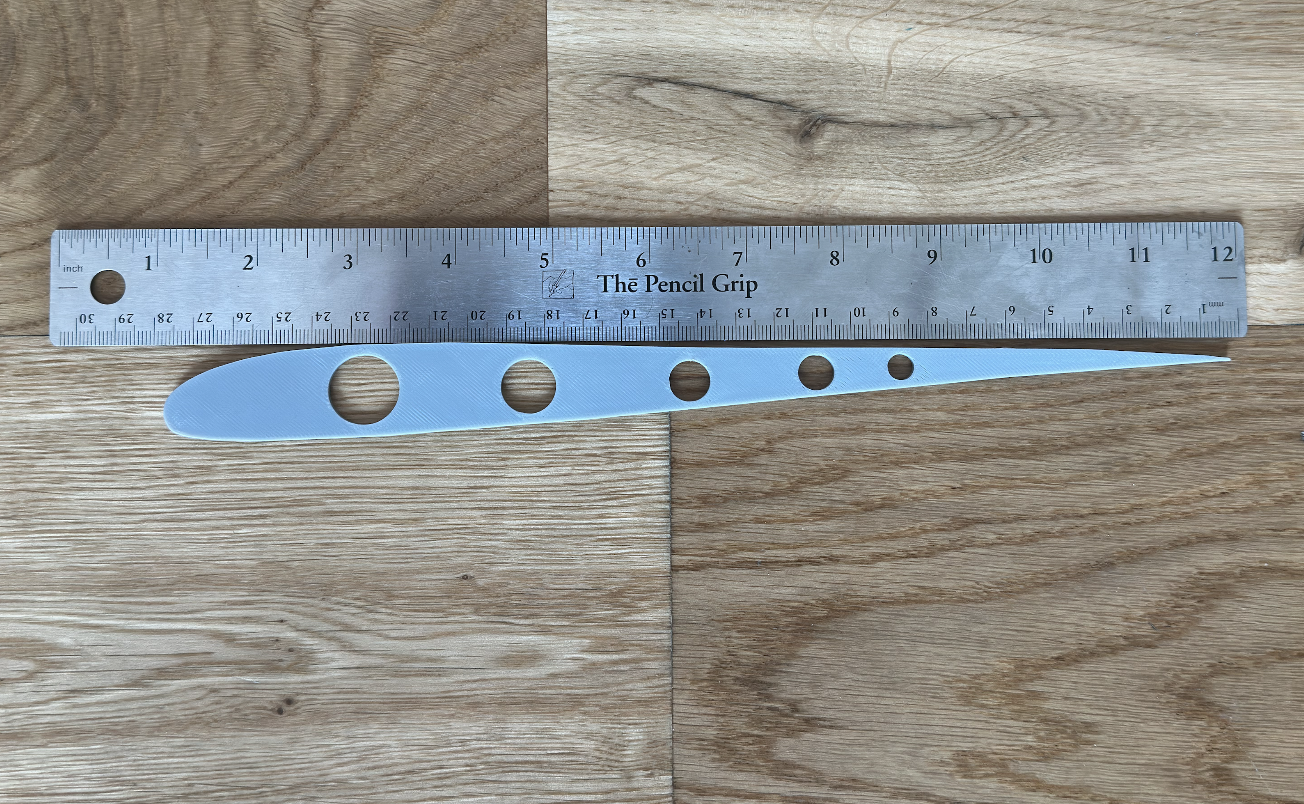
To stay consistent with the goal of making the aircraft almost entirely 3D-printed, I decided not to rely on carbon fiber reinforcements or other external materials aside from the necessary hardware and control linkages for the control surfaces. I modeled a custom airfoil in Onshape, with an initial chord length of 28 cm. After producing a test print, I made a rough layout with BBQ skewers to visualize the aircraft's general shape and estimate its likely size.
It became increasingly clear that apart from the shockingly long print time of 1 hour and the high weight of 8 grams for a single rib, the design was far from practical, as I would have to scale everything, including the fuselage, which would likely drive the aircraft's total weight close to 2 kilograms. While doing some simple calculations to confirm my hypothesis, I concluded that 7 ribs per wing, would result in a total weight of 56 grams — just for the ribs. If the spars and flaps had been added, that number would likely have reached 100 grams. Based on these findings, I decided to scale down the airfoil to a chord length of 18.2 cm to bring the projected weight back into a more reasonable range.
Create an account to leave a comment. Already have an account? Log In.
Become a member to follow this project and never miss any updates