 Alessandro Sgarzi

The daily commute is what finally broke me. Every day, I am standing in the middle of one of the noisiest environments humans have ever built, surrounded by 80 decibels of engines, construction, and crowds, and my headphones are dying because they cannot tap into any of it.
That frustration led to AcoustiHarvest. The core idea is almost embarrassingly simple: bond piezoelectric film to the inner membrane of the ear cups, let the ambient sound pressure flex that membrane, and collect the resulting charge. No solar panels, no cranks, just the city powering your music.
The real question was whether the physics actually held up. The answer is yes, but only if you are obsessive about low-power engineering.
Sound pressure is logarithmic, but acoustic intensities add linearly. In a typical urban commute, combining traffic (80 dB), a bus horn (85 dB), and distant construction (75 dB), you are looking at a total intensity of roughly $451 nW/m^2$. After running that through the full harvesting chain, two cups, PVDF transduction at 2% efficiency, a 3.3V regulated rail, you get about 122 nW of usable power. Since the system only needs 17 nW for audio playback, a typical city street actually gives you 7x the power required, with the surplus flowing back into storage. A pneumatic drill nearby delivers enough energy to run the headphones fifty times over.
The system sustains itself down to 73 dB, basically the volume of a busy office. It only fails in a library or a quiet bedroom at night. Everywhere else, it is infinite battery.
The front line is the PVDF film (Measurement Specialties LDT2-028K). It is a fluoropolymer that generates voltage when deformed. I bonded about 100 $cm^2$ per side to 3D-printed PLA cups. To boost efficiency, I designed a small acoustic compliance chamber behind the membranes to act as a mechanical impedance transformer, increasing displacement by about 20% compared to a rigid backing.
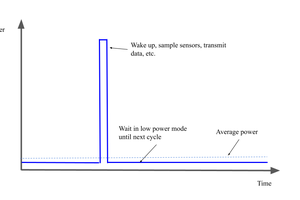
The signal then hits an LTC3588-1. Standard diodes are useless here because their 0.6V drop would swallow the entire signal, instead, this chip uses internal MOSFETs for synchronous rectification with almost zero loss. It also manages the burst-mode behavior, the system harvests, sleeps, and wakes autonomously. Without this architectural trick, the quiescent draw of the electronics would exceed the harvested power every time.
For storage, I skipped lithium entirely. I am using two Panasonic supercapacitors (0.5F total). They store energy electrostatically, meaning they will outlast every other component on the board. Even with self-leakage, they provide about four minutes of bridge time for total silence, plenty for an elevator ride or a lull in traffic.
The brain is an STM32L011K4T6 running bare-metal. No RTOS, no HAL, nothing that wastes cycles. It pulls audio from a TDK MEMS microphone via PDM, which eliminates the need for power-hungry ADCs or op-amps. The MCU applies a minimal FIR filter to fix the driver's frequency response and sends a PWM signal to a PAM8302A Class-D amplifier. At these nanowatt scales, Class-AB would just turn your energy into heat, Class-D is the only way to stay efficient.
The whole thing lives on a custom two-layer PCB with a strict ground plane split. If the switching noise from the boost converter leaked into the femtoampere-level PVDF path, the whole system would collapse.
The final result? No Bluetooth, no apps, no USB ports. Just a 3.5mm jack and a single LED to show if you are gaining or losing charge. It is a $33 BOM that turns urban noise into a permanent power supply. As long as the city stays loud, the music stays on.



 Jake Wachlin
 Sagar 001
 Entunassa
@Merlin I couldn't reply directly to your comment, anyway the system allows you to hear music with the loud sorrounding as only source of power, so no batteries or annoying power cords, however the implementation of a noise canceling feature is a great idea! Thx