 Robert Gawron
There has been a lot going on with the project lately :)
The SiPM sensor I originally planned to use (MICROFC-60035-SMT-TR1) has 3.4nF internal capacitance, which is huge. Normally, to compensate for this in a transimpedance amplifier (TIA), a capacitor is connected between the inverting input and the output. Since the capacitance is so large, the circuit will effectively behave more like a charge amplifier rather than a true transimpedance amplifier.
I think this may be a problem because a charge amplifier, by its nature, integrates the input signal. If we simplify the math: integrals are slow, derivatives are fast. There are gamma spectrometers with charge amplifier as first stage so the design is not wrong however. The pulses will be slower and wider, so the device will have lower time resolution. In that case, using a fast ADC and FPGA might be overkill, also fast ADC are expensive.
My idea is to switch from the AD9226 (65 MSPS, single channel) to the AD9238 (pin-compatible variants: 20/40/65 MSPS, dual channel). I plan to use the 40 MSPS version for now and switch to a higher sampling rate later if needed. This already saves roughly 20 euros.
Since the ADC has two channels, I could use two smaller SiPMs (3×3 mm) with two analog front-ends. Two channels require twice as many op-amps, so the savings form choosing different ADC are eaten, but I still think this is a better solution because:
- The sensor capacitance is roughly x5 lower.
- Having two channels gives the opportunity to perform some digital processing in the FPGA (I don’t have idea about digital processing yet, but I will look into it later).
The downside is that the total sensor area will be twice smaller: 6x6 mm vs. two 3x3 mm sensors.
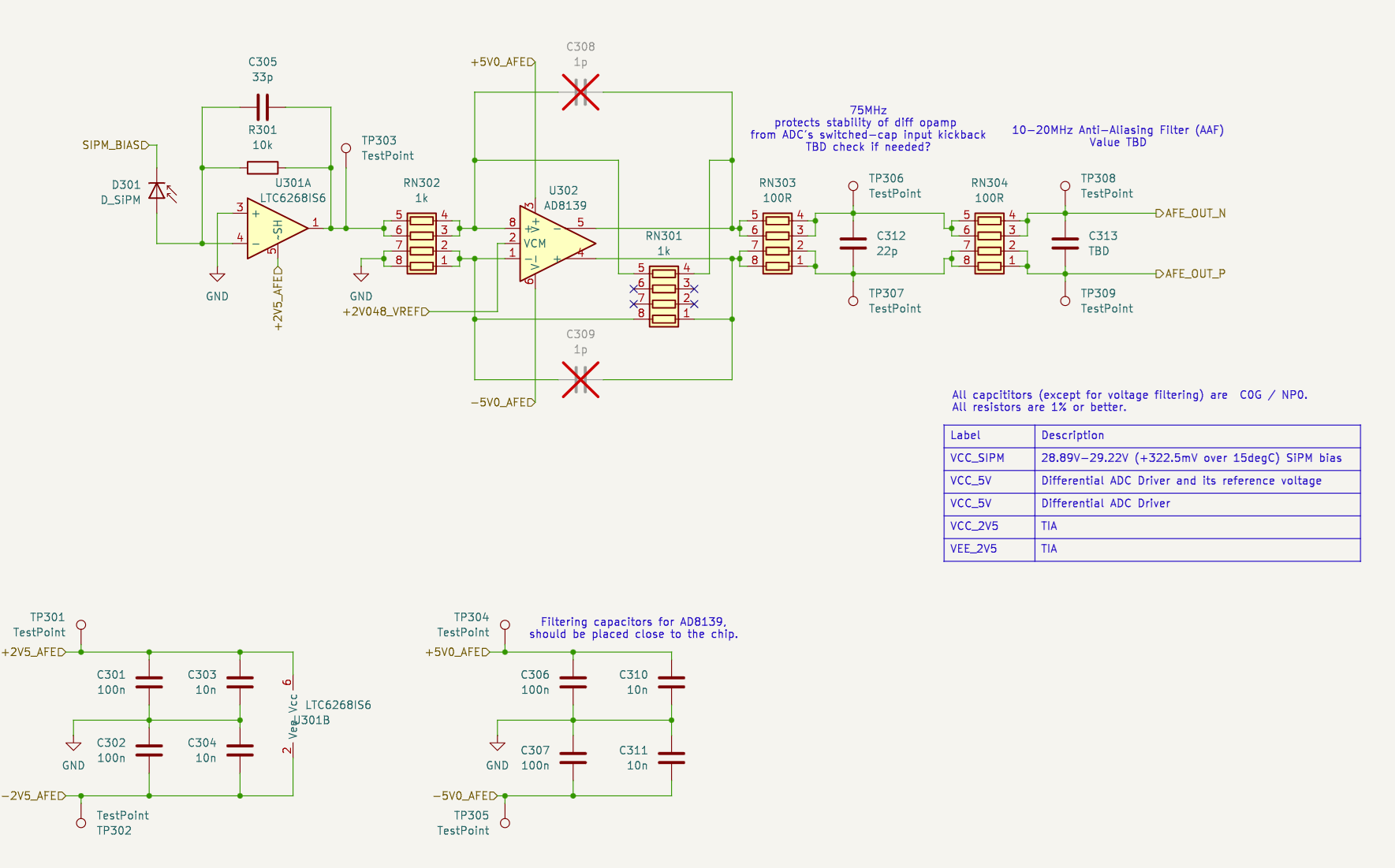
In the image below, you can see how one channel currently looks. It includes a TIA and a differential amplifier. Due to the ADC change, the element values will change, but the general idea will remain the same I think.
Discussions
Become a Hackaday.io Member
Create an account to leave a comment. Already have an account? Log In.