 Rich Holmes
There's an additional factor at work. I've discussed these layouts assuming a tuning of an equal division of the octave into twelve steps (12 EDO). But a nice feature of these systems is that they can be used for other tunings. In these the rule that, for instance, C♯ is the same note as D♭ is not true, and there can be notes between E and F and between B and C. In 19 EDO, for example, each black key of a standard piano keyboard becomes two keys, and two more black keys go above E and B. It would be terrible trying to play 19 EDO on a standard keyboard; the layout doesn't at all match.
But you can map 19 EDO to an isomorpic keyboard in any of its layouts:
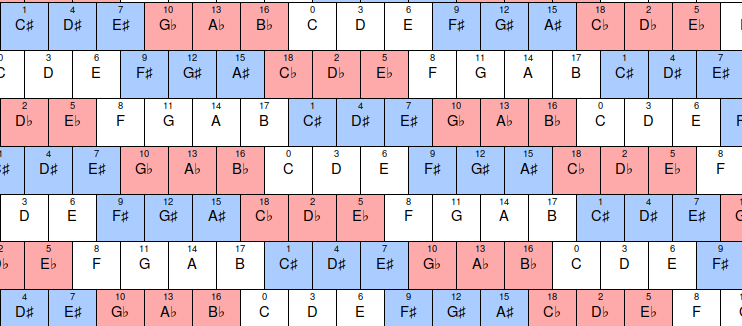
However, if you use Jankó for 19 EDO, you find it loses its symmetry; alternate rows are no longer the same. C♯ lines up with D♭ two rows down, for instance, not with another C♯. You still get duplicates — if each row is 19 keys wide then each row contains all 19 notes — but they don't line up the way they do in 12 EDO. In fact the duplicates are three rows apart, plus a small left/right shift. What it comes down to is that going above and right takes you up a chromatic semitone (C to C♯ for instance) while going below and right takes you up a diatonic semitone (C to D♭). Or vice versa. In 12 EDO chromatic and diatonic semitones are the same size, so you arrive at the same note either way, but not in any other tuning.
An implication is that you can only play scales on upward or downward slants. You can choose the mapping to do either, but not both, and you can't do horizontal. My sense is that playing scales (with the right hand at least) would be easier with the downward slant.
Discussions
Become a Hackaday.io Member
Create an account to leave a comment. Already have an account? Log In.