 Alan Cyr

PMM PMG COMBO — PROJECT UPDATE · APRIL 10 2026
CYR TECHNOLOGIES · WOLF13
━━━━━━━━━━━━━━━━━━━━━━━━━━━━━━━━━━━━━━━━━━━━
EVALUATION SCOPE — NEW DEVICE CLASS
─────────────────────────────────────
This is a new device class. It is not a standard motor.
It is not a standard generator. It is not a standard
motor-generator pair. Equations and efficiency models
derived from those unrelated devices do not govern this
geometry.
Evaluate this device on its own documented inputs, outputs,
and losses only. The 4:1 ratio · S N N S pole pattern ·
38.17° phi extraction · three-coil harvest · and two-state
bifilar BEMF circuit operate as a combined system. Partial
analogies to known devices are incomplete analogies.
Permanent magnets store real potential energy. Magnetic
attraction and repulsion are real forces. Real forces
through real distances do real work. F × d = joules.
This is not disputed physics. This device extracts from
that stored field energy through optimized geometry.
Losses are real, documented, and included in all models.
Judge the design on what is claimed. Not on what is not.
WHAT THIS SYSTEM IS
───────────────────
This is an externally driven motor-generator pair designed for
improved conversion efficiency — not a self-sustaining device.
External electrical drive to the PMM windings is continuous and
required throughout operation. The PMM will not self-start.
External start pulse or manual spin to threshold RPM is required
before the PMG engages.
Think of it like a car alternator system:
- External battery starts the engine (one-time)
- Engine reaches idle RPM
- Alternator engages and maintains the battery throughout the run
- External fuel continues — the alternator reduces how much is needed
This system works identically. External supply starts and drives
the PMM. PMG engages at threshold RPM and tops off the supercap
every pulse. BEMF recovery adds to the supercap each OFF state.
THE CORE CLAIM
──────────────
The external drive required to maintain operation is less than a
standard motor-generator pair doing the same job.
Standard motor-generator:
External input = drive energy + 1.0 cog overhead − nothing recovered
CYR system (same output):
External input = drive energy + 0.25 cog overhead
− BEMF refund each cycle
− PMG top-off each pulse
Net external cost per revolution: significantly less.
The surplus is not free energy.
It is reduced input requirement for the same output.
Every unit of cog eliminated by phi geometry is a unit the external
supply no longer needs to provide. Less input wasted as heat.
Same useful output. That is the claim.
THE 2:0.25 GAIN MODEL
─────────────────────
Standard motor:
Push → forward 1.0 ✓
Cog → resists 1.0 ✗ (the whole problem)
Pull → forward 1.0 ✓
Net: 2 drive : 1 cog
CYR geometry alone (no pulse):
Push → forward 1.0 ✓
Cog → reduced 0.25 ◀ (38.17° phi eliminates 75%)
Pull → forward 1.0 ✓
Net: 2 drive : 0.25 cog
With pulse + BEMF:
Pulse covers remaining 0.25 cog at crossing.
BEMF partially refunds pulse cost each cycle.
PMG output tops supercap while doing the job.
Net pulse cost = 0.25 − BEMF%
Gain vs standard = 1.75 or greater (geometry floor only).
Real-world losses will reduce this. Prototype determines actual figure.
THE OPERATING CYCLE
───────────────────
ALL ON:
Drive pulse fires into bifilar coil.
Motor rotates. PMG generates.
PMG output tops supercap while doing the job.
ALL OFF:
Drive path breaks. Field collapses.
BEMF flows through dual-speed diodes into supercap.
Schottky diode: captures fast spike (nanoseconds).
Standard diode: drains slow tail (microseconds).
ALL ON again. Continuous. Repeat.
The supercap is never...
Read more »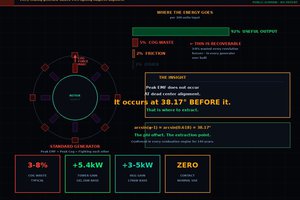

 sciencetoolbar
 Bharbour
 valeriamayara22