 Profe Tolocka

Introduction
In recent years, Meshtastic has been growing strongly in Argentina. What first seemed limited to small groups in major cities has gradually spread to new places, and today new nodes appear almost daily in different parts of the country.
At first, the first mesh networks emerged in the most populated urban centers, where it was easier for several users to be active and connect with each other. Over time, however, the idea expanded beyond those areas and began to spark interest in smaller cities and suburban environments as well.
This is exactly the case in Salsipuedes, the town where I live and work. It is a small city of just over 20, 000 people in central Argentina, located near Córdoba, one of the country’s major urban areas. Despite being close to a large city, its hilly landscape creates some of the usual challenges for connectivity, and there are still areas where communications are weak or unreliable.
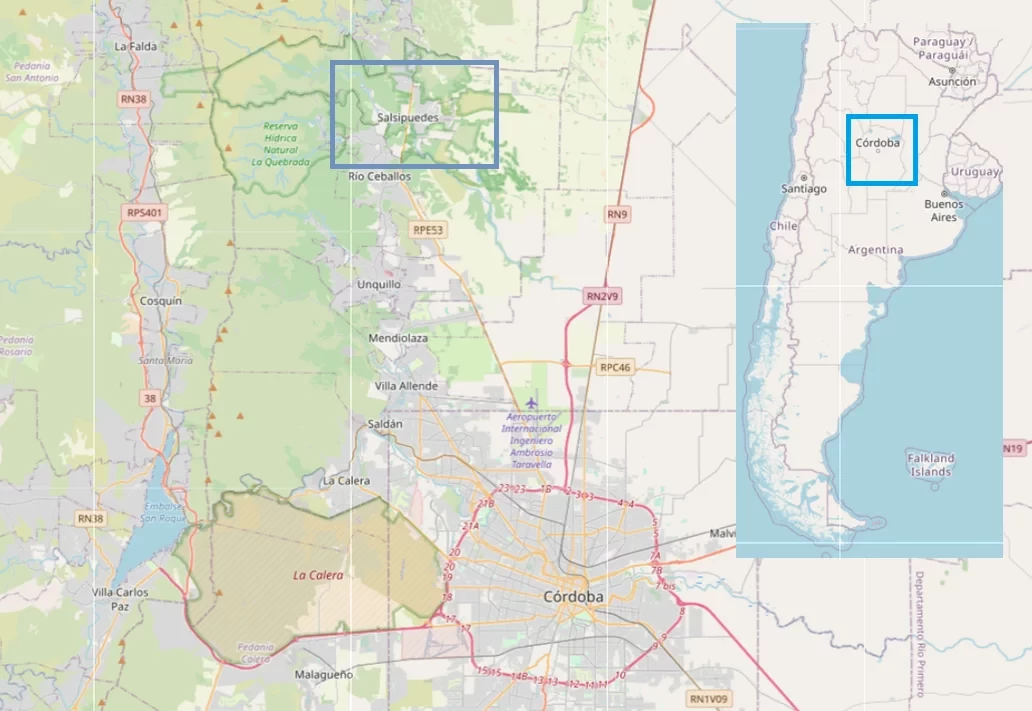
Geographic location of Salsipuedes
Another important factor is that Salsipuedes still has a strong memory of critical events, such as the major flood of 2015 and, not long after, a serious wildfire in the surrounding area that had severe consequences for some neighborhoods. These events change the way people think about communications. In an emergency, having alternative, decentralized, and resilient systems is no longer just a technological curiosity. It can become an essential tool.
In that context, Meshtastic appears as a particularly interesting option. A network like this could provide an alternative communication path in areas with poor coverage or in situations where traditional systems fail, whether because of power outages, infrastructure problems, or disruptions to services such as the Internet or cellular networks.
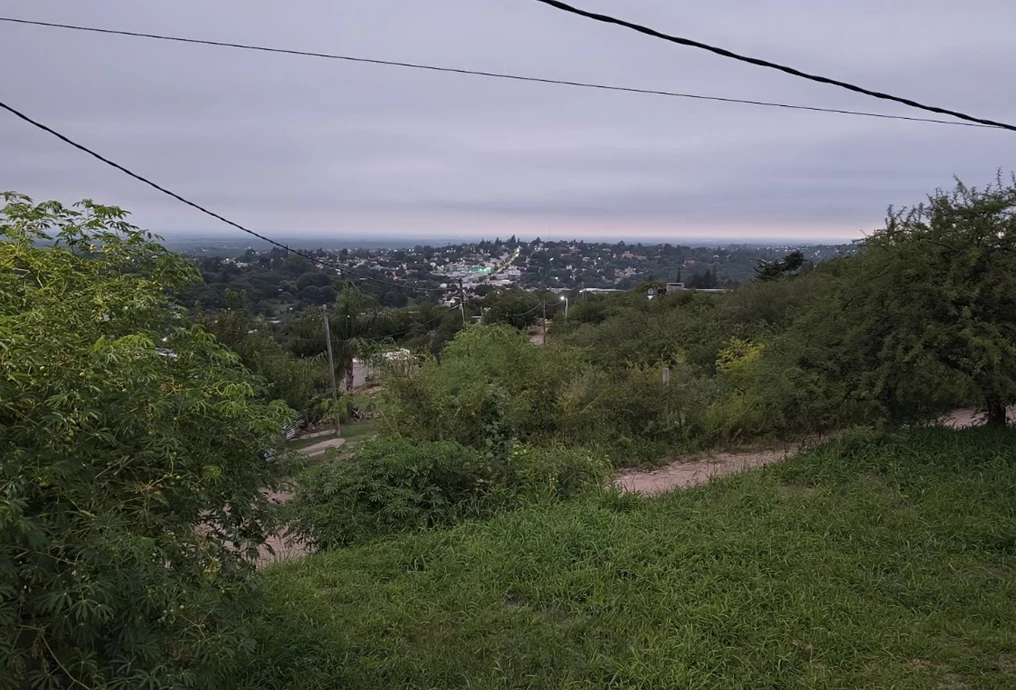
The central urban area seen from the west
By the end of last year, there were still no active public nodes in town, so I decided to start with the simplest step: running a few tests with portable nodes.
For that, I used two Wio Tracker L1 Pro devices and one SenseCAP Tracker T1000E from Seeed Studio to carry out range tests between different points in the city. Those first experiments showed quite clearly that Meshtastic had real potential as an alternative communication system in Salsipuedes.
After that experience, I began thinking about a more ambitious next step: installing fixed nodes that could serve as the foundation for a future local network. With that goal in mind, I started reaching out to different local institutions that could benefit from this kind of infrastructure, and that is how the SalsiMesh project began to take shape.
The proposal is based on the gradual deployment of nodes at strategic locations, with the goal of building a community mesh that can eventually provide coverage to a large part of the town. The project is still in its early stages and involves several local stakeholders. In future articles, I will share the progress, the tests, and the technical decisions that help shape this network.
For now, I want to tell the story of installing Node 0, the first concrete step in building this future local mesh.
Node 0
As a starting point, and with the goal of running some initial tests and gaining experience, I installed a fixed node at my home: SalsiMesh Node 0. The location is not exactly ideal. Although it sits noticeably higher than the surrounding neighborhood, it is still in a lower part of the city. Even so, I considered it a very good place to begin because having the node close to me makes it easier to try different configurations and run a series of tests to verify how it performs.
When choosing the hardware for this installation, I considered two main options: building a homemade node using a board based on ESP32 or nRF52840, along with batteries and a solar panel, or using a ready-made device. Since I wanted to avoid dealing with...
Read more »