 Ethan
Ethan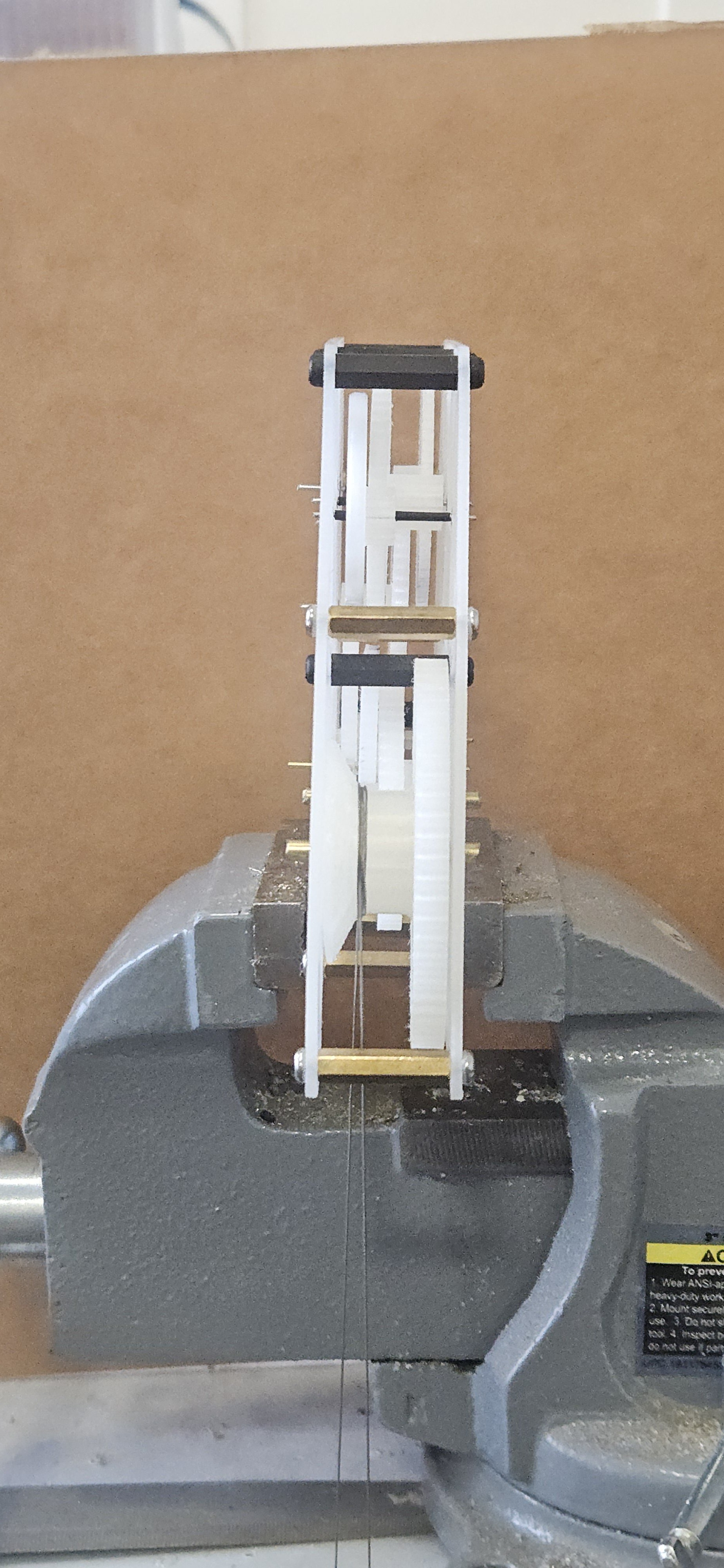
Update on the last ~week of mechanics work.
I'm using Onshape to design the mechanical setup.
I'm using a spur gear generator feature; I can't figure out how to link to it here but of the couple I've tried this is my favorite.
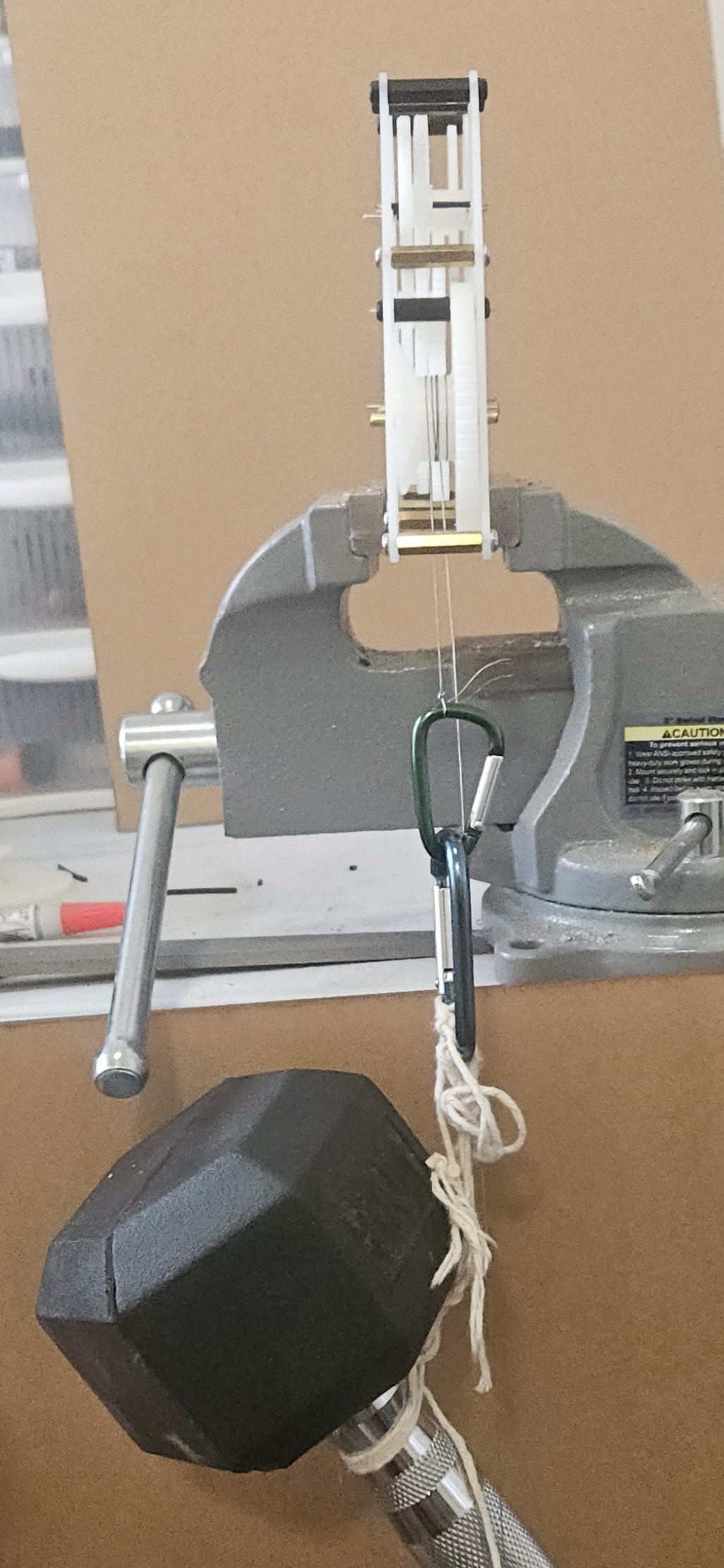
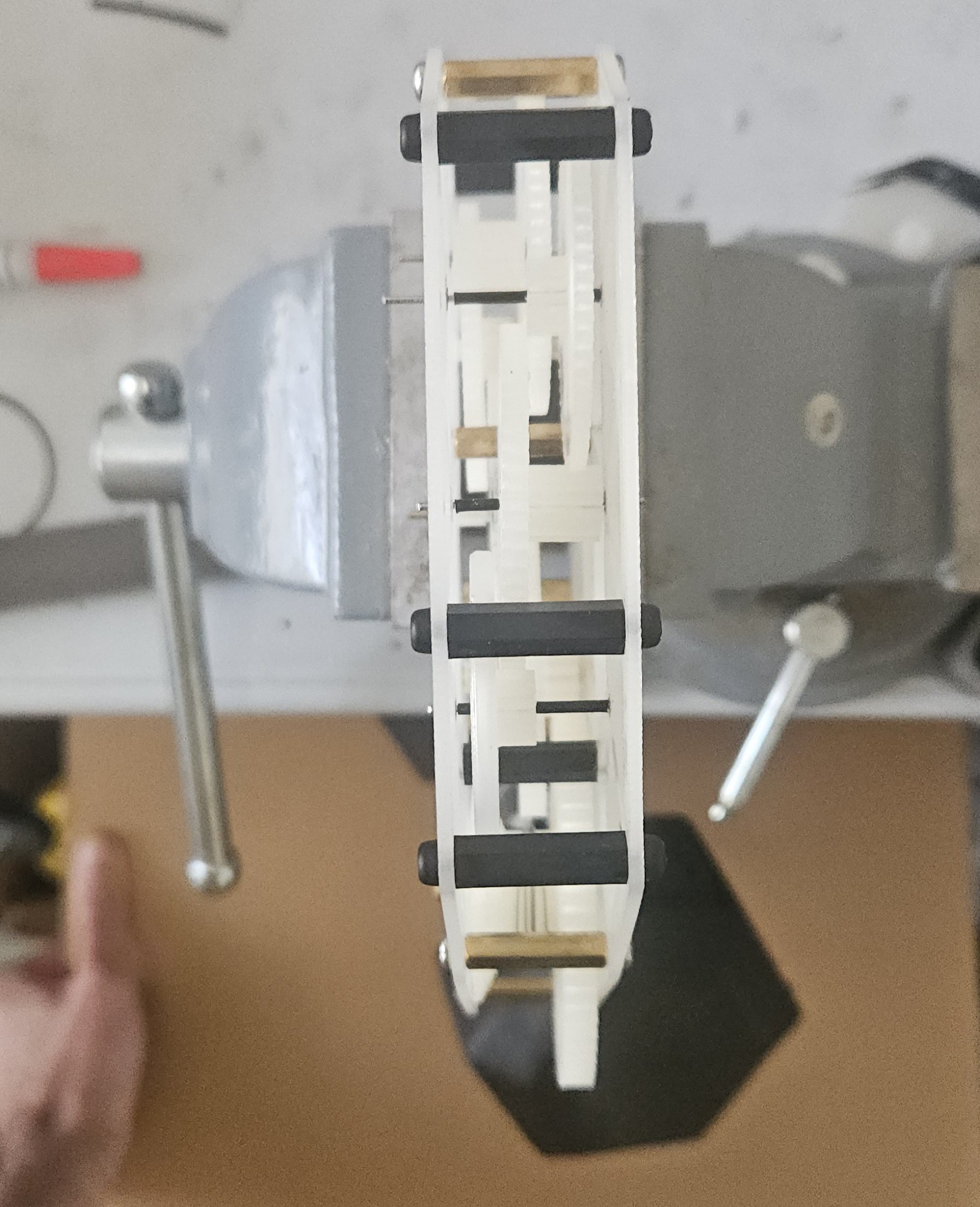
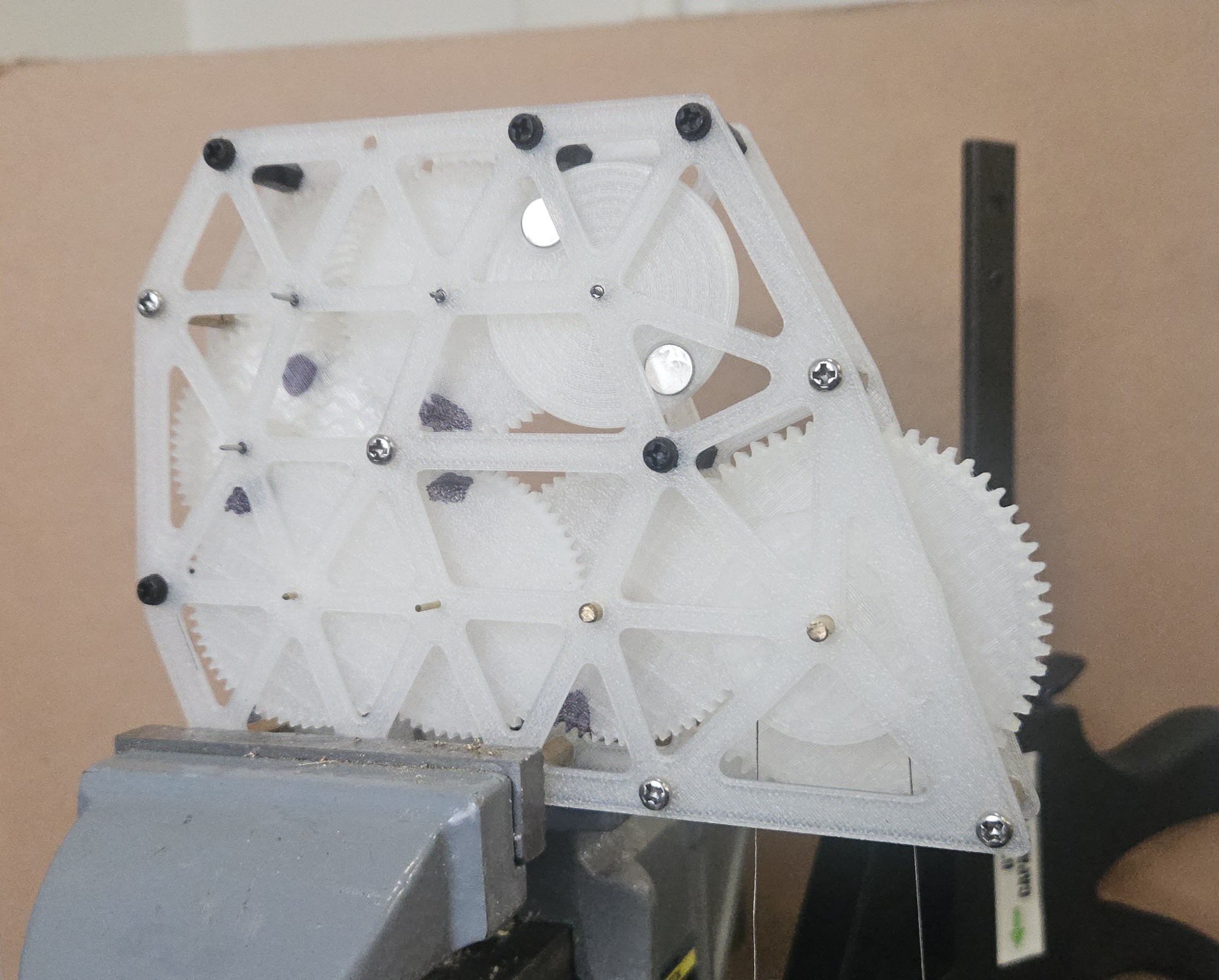
All parts shown in Onshape are 3d-printed with plain PLA. Structure is M3 threaded standoffs. Everything is set up to fit on the bed of my Bambu lab A1 mini.
Stages are a series of double-reduction idler gears:
| axle | input | output | ratio | axle | bearing | ratio, tot. |
| 1 | spool for rope | 60T gear, m=1mm | 1 | 1/8" brass rod | plain | 1 |
| 2 | 12T m=1mm | 60T, m=0.75mm | 5 | 1/8" brass rod | plain | 5 |
| 3 | 12T m=0.75 | 60T m=0.75 | 5 | 3/64" brass | plain | 25 |
| 4 | 12T m=0.75 | 60T m=0.75 | 5 | 3/64" brass | plain | 125 |
| 5 | 12T m=0.75 | 60T m=0.75 | 5 | 1mm SS | Ball | 625 |
| 6 | 12T m=0.75 | 60T m=0.75 | 5 | 1mm SS | Ball | 3125 |
| 7 | 12T m=0.75 | 60T m=0.75 | 5 | 1mm SS | Ball | 15625 |
| 8 | 12T m=0.75 | magnet disc | 5 | 1mm SS | Ball | 78125 |
Input torque is determined by charge mass and spool diameter.
The first few stages of the gear train use plain bearings -- simple brass rods from the art supply store as axles, through a bore hole in 3d-printed PLA. I'm using 1/8" and 3/64" rods for the first 2 and second 2 bearings, respectively. In these first few stages friction isn't really a concern because input torque is high.
The next 4 axles use tiny ball bearings I found on amazon. I bought them to fit into my existing design to retrofit plain bearings without really grokking how tiny these are; by far the smallest ball bearings I've ever seen. 3mm OD, 1mmID, 1mm thick. They reduce friction by a lot; hard to quantify without better testing I don't have time for, but a flicked gear spins about 4x longer than in a plain bearing. Friction becomes exponentially relevant at later stages.
Since the ball bearing ID is smaller than 3/64", I use 1mm stainless steel wire as the axles here. I pull a bit off the wire spool, chuck one end in a drill, and spin it while pulling on the wire with needle-nose pliers. This straightens it, thins the wire a little, and tapers one end for easier assembly.
Gears are spaced on axles using bushings made from 1mm heat-shrink tubing. Clearance is really important.
Discussions
Become a Hackaday.io Member
Create an account to leave a comment. Already have an account? Log In.