Mechanical television came up around the year 1931, but the experimental work has been done during the 1920s.
There are a few projects around that showcase mechanical television using a Nipkow disk.
But practically all of them use modern components like stepper motors, optical sensors, LEDs, microcontrollers or at least power transistors.
My goal is to build a mechanical TV set using parts from the real 1920s - imagining beeing an inventor 100 years ago, with no access to stuff produced after 1925.
It should also be a standalone receiver, meaning that the TV itself is only receiving and does not provide any feedback to the transmitter.
Provided possible, I am sourcing original parts from that era. A few components are so niche that it prolly won't be possible to get genuine parts. I will try to find the closest modern (or preferably just slightly younger) components that are almost identical in construction and functionality.
Good news is that the balancing resistors nicely eliminate the 60 Hz hum to an acceptable level. Bad news is that I get around 0.5Vpp of hum at 120 Hz.
I was wondering what it was, crosstalk, bad ground design, etc. Amplification works super silent with a direct 5V DC supply, so I know that the rest of the circuit is very clean. But even with the 'humdinger' resistors, this 120 Hz hum reappears despite filament AC voltage beeing a very clean sine wave. This is a known problem that vintage Hi-Fi guys, who wanna use period correct partts, struggle with until today.
The true reason is that those old tubes have a very thin, fragile filament without much thermal mass. The filament is basically "blinking" at 120 Hz (when fed with 60 Hz AC), modulating the current of the tube. I wasn't aware of that, because I'm only used to indirectly heated tubes that don't have this issue.
I found out that this was one of the reasons why mechanical TVs came so late, because indirectly heated tubes were not wide spread in the era of battery radios. However, there was a solution. Copper oxide rectifiers existed since WW1, and they have been used in the 1920s in battery chargers and battery eliminators (radio power supplies).
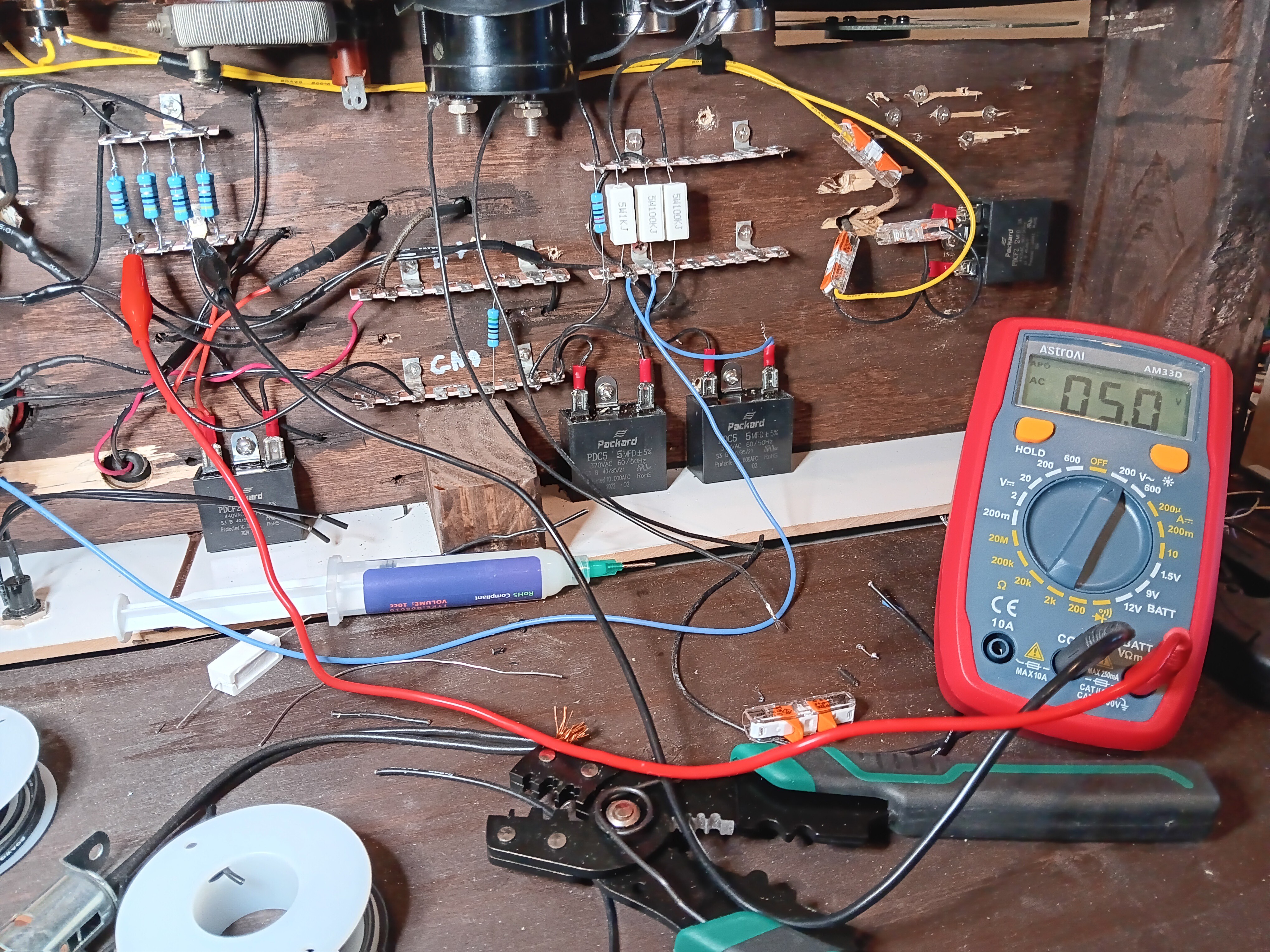
Perfect. They are low voltage/high current devices, can be perfectly used to rectify 12V AC to over 5V DC. I ordered two on Ebay for $20 and $60 (the only ones available today that won't cost over $300). One has 5 plates, one has 16 or so, but I can prolly remove some to avoid too high voltage drop. Current rating should be OK to light two 5V/0.25A filaments.
Together with a cap/choke the supply should be ripple free, at least good enough for not seeing hum bars on the image.
The two amplifier tubes UX-201A and UX-171A both need a 5.0V filament supply. The filament is directly heated, because the tubes come from an era where radios have been mostly battery powered. Indirectly heated tubes appeared in the mid 1920s, but I got the other ones already. I chose tubes that have been produced in the millions, so they are still available. And they have this nice pear shape and use those screw-on-board sockets. I wanna use them, because they come from the early 1920s and look stunning.
As the filament is the cathode of the amplifier circuit, AC voltage would introduce tons of hum. There are three common solutions to that problem:
1) use a clean, rectified DC voltage 2) use a "humdinger" pot for every tube 3) use a filament supply with a grounded center tap
I decided to use option 3 to avoid bloating up complexity by adding additional adjustments and parts. My transformer has two 6.3V supplies, so I made a symmetrical -6.3V - 0 - +6.3V supply from them.
As the tubes need 5.0V each, I used two equal 15 Ohm resistors for each supply leg to drop the voltage for each tube. It seems to work - let's see if it will be hum-free.
Wiring up the bias supplies: Two negative voltages, around -4.5V and -35V, using an old trick from the past: back-biasing. Instead of returning from chassis-ground to the transformer, you run through a resistor network to get negative voltage drop across the resistors. It's possible, because the main load is a two stage class-A amplifier, so there is a predictable average current running through it. Fluctuations are taken care of by buffering the voltages with capacitors. Grids should not draw current in nominal operating mode, so you can use very high resistor values (like 500kOhm-1MOhm) for biasing. For stabilizing the voltage, run it through a 100k resistor to a capacitor. Way back then, even small caps like 30uF were HUGE. That's why that resistor trick was VERY helpful, cause you can use an 1-2 uF cap and get same stability.
I am using big form factor capacitors on purpose. Those foil caps are available off the shelf and come close to what would be available back then regarding the form factor. You can get a 2-5uF cap for that voltage that's smaller than your fingernail, but that would have been science fiction in the 1920s, so I bought caps with same capacity but more higher voltage, as they are as chunky as the caps of same capacity way back then. Why I don't use genuine parts? Those are pretty much all degraded and non functional by now. IF I get a functional one by chance, I'll replace the modern part :) If time permits, I can stuff a modern one into an antique casing.
I am using modern resistors, as I don't know the final values yet. If the project proves worthy of beeing more original, I will replace them with 1920s parts. However, they are super rare and hard to find and quite expensive. To make it more like early 20s, I could wind resistive wire onto a ceramic tube - will prolly do that :)
Two UX-281A rectifier tubes installed and wired. Two huge balloons for a bit of DC, but that's how life's been back then. I'm glad the tubes are working. I bought three, one was toast.
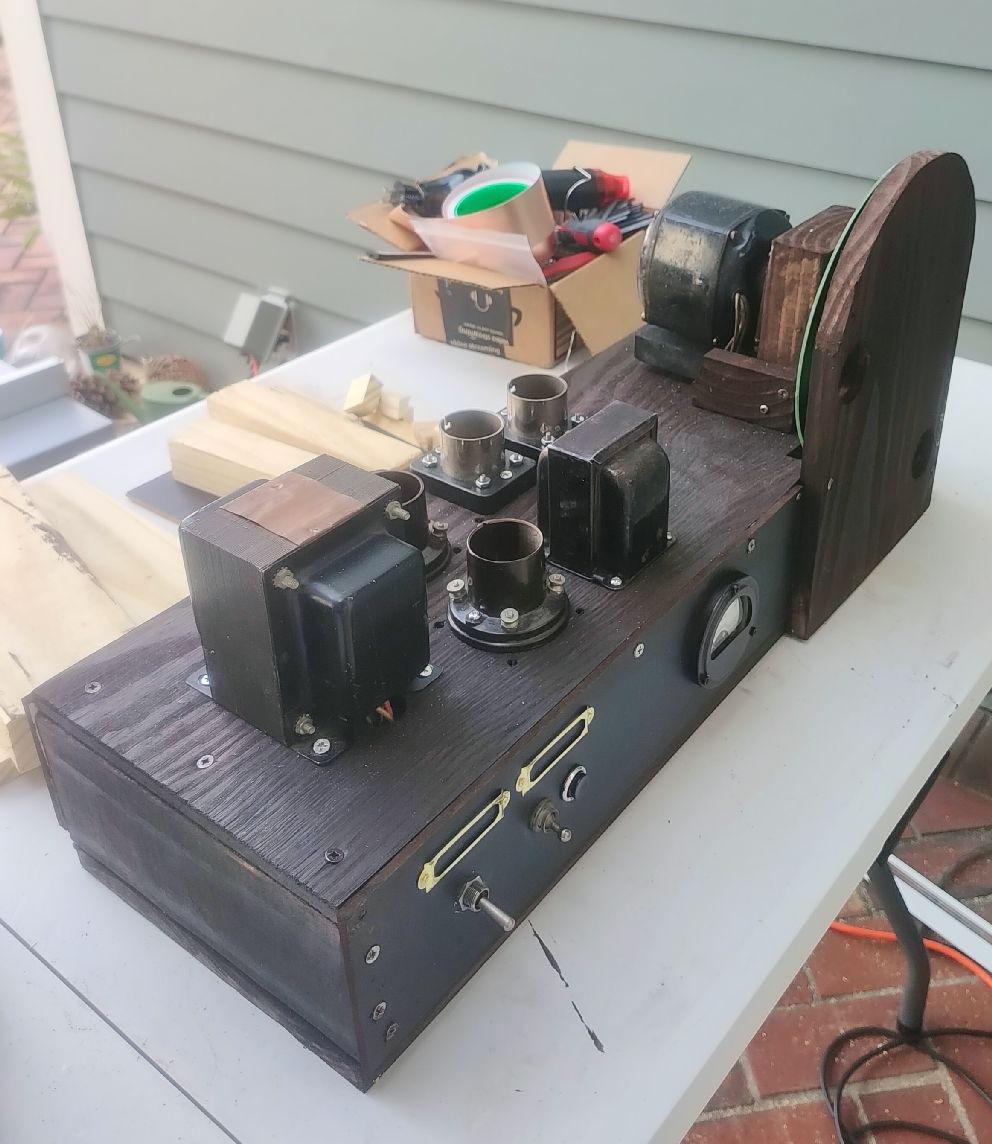
The cabinet is finished, and all the heavy parts are assembled. The neon bulb, lens fixtures and electrolytic caps are still missing - waiting for shipment, but overall the device is ready for being wired.
I never did woodwork before, neither cutting nor staining - pls don't be mad at me :-D
Just bought some wooden boards and started tinkering without a plan. Thought before making notes and 3D stuff - NOPE just start making. Not as beautiful, but it's prolly something I won't be doing every day, so just improvising here. Thought of routing some nice edges, but I'm not there yet. At least staining this thing to give it some beauty and pride - like it was standard in the old times. For sake of catching the spirit of how it must have been like "breadboarding" a 100 years ago.
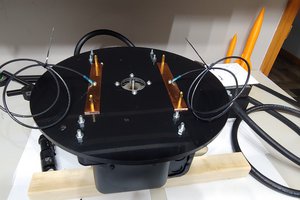
I planned to do it with aluminium externally at first, but they won't drill 0.4mm holes, so PCB was the next sane option. The disk will be mounted with a mounting hub directly on the motor axis. I could have gone with a record and hand drill, but this way is easier, and I don't want another abandoned project due to lack of free time.
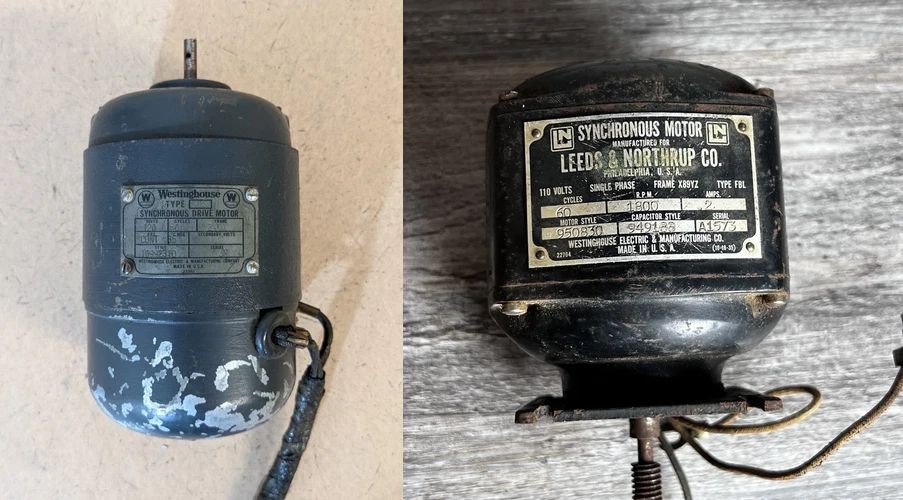
I got two synchronous motors (see previous log). The most period correct model is seized.
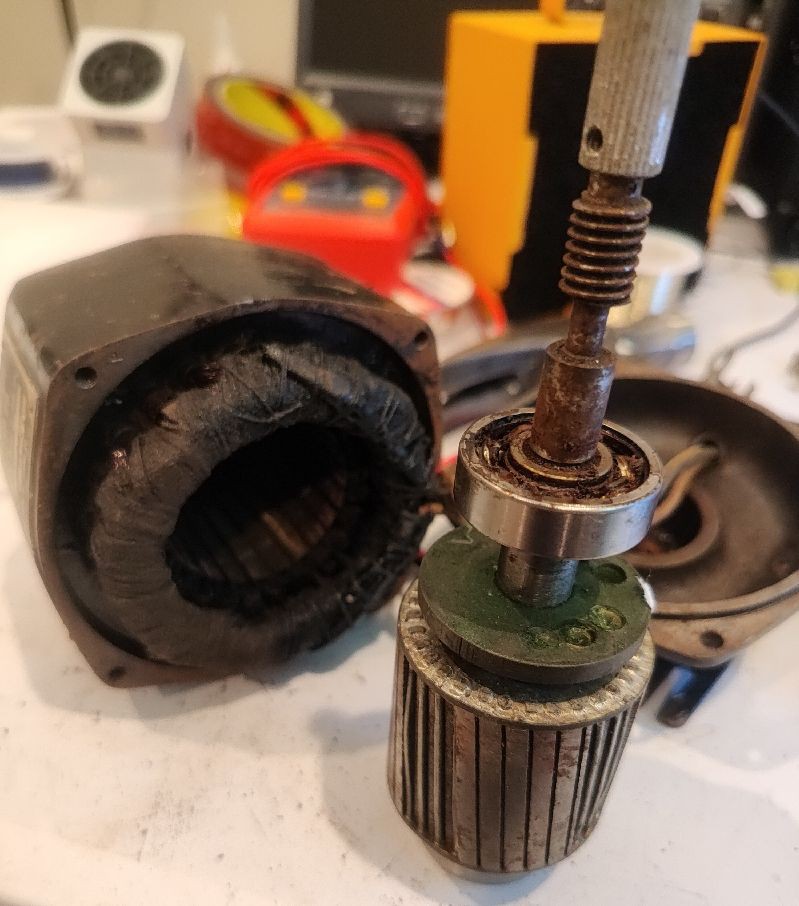
The bearings look OK, but the grease inside has hardened.
I used flux remover to get them going almost instantly. Now I am rinsing the rotor in isopropyl alcohol. The inside looks undamaged - i will just wipe it clean from eventual rust particles and will not give it any other treatment. The windings measure good.
Found out that Baird used synchronous motors after it's been proposed that the US should have a phase synchronized 60Hz grid. At first, the electricity companies didn't want to have an additional burden for zero benefit, but it's been adopted very soon, as it proved beneficial, because they could use the grid to compensate for failures and power lacks.
I decided to go with a synchronous version for the first try. I was able to source two synchronous motors (however untested). The one on the right looks period correct (early 30s ?, identical versions existed mid 20s), the left one is a backup. Let's see if they work. It's the best substitute I can get, and it's what they were able to buy off the shelf back in the mid 20s.
They will lock onto the 60Hz which will make things MUCH easier. However, you can't guarantee the phase at start. Depending on the number of poles (4,6,8), it might lock in a different position.
I guessed this could be compensated for by either rotating the whole motor assembly (has been done), or by briefly interrupting the power supply for a quick moment. And yes, looks like Baird did that as well. There was a push button that the user had to tap a few times, until the motor locked to the correct phase. I found a picture where he uses a synchronous motor in his late 1920s setup that looks pretty much identical to the one on the left.
Fingers crossed that those motors are OK, as finding an old synchronous motor of that type is not easy.