Mechanical television came up around the year 1931, but the experimental work has been done during the 1920s.
There are a few projects around that showcase mechanical television using a Nipkow disk.
But practically all of them use modern components like stepper motors, optical sensors, LEDs, microcontrollers or at least power transistors.
My goal is to build a mechanical TV set using parts from the real 1920s - imagining beeing an inventor in that era with access to the stuff only available back then.
It should also be a standalone receiver, meaning that the TV itself is only receiving and does not provide any feedback to the transmitter.
Provided possible, I am sourcing original parts from that era. A few components are so niche that it prolly won't be possible to get genuine parts. I will try to find the closest modern (or preferably just slightly younger) components that are almost identical in construction and functionality.
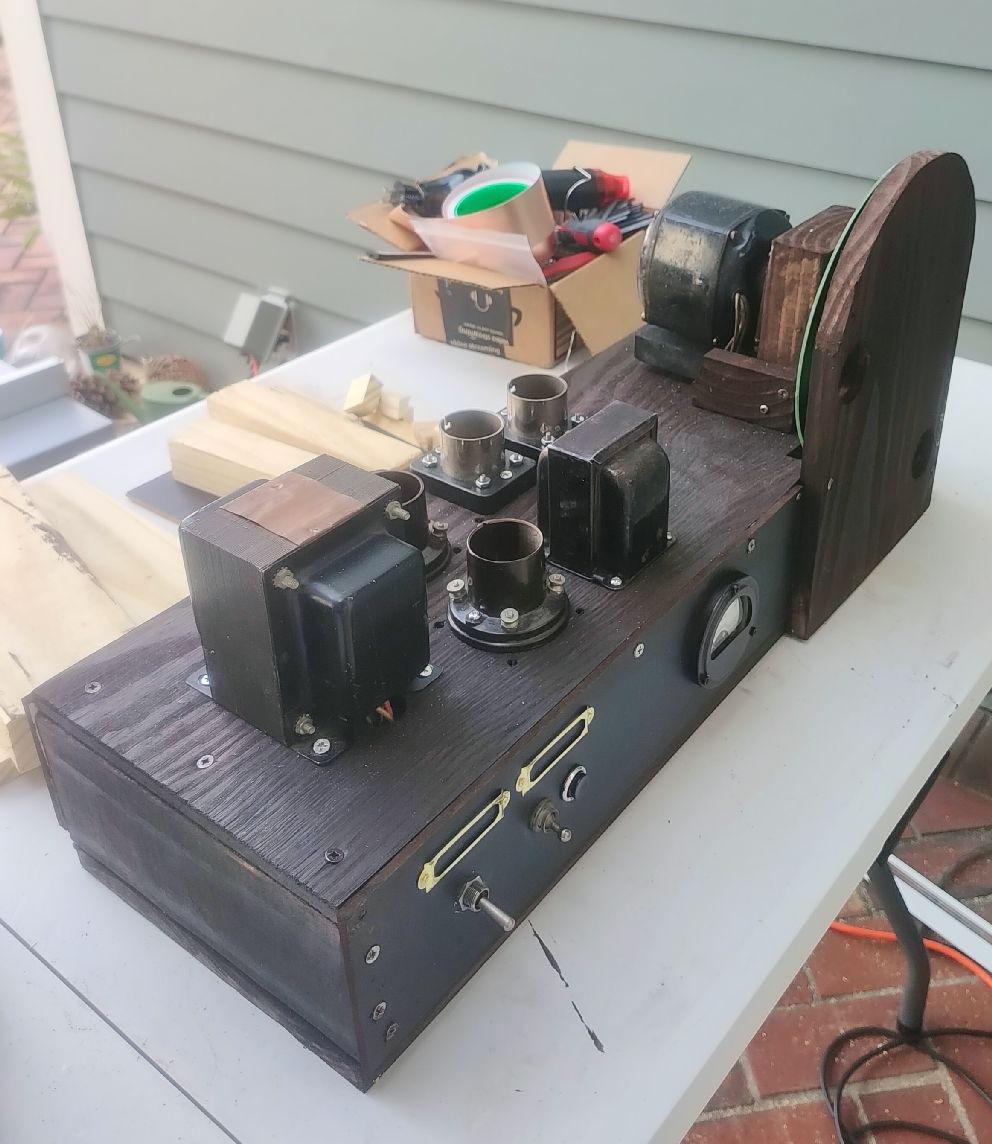
The cabinet is finished, and all the heavy parts are assembled. The neon bulb, lens fixtures and electrolytic caps are still missing - waiting for shipment, but overall the device is ready for being wired.
I never did woodwork before, neither cutting nor staining - pls don't be mad at me :-D
Just bought some wooden boards and started tinkering without a plan. Thought before making notes and 3D stuff - NOPE just start making. Not as beautiful, but it's prolly something I won't be doing every day, so just improvising here. Thought of routing some nice edges, but I'm not there yet. At least staining this thing to give it some beauty and pride - like it was standard in the old times. For sake of catching the spirit of how it must have been like "breadboarding" a 100 years ago.
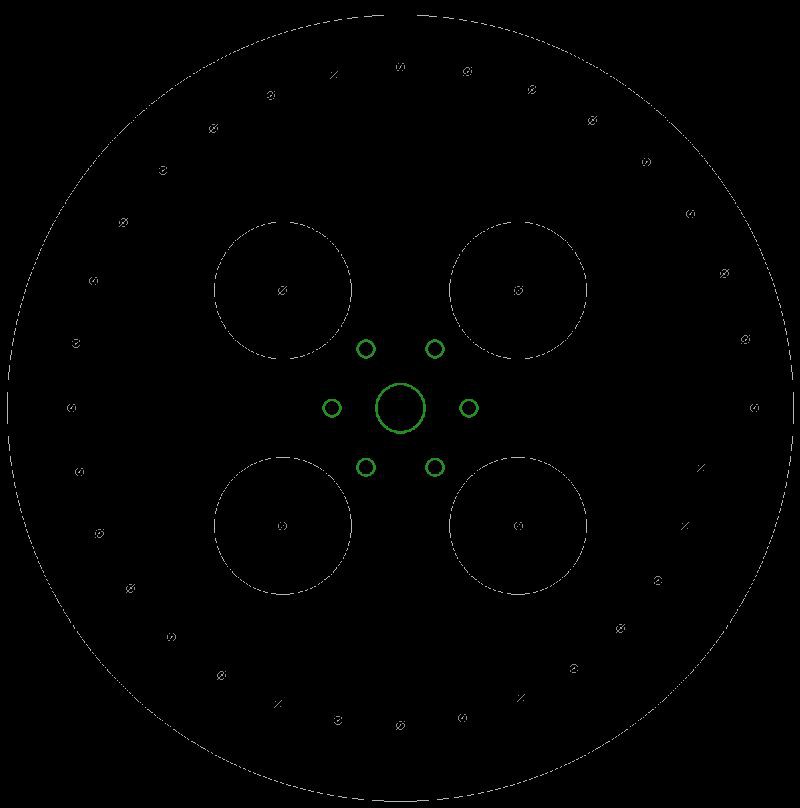
I planned to do it with aluminium externally at first, but they won't drill 0.4mm holes, so PCB was the next sane option. The disk will be mounted with a mounting hub directly on the motor axis. I could have gone with a record and hand drill, but this way is easier, and I don't want another abandoned project due to lack of free time.
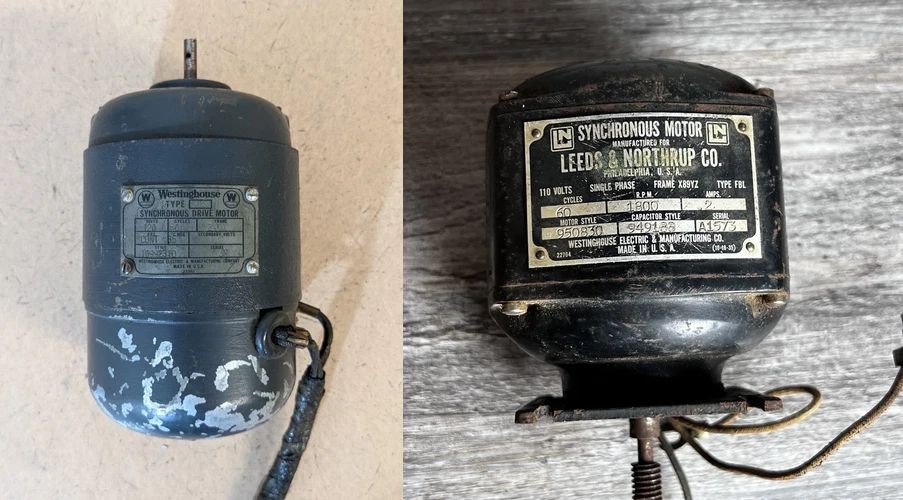
I got two synchronous motors (see previous log). The most period correct model is seized.
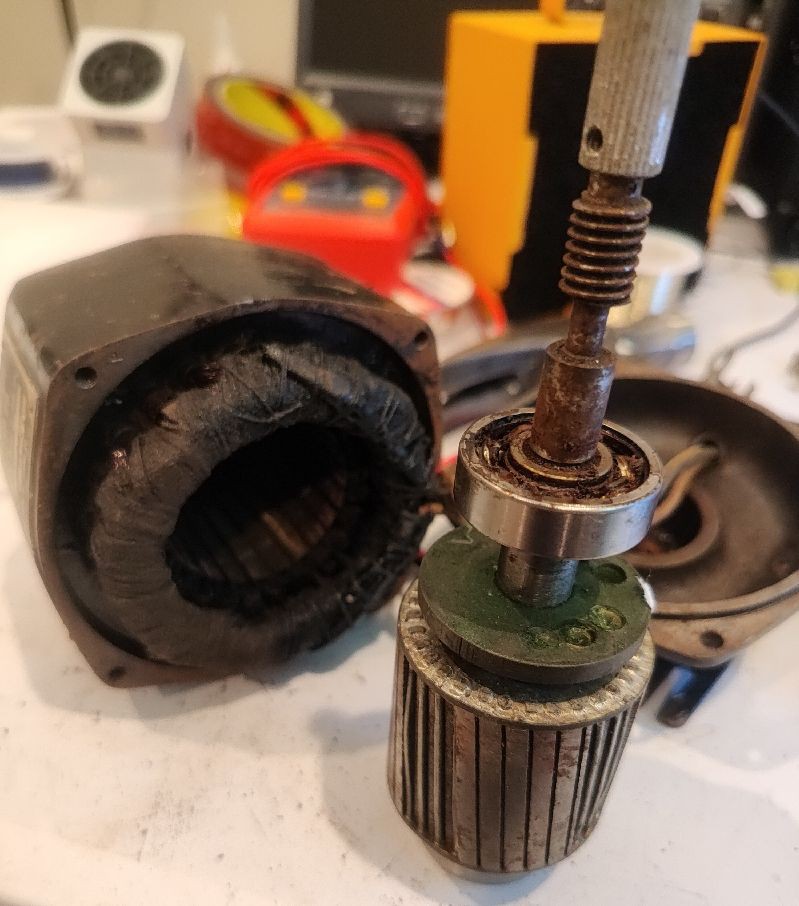
The bearings look OK, but the grease inside has hardened.
I used flux remover to get them going almost instantly. Now I am rinsing the rotor in isopropyl alcohol. The inside looks undamaged - i will just wipe it clean from eventual rust particles and will not give it any other treatment. The windings measure good.
Found out that Baird used synchronous motors after it's been proposed that the US should have a phase synchronized 60Hz grid. At first, the electricity companies didn't want to have an additional burden for zero benefit, but it's been adopted very soon, as it proved beneficial, because they could use the grid to compensate for failures and power lacks.
I decided to go with a synchronous version for the first try. I was able to source two synchronous motors (however untested). The one on the right looks period correct (early 30s ?), the left one is a backup. Let's see if they work. It's the best substitute I can get, and it's what they were able to buy off the shelf back in the mid 20s.
They will lock onto the 60Hz which will make things MUCH easier. However, you can't guarantee the phase at start. Depending on the number of poles (4,6,8), it might lock in a different position.
I guessed this could be compensated for by either rotating the whole motor assembly (has been done), or by briefly interrupting the power supply for a quick moment. And yes, looks like Baird did that as well. There was a push button that the user had to tap a few times, until the motor locked to the correct phase. I found a picture where he uses a synchronous motor in his late 1920s setup that looks pretty much identical to the one on the left.
Fingers crossed that those motors are OK, as finding an old synchronous motor of that type is not easy.
The easiest way would be to use a synchronous motor. This technology was known back then, and they have been used for instrumentation. However, they were not very common, and it's very hard to get one from that era. I found one from the late 1930s - only one... I ordered it for playing around with it, though, but I tend to go with induction motors that were very common in the 1920s. It will be interesting to build a synchronization system for it as well.
Getting one from that time is trivial.
Induction motors from the 1920s in working condition can be sourced from Ebay for $50-$100.
An induction motor has no brushes, and it´s very reliable.
- it is rotating at around 1700 RPM, but the speed varies with load - it´s not fully synchronous with the mains
- when it's sped up or slowed down by force, it will change the phase, but it will catch up again to original speed
Both is important for synchronization. A common method was the "phonic motor" approach: You mount a steel gear sprocket (or a rod in the simplest case) on the axis and two electromagnets on opposite sides.
When a synchronization pulse occurs, the coils will try to align the sprocket along the axis of the magnetic field.
When the motor is already spinning very close to the image frequency, the coils will lock its phase into place.
Light Source:
The practically usable source from that era that can be modulated fast enough is a gas discharge lamp. Neon was the choice back then, and it was the most commonly used technology for mechanical TV.
It gets a bit harder here. There have been specialty bulbs available that had big rectangular plates, designed for mechanical television: https://www.earlytelevision.org/neon.html
But good luck finding those nowadays. I found a single one on Ebay for $300, untested, and I don't even know if the seller is genuine. I found out that amateurs used beehive style glow lamps like the "Osram osglim" - but I can't find any on Ebay. If you have one of those and wanna sell it, please make me an offer. Same for the big plate tubes.
There are bulbs with somehow bigger plates available, though slightly younger, 40s-60s. Smaller bulbs are even more common - maybe using a lens or a reflector will help? I also found a modern style "smiley face" neon bulb with big electrodes. Same stuff, might work as a modern replacement. An old part would be of course better, though.
Synchronization:
I wrapped my brain around the synchronization circuit, checked suitable vacuum tubes, but it's in an early stage for now.
First TVs of that era did not even have a synchronization signal. They just filtered the scanline frequency from the video signal to pulse the synchronization coils. This worked only if there was an image with good contrast coming in. If it was dark for a second, the whole system drifted out of phase. I definitely want to add a proper synchronization strategy.