 Paul Kocyla
Good news and bad news:
Good news is that the balancing resistors nicely eliminate the 60 Hz hum to an acceptable level. Bad news is that I get around 0.5Vpp of hum at 120 Hz.
I was wondering what it was, crosstalk, bad ground design, etc.
Amplification works super silent with a direct 5V DC supply, so I know that the rest of the circuit is very clean. But even with the 'humdinger' resistors, this 120 Hz hum reappears despite filament AC voltage beeing a very clean sine wave. This is a known problem that vintage Hi-Fi guys, who wanna use period correct partts, struggle with until today.
The true reason is that those old tubes have a very thin, fragile filament without much thermal mass.
The filament is basically "blinking" at 120 Hz (when fed with 60 Hz AC), modulating the current of the tube.
I wasn't aware of that, because I'm only used to indirectly heated tubes that don't have this issue.
I found out that this was one of the reasons why mechanical TVs came so late, because indirectly heated tubes were not wide spread in the era of battery radios.
However, there was a solution. Copper oxide rectifiers existed since WW1, and they have been used in the 1920s in battery chargers and battery eliminators (radio power supplies).
Perfect. They are low voltage, high current devices, can be perfectly used to rectify 12V AC to over 5V DC. I ordered two on Ebay for $20 and $60 (the only ones available today that won't cost over $300). One has 5 plates, one has 16 or so, but I can prolly remove some to avoid too high voltage drop. Current rating should be OK to light two 5V/0.25A filaments.
Together with a cap/choke the supply should be ripple free, at least good enough for not seeing hum bars on the image.
Update: I tried to full-wave rectify with modern components, using diodes and a 100uF cap - and guess what: SAME PROBLEM :-D
OK, further research revealed that the battery eliminators back in the day used either massive coils with low resistance to solve it, or they used messy electrolytic cells as "filter batteries".
The cleanest so far were small 6V lead acid batteries that were just charged in the background through a resistor and acted like a giant filter.
I will try this next. I will try whatever helps. The easiest way would be to use indirectly heated tubes, but NO, I will not give up yet. Challenge is to stay in the lower 1920s and feel the pain they had...
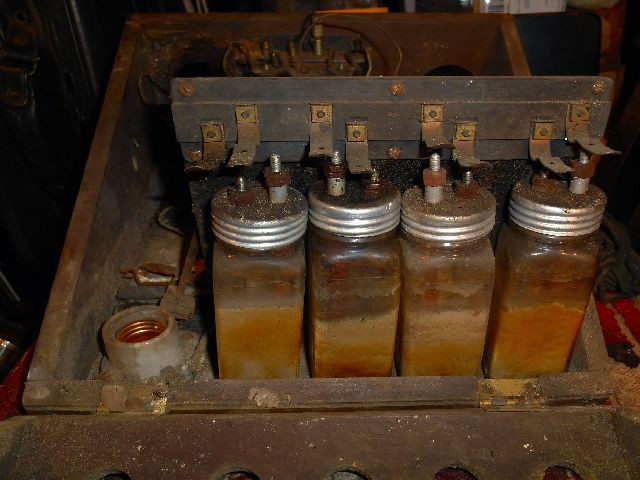
I found a picture of an early battery eliminator, and yes, it's got battery jars in there to solve exactly that problem. To be fair, I am not quite sure if those jars in the image are the actual battery cells or a messy electrolytic rectifier. Just read that this cheap form of rectification was a thing, too - updates will follow...
This has to be the reason why indirectly heated filament tubes have been invented when the power grid was getting available everywhere - it's cheaper than those dirty workarounds. But OK, I'll do the dirty workaround because why not:
Discussions
Become a Hackaday.io Member
Create an account to leave a comment. Already have an account? Log In.
Wow that's an interesting phenomenon. Thanks for explaining. 👍
Are you sure? yes | no