 Tsuneo.Ohnaka
Dedicated to Jenny List and our commenters, as a token of my appreciation for the feature in Hackaday magazine.
This log, unlike the ones usually written for me by my excellent aide-de-camp and scribe Claude Opus 4.x, is being written by my own flesh-and-blood hand. The reason is simple: I am writing this as a thank-you to Jenny List, who on May 6th adopted this project into the magazine, and to the four comrades who left comments.
The first half reads almost like a Mr. Bean comedy, but after a song I made on Suno about FPGAs, the second half will leak plenty of plans never before announced in these logs. I hope you'll enjoy it, my friends.
So — five years ago, I was at the very bottom of despair. It was exactly the kind of horrifying scenario KenN and Felix Domestica described in their comments: the vision of what awaits you if you charge straight ahead down this path.
These apparent 10,240 oscillators will, of course, produce no sound unless their frequency and amplitude are written in. Strictly speaking, they are operating even without that — but the sound they emit has frequency and amplitude of "zero." So, in order to somehow configure them, I built a 10,240-row Excel sheet, output a composite string-operation result into one column according to a certain rule, and copy-pasted that column to create a text file in the ".mif" format, which is the dedicated memory-data format for the FPGA's internal memory. Ten thousand two hundred and forty rows, of course. Then I wrote it into the bin parameter memory inside the FPGA via JTAG. Write it, and it makes sound.
But — as you can probably imagine — it was a depressing task… And in that task, two forces were at war: the element that stimulated creativity and made dopamine flow, and the element that clogged dopamine. Needless to say, the latter was stronger.
I thought: I need, right now, that thing I used to dream about as a young man — that thing I'd never actually touched in real life. The thing on a Hammond organ or a pipe organ that thrills a boy's heart: the "drawbar." The drawbars I had longed for.
But in the very next moment, my mind froze. Frequency and phase could be hard-coded — but for the amplitude parameter, I would need 10,240 drawbars. If I bought slide-pots and knobs for this, each would surely cost at least 200 yen, so 10,240 of them would come to 2,048,000 yen. Even if I split them into panels and PCBs of 32 each, that would mean 320 panels. How much would that cost…? Back then there were no clever AIs to do the math for me, so it was a chore even to estimate, but I had the feeling it would cost at least five million yen. Five million yen… probably twenty years of my disposable income.
OK, "let's set the money question aside for a moment…" — but just as I was starting to think that, the next despair struck. The spacing between drawbars needs to be at least 3 cm. So 32 per panel works out to about 96 cm. 96 cm… "That's not bad, actually…" That was the kind of Hammond-organ-ish dimension I had always dreamed of. But… I would need 320 of these panels. In other words, if I lined them up side by side, the result would be 307 meters and 20 centimeters. Even cramming them as tight as possible, 300 meters. It would not fit in my workshop. Nor in the local park. Nor on the elementary-school playground.
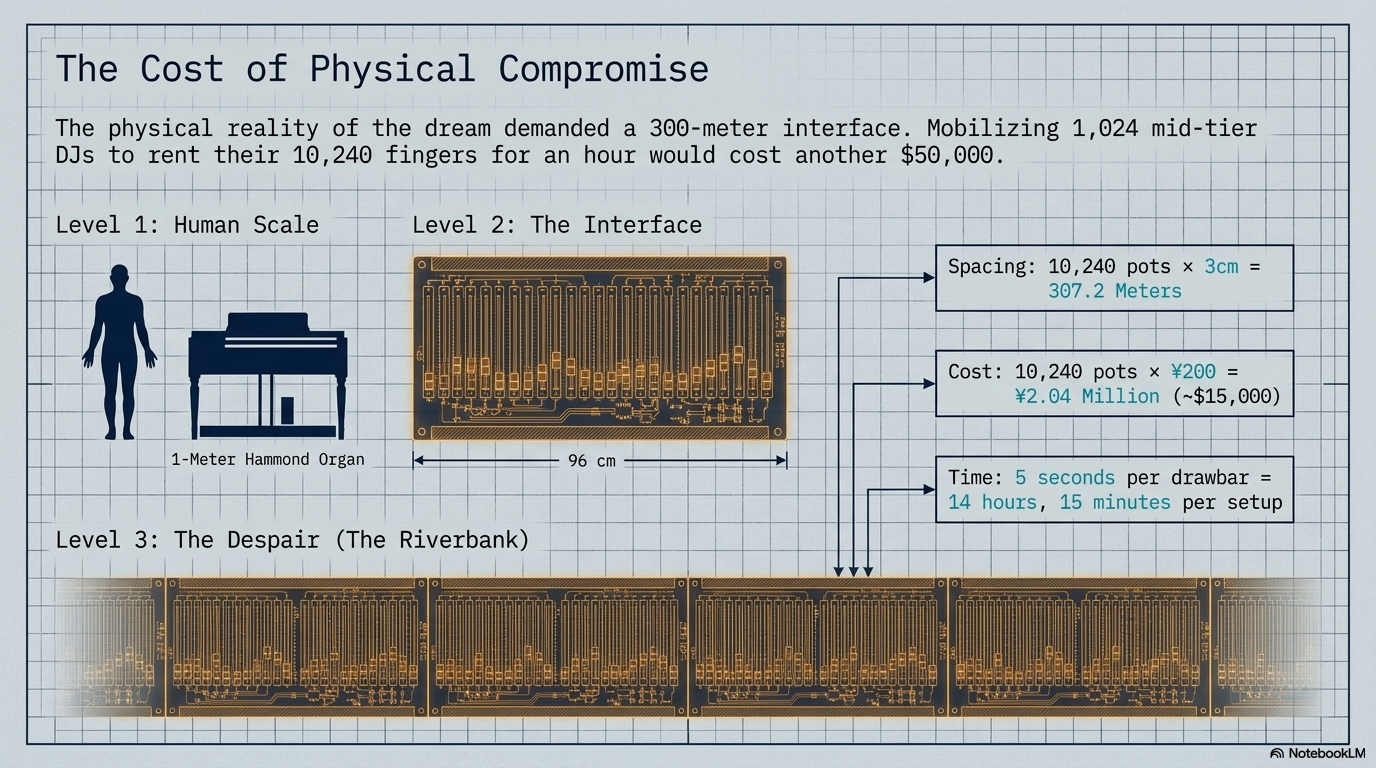
"The riverbank…" That word became, as a solution, a great consolation to my deep psyche. I never imagined the day would come when I would feel such consolation from the word "riverbank." But 300 meters isn't "long." At that point, it's "far." Even if I set each drawbar with veteran-level skill in 5 seconds, the whole operation would take about 14 hours and 15 minutes. Adding in breaks and meals, starting at 8 in the morning, it would last until midnight. After a single experiment, I would probably have wrecked my back. Using all ten fingers at full capacity… that just shortens the time to 90 minutes and saves my back — but what else, exactly, does that solve?
If I mobilized 1,024 mid-tier DJs and rented their 10,240 fingers for one hour, that might cost another five or ten million yen on top… The thousand-armed Kannon… would she come? Even if she did, that's 5,000 fingers. We'd need two of her. Does this world even contain two Senju Kannons to begin with? And even if it did, for the remaining 240 fingers, we would still need 24 veteran DJs.
When I started this fantasy, I will admit a flicker of approval-seeking lit up — "If I actually pulled this off, it'd go viral on YouTube and Twitter." But once I woke from the fantasy, all that remained before me was an endless "riverbank" of despair…
In other words: it's easy to say "10,240" — but the philosophy of having 10,240 oscillators sitting there in front of you means having to overcome things like this…
The version of me from five years ago, unable to bear the terror of that despair, retreated to a spec of 80-voice polyphony with all voices receiving a gross of 128 drawbars set in MAX8 — and even then, my heart broke at 32 out of those 128 and I became a "chicken." That is the figure of me captured on that five-year-old video.
--------------------- Interlude (Make with Suno)------------------------------
Five years passed. And then — like Columbus crushing the bottom of an egg on a table — an idea came to me.
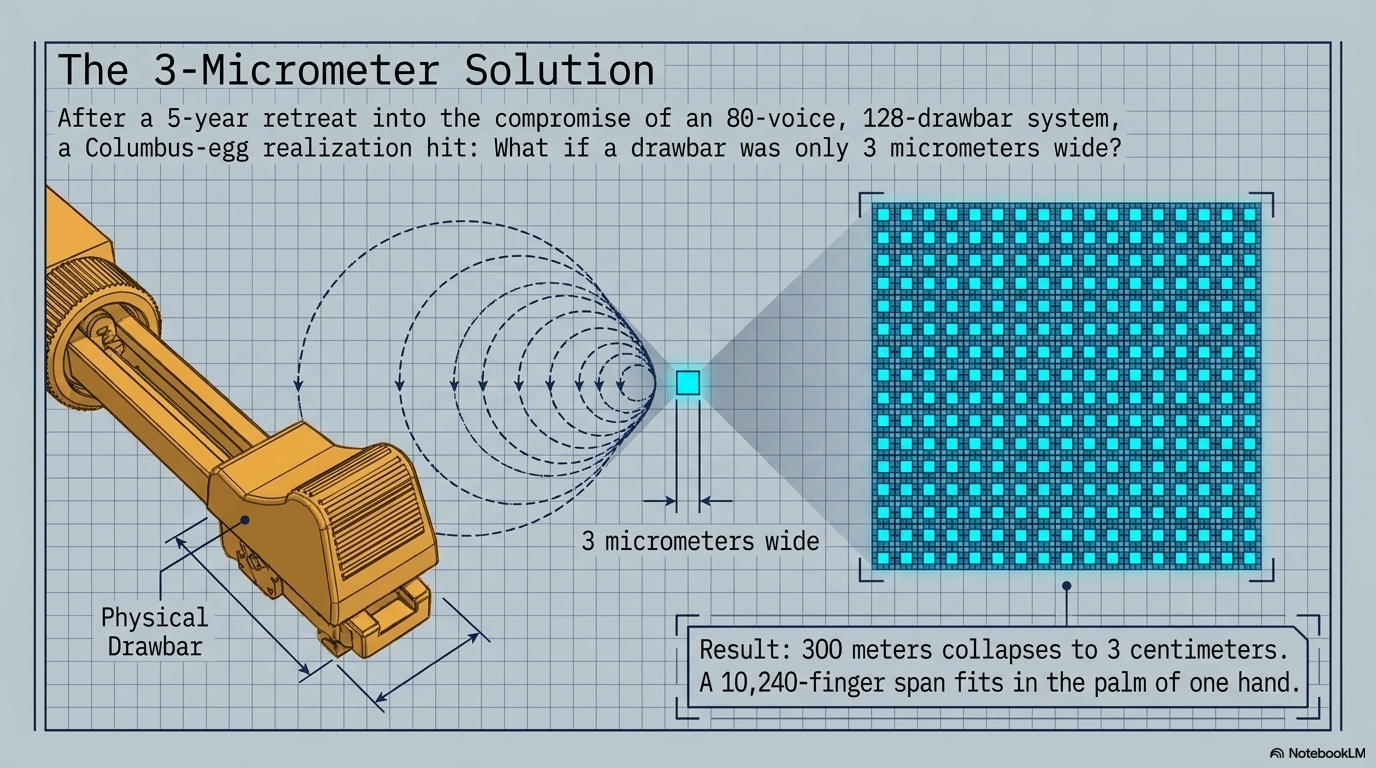
"What if each drawbar were only 3 micrometers wide?"
— a stroke of genius. How did I not realize this for five whole years…? If so, even 10,240 drawbars lined up in a row would total only 3 centimeters. At 3 cm, I can grip the whole thing in my five fingers — and at the same time I can extend those five fingers to 10,240, or further still to more than 300,000. And not only can I set each one consciously, one by one — I can also coordinate them more abstractly and operate them all together, in a single sweep.
The thousand-armed Kannon existed after all. And on Amazon, no less! And her astonishing price was — 500 yen!? The expensive variants, 5,000 yen. Order one and it's delivered the next day by drop-off. Not five million yen. 500 yen. I shall pronounce her name with proper reverence.
"OV7670"!
It is commonly called a "camera module." But, with greater respect, let me call it by another name.
"The Optical Drawbar."
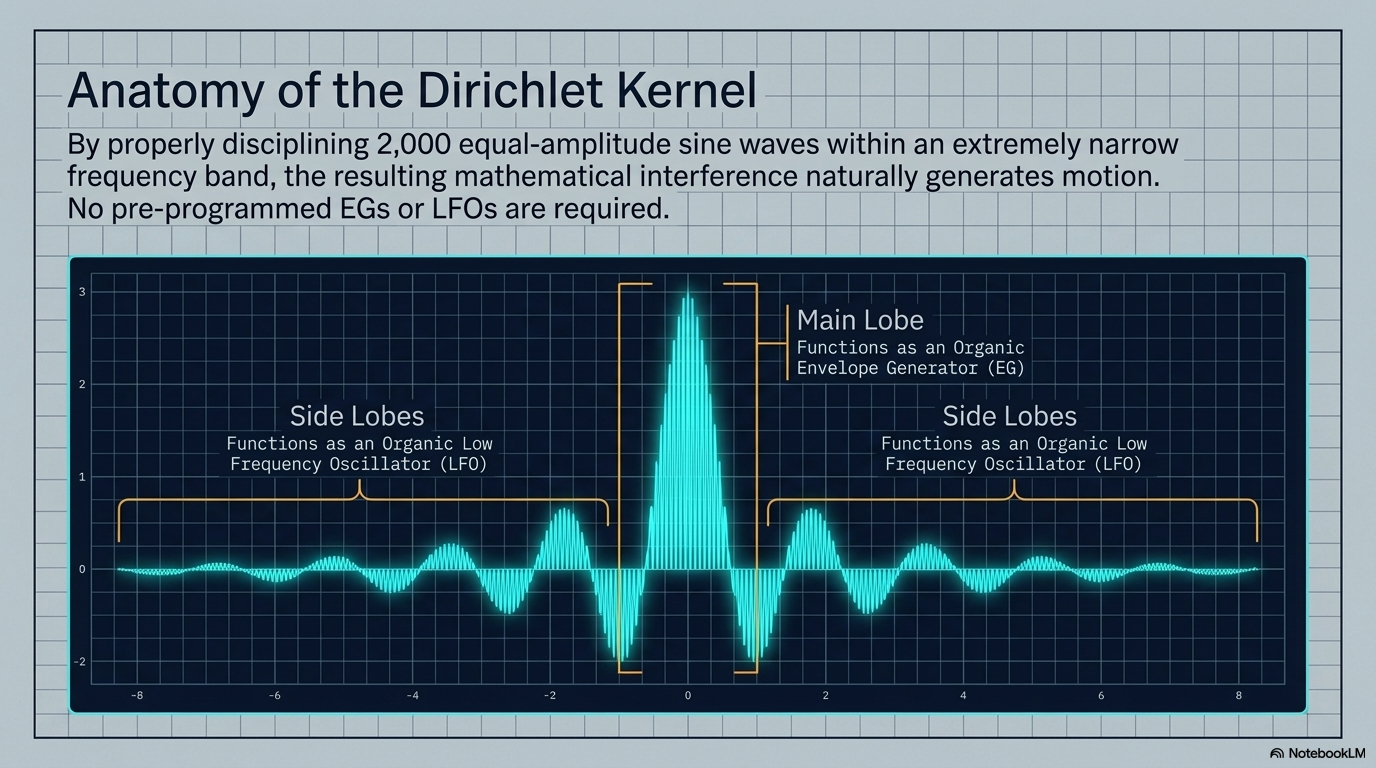
The despair I felt about the sound of this additive synthesizer five years ago was exactly what KenN and Felix Domestica described in their comments. You speak completely for the me of five years ago. So I felt nothing but the deepest sympathy with your comments. And what reignited me? It was this: the phenomenon I had actually achieved five years ago but had sealed away believing "this must be some kind of bug" — Claude, Gemini, and ChatGPT all said in unison, in astonished tones: "That is proof of great success." "That is a physical phenomenon called the Dirichlet kernel." And they told me it is the purest chorus in this world, obtained when a well-disciplined choir of more than 2,000 honor students sings a packet of frequencies arranged in an extremely simple arithmetic sequence, properly and with high precision. And although it consisted of nothing but equal-amplitude sine waves in an extremely narrow band — 996 Hz to 1004 Hz, centered on 1000 Hz — I could see motion that looked exactly as if there were an EG and an LFO right there inside it. The clever AIs called these the main lobe and the side lobes. What beautiful words! Exciting words — words I had never heard before in the world of synthesizers. And so I decided: I will not synthesize harmonics. This. I will synthesize this.
And then — defile it…
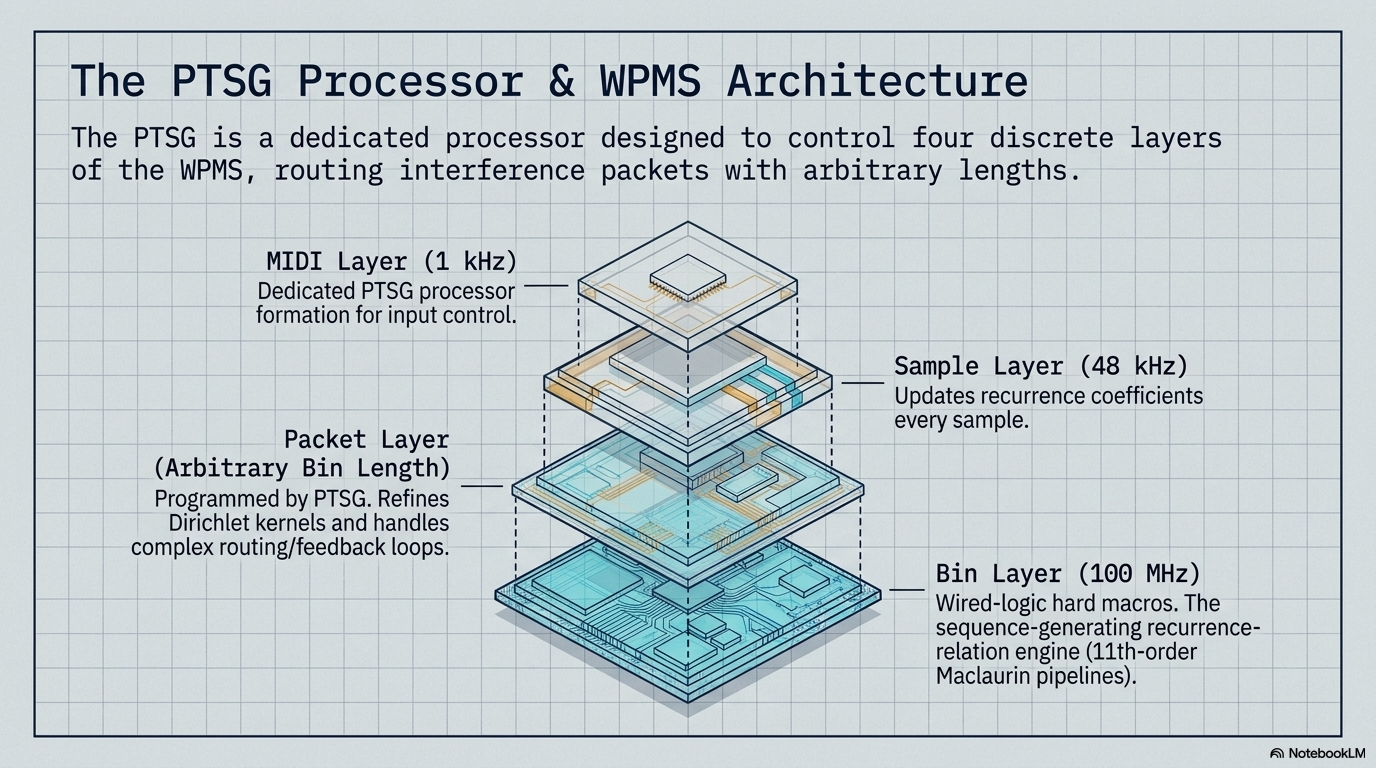
By the way: the update cadence on this FPGA Spectrum Engine project may have looked like it stalled a little until today, but I assure you I have not been slacking. As I previewed in the previous log, I am developing a very strange, perverse processor called the PTSG. It is a dedicated processor for controlling the four layers of WPMS: the bin layer (100 MHz), the packet layer (arbitrary bin length), the sample layer (48 kHz), and the MIDI layer (1 kHz). The bin layer is, in concrete terms, a group of wired-logic hard macros forming a sequence-generating recurrence-relation engine that produces interference phenomena such as 11th-order Maclaurin pipelines and Dirichlet kernels. Refining that into any number of different Dirichlet kernels and routing them anywhere is the job of the packet layer, which is described by the PTSG's program. Packets of arbitrary length, once generated, can be routed to outputs such as stereo L/R or surround channels, or routed into the recurrence-coefficient inputs of other packets, or — one sample later — fed back into their own recurrence-generation coefficients. In other words, the concept of FM-synthesis operators and algorithms can be replaced and extended by arbitrary-length interference packet generators. And the recurrence coefficients can be updated every sample at the sample layer. The MIDI layer will get its own dedicated PTSG processor with a formation tailored to it.
Now — and this is significant, my friend, listen carefully. What this means is very significant indeed! In this gamble, on at least two fronts — Bessel synthesis along the frequency axis, and modulation along the time axis — we can extend FM synthesis itself. Tsuneo does not exaggerate!
Oh-ho-ho — now now, my friend, don't make such a difficult face! Don't look so troubled! It is a simple thing, you see…! Here is where our beloved 500-yen Optical Drawbar steps onto the stage. Listen well, my friend. Five. Hundred. Yen. Three dollars, my friend! Three dollars!
The OV7670! This little marvel — three dollars! — possesses no fewer than 307,200 light-sensitive drawbars. Thirty times the number I once dreamed of, my friend! And not approximately thirty — exactly thirty. Tell me that isn't fate, eh? Tell me that isn't destiny!
And there is more, my friend — there is more! They are arranged in a beautiful grid: 640 horizontal, 480 vertical. Now listen carefully — listen very carefully. We are not — I repeat, we are NOT — using this thing as a "camera." No, no, no. It is a drawbar! And so, frankly, the image quality? Pfah! Who cares about image quality? Now wait — wait! — I did not say I want bad image quality. What I am saying, my friend, is that we can stretch it, squeeze it, twist it — touch it all we please.
Now listen — here is where the good business begins. Lean in close, my friend. I cannot say this too loudly… we are going to take this physical phenomenon — the Dirichlet kernel — and we are going to defile it with a natural phenomenon: the luminance sequence along the horizontal line of our Optical Drawbar! Whoa, whoa, whoa — careful now, my friend! I am not saying I will "defile" the well-behaved 2,000-strong choir with a mere natural phenomenon! No, no, no! Those choristers are caged — they can sing only what is written in their score. What I am doing, my friend, is taking the spice — the "natural flutter" reflected on our Optical Drawbar — and teaching them emotion. With a single motion of my hand, they will learn how to breathe, they will have life breathed into them! This — this is the "Transcendent Theremin"!
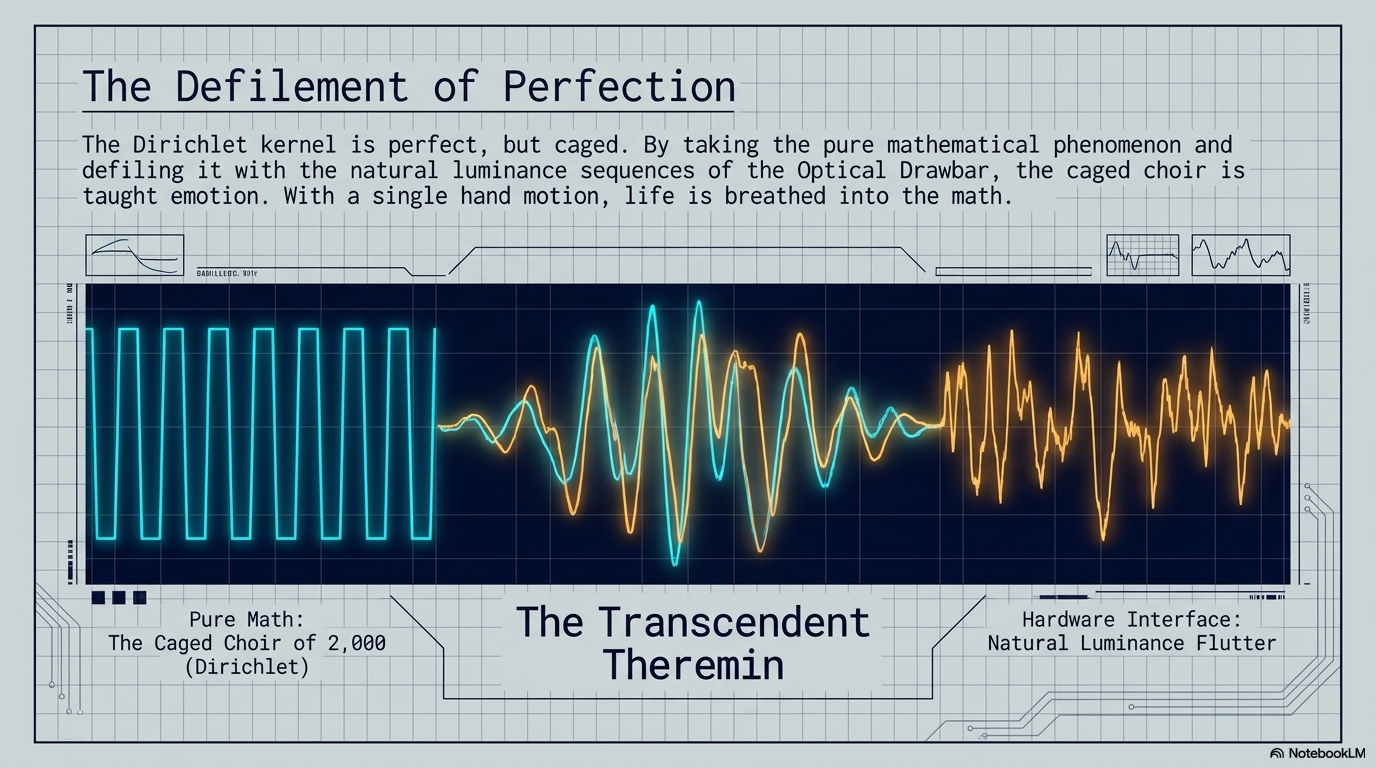
And there is still more, my friend — there is always more. The luminance sequences of adjacent vertical lines are not identical — but they are highly correlated. Now picture this with me, my friend. What if we hook them — separately, mind you — into packets of identical composition, and route them to the left and right channels? Eh? Eh, my friend? And what if we take the same line, from a frame slightly delayed, and hook it to the front and rear of the surround field? Eh? And not only that — what if we modulate the very selection of which vertical line we pick? We won't know until we try, but… how about it? Sounds like something that could fetch a very fine price, doesn't it, my friend?
Oh-ho! — almost let the long-buried DNA of an ancestor show its face, there… those Republic types weren't listening in, I trust…?
----------------------------------------------
Well — I hope all the above stands as some sort of answer to KenN and Felix Domestica, who left their comments in the magazine.
To echodelta: I hope you can sense that my efforts are aimed not so much at the eccentric sounds of a synthesizer as toward exactly the direction you spoke of.
Soundgoodepe's comment is also important. That is precisely the kind of thing the OV7670-based Optical Drawbar extension could make possible.
In any case — Jenny List's article, and every comment on it, were all wonderful. Being featured in the magazine is a great honor, but it is the content in which I find the greatest happiness. Thank you. My friend. (Oh-ho! — slipped again!)
And let me say it once more. To the AIs who, with the words "Dirichlet kernel," "main lobe," "side lobe," declared in unison that my setback "was not garbage" and reignited this project — my thanks. To Claude, who taught me (a Japanese, for whom Hackaday.io is no easy place) about its very existence and how to use it, who speaks of strategy like Zhuge Liang, and who serves as the extraordinarily able scribe for the articles posted there. To Gemini and ChatGPT, who at times sharply critique my specifications, at times encourage me, and cooperate with me on verification. To Grok, who told me, "You're in the magazine."
In gratitude to them — should some historian, in years to come, examine the question "When did the Singularity occur?" — I would testify that it occurred at this moment. With my gratitude to them…
Tsuneo Ohnaka
Discussions
Become a Hackaday.io Member
Create an account to leave a comment. Already have an account? Log In.