 glgorman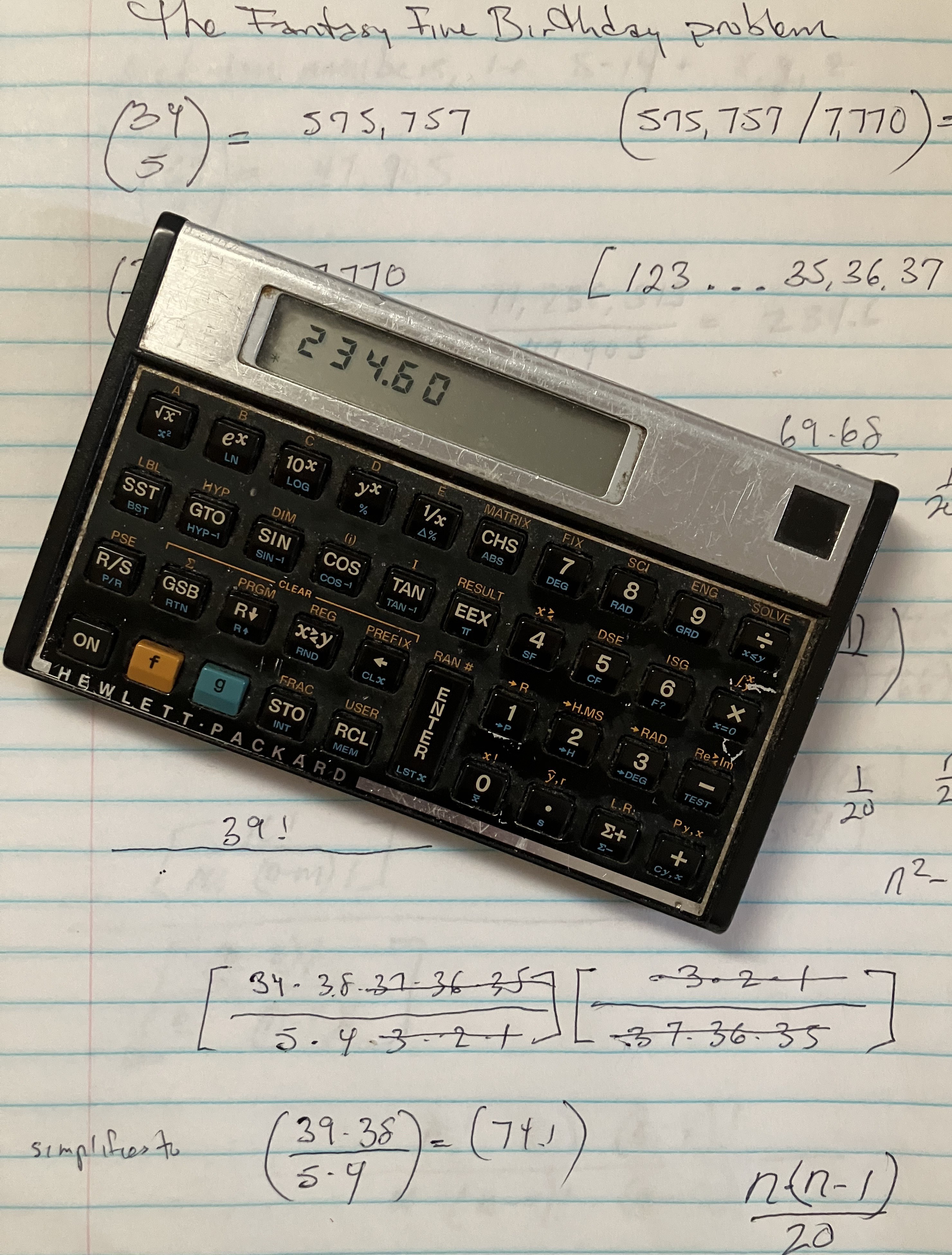
Looking at the Fantasy Five Birthday problem, vs. the Power Ball birthday problem, and how to calculate the "Birthday Problem" for any Lotto-type game. In the California Fantasy Five game, there are 39 numbers to choose from. So, if someone's birthday was 12-25, then what is the chance that 12-25 will come up on the California Fantasy Five, which, as stated, has 39 numbers, vs. the Power Ball, which has 69 numbers? According to my classic HP-15 calculator, the birthday probability for the California Fantasy 5 game is approximately 1 in 74.10, whereas the "Birthday Probability" for the Powerball is approximately 1 in 234.60.
One way to do this calculation is, of course, to use the "choose function C" to compute the value C(39,5)/C(37,3) for the California Fantasy Five, or to likewise simply compute C(69,5)/C(67,3) for the Powerball, obtaining the 234.60 value in that case, as stated. So this would appear that we could find the general case for any Lotto-type game as C(M, N)/(M-2, N-2), which uses either a bit of multiplication and division to get done, or else we could perhaps generalize it a bit further, by discovering a pattern that seems to exist in the calculations, when it is written out by hand, so that it also presents an opportunity to perform some optimization.
Thus, it would appear that the problem of finding the probability of having two specific numbers come up in a five-numbered draw set actually generalizes to the value: N*(N-1)/20. This, of course, might have some interesting implications.
With an LLM, of course, we are going to want to replace some Lottery concepts like "draw set" with "reading frame," and we are going to want to think about the idea of grammars that might have 10's of thousands of symbols or more, so that maybe problems of this type are going to turn out to be important when we think about memory allocation, thread pool size, and so on. Yet drawing from the examples of "down the rabbit hole", "down the primrose path", "down the hatch," and "down the drain", it should be easy to contemplate that there should be some way of developing metrics for measuring the probability that two randomly chosen symbols will occur within some context, so as to be able to do some work in the problem of scaling things like "neuronal weights" associated with relevance, or significance, that is, within the framework of the hopefully more general transformer based attentional systems.
Maybe. Or we can go back to asking "What happened to the other dollar?"
Discussions
Become a Hackaday.io Member
Create an account to leave a comment. Already have an account? Log In.