 glgorman
I will figure this part out later. At least I found a "famous movie quote" that is different from one of my own favorite lines to perhaps someday begin every chapter of a book filled with short stories with, such as "It was a dark and stormy night, and as the swamp thing staggered from the crypt, suddenly there was a need for words." In the meantime, instead, before I say anything else about any of that, I learned that there is yet another approach to AI that might be in vogue, so to speak, even if "Vogue", the magazine, hasn't taken notice of it yet. All in good fun, of course!
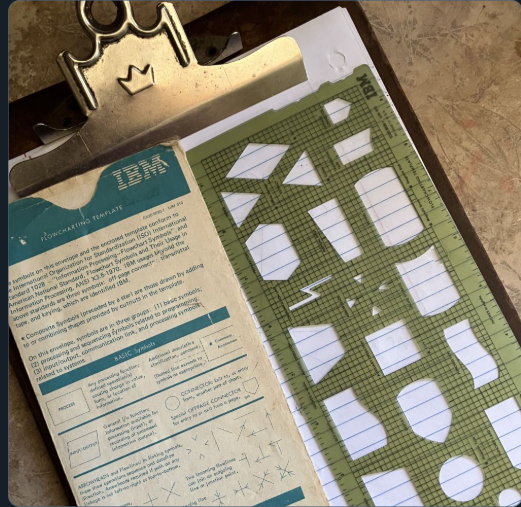
Somewhere, I still have this thing. Maybe it will turn out to be useful? In the meantime, I was spending quite a bit of time watching YouTube videos about AI, and in particular, there is yet another approach to problems like image recognition that has been gaining traction, and that is the one that some are referring to as "JEPA", which in turn is an acronym for "Joint-Embedding Predictive Architecture." So I suppose that I need to figure out what that seems to imply, just in case it does in fact imply something. Something quite specific, I think, insofar as how the same technique might have application within a broader "mixture of experts model", such as the one that I am trying to create here.
So now I have this idea, which I have had for a while, actually, and a plan seems to be coming to fruition as to an interesting approach to text generation, chain of reasoning, and all of that. Really, it seems pretty simple. Maybe as simple as this: Well, almost. This, I mean:
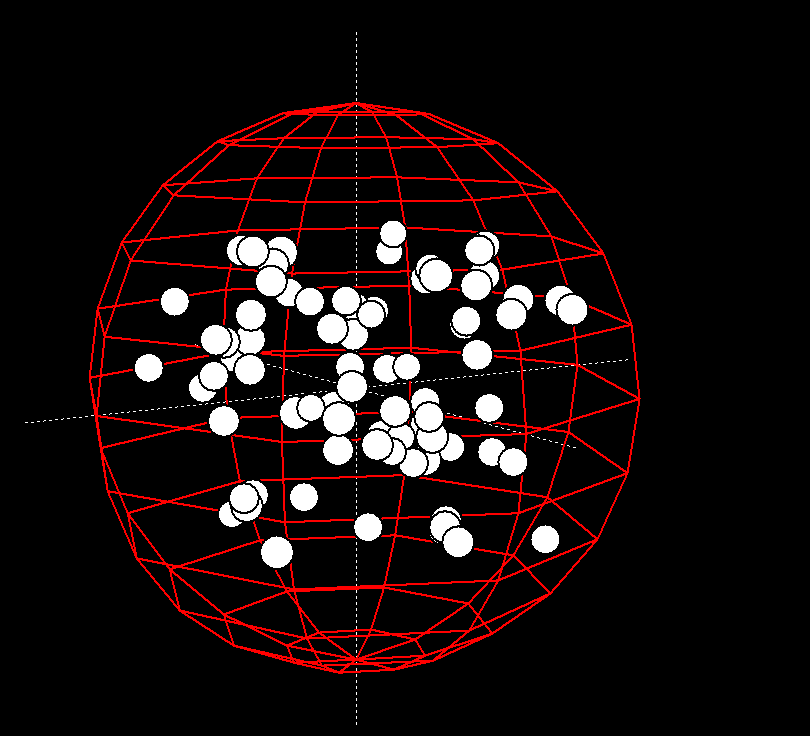
Of course, we could put some simple spheres inside a sphere, and let them bounce around, as if to simulate the kinetic theory of gases, or else we could simulate a Lotto-type game. Or we could imagine replacing the sphere with a human brain, and imagine a way of modelling random neurons firing, and perhaps even tracing out the path that some of the sodium and potassium ions might be taking, or else we might want to think in terms of specific ganglionic structures, and how the flow of different neurotransmitter substances might affect things. Really, it is all just physics. Or is it?
Not that things might not get a little bumpy, of course, if we wanted to model something else, perhaps with nearly exactly the same code. Like when we decide to put a sphere inside a sphere, which might be inside another sphere, and so on. Setting the stage perhaps for other such fun things as "thermonuclear initiation", or maybe just "plate tectonics".
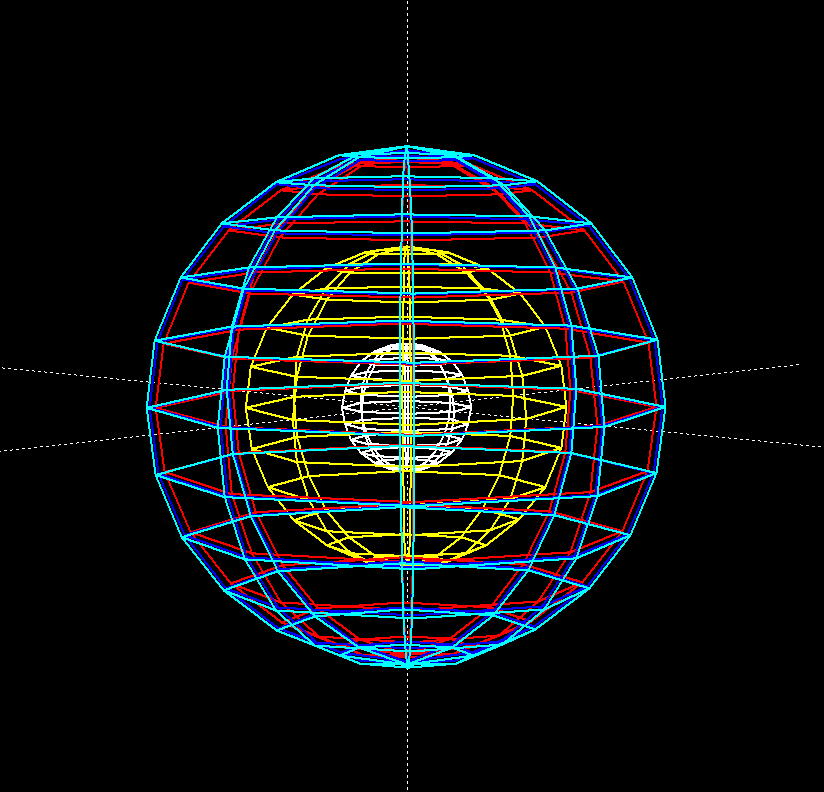
But that is not where this train is headed. Yet. Or else, maybe in the brain we might have the hippocampus, and the cerebellum, and a bunch of other hierarchically connected, as well as "otherwise connected" structures. Yet one approach is still to take the Lottery simulation and subdivide a three-dimensional space into a collection of interconnected realms, which would, of course, allow multiple simulations to run in parallel, on the one hand, while at the same time providing some completely general methods for partitioning.
So maybe I need to change the subject. Let's look at a real-world problem, along with a possible application for AI in order to solve it. Let us consider the utility, therefore of the "kinetic theory of gases" and its application to a potentially very simple, and hopefully not dangerous problem, such as "Can I put a window air conditioner in a fireplace?"
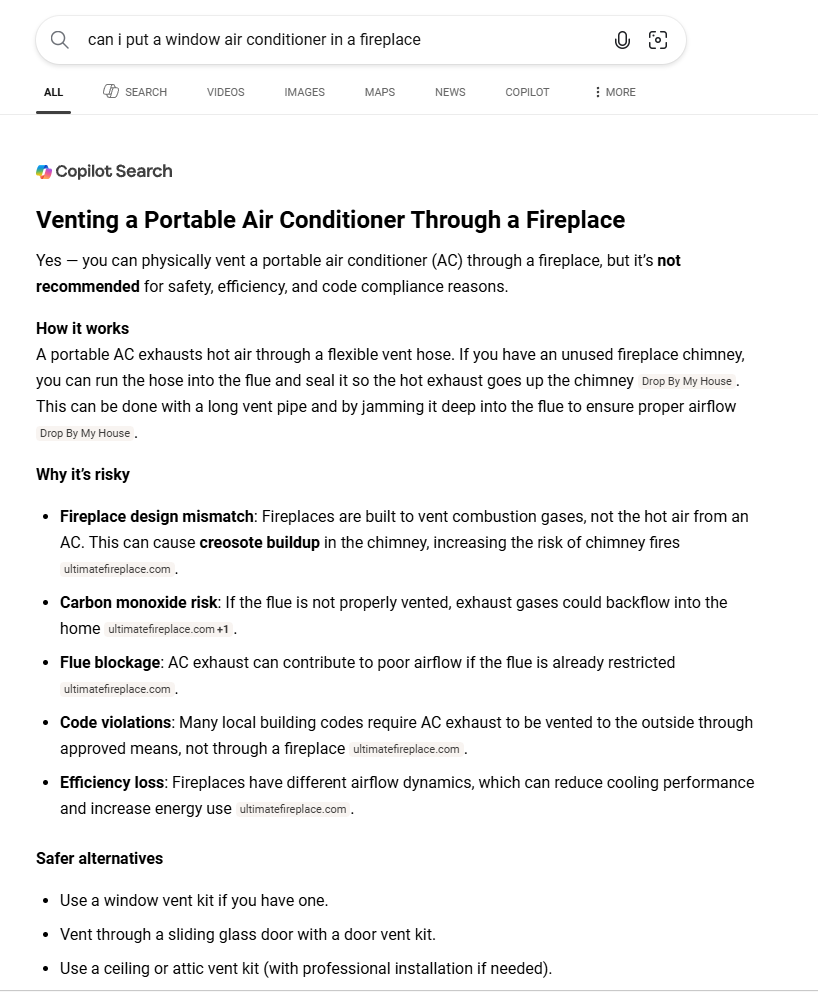
As I said earlier, hold on, it is going to be a bumpy ride! I do, after all have an ever increasing list of AI blunders, of varying degrees of severity or seriousness. Now what is happening here should be obvious. The AI in this case, I think, is suffering from a form of near-sightedness, and it is actually a particularly dangerous one, or could be, whether in this situation or not, but definitely in other circumstances, there is a certain kind of "near sightedness" that creates a particularly grave danger.
For example, it is well known that in ancient times, the Roman Senator Cato was in the habit of ending every speech with the phrase "Carthago delenda est," which loosely translated means "and as for the rest, I hold that Carthage must be destroyed". Now imagine the ancient generals in Carthage had received "intelligence reports" that Cato was "contemplating an ideology of conquest", but perhaps those notions were merely "aspirational", and so on, and that that was further paraphrased to suggest that "there is no immediate risk of invasion" but that "maybe the Roman Senate will take up the subject "next year." Now what if history repeats itself?
In the meantime, the Titanic is still equipped with five watertight compartments, any two of which can flood with no risk that the ship will sink. This gets paraphrased to "this ship is unsinkable", but out of an abundance of caution, we want to transfer as many of the passengers as possible to a rescue ship because of the possibility of a power failure. Now imagine that you are a first-class passenger. Do you wait for a rescue ship to arrive, and wait comfortably in your stateroom, or do you brave the otherwise 'unnecessary discomfort of the icy cold conditions of a lifeboat?"
Yet if attention is all you need, and if the fireplace problem as it is stated, is actually a problem in "optics", as well as a problem with "the kinetic theory of gasses", since it would seem to me, that "political thinking is often full of hot air", and "hot air rises", well the conclusion should be obvious, as long as you are not lighting a fire in the fireplace while the air conditioner is in use, or otherwise, "in the fire box", potentially blocking the flow of air.
Clearly the AI does not have a world model. Neither does its attentional system accurately understand what is and is not a real-world risk based on the apparent distance to its "analytic horizon".
In other words, it is "shortsighted". And while air-conditioners are not supposed to emit creosote or carbon monoxide, assuming that building codes do not prohibit it, I don't see why it would be inherently unsafe, or not worth trying in a pinch, especially when 100's of elderly or otherwise fragile persons might be at risk of dying during a heat wave if there are no other practical means of cooling.
That does not mean, however, that "building codes" are just another form of hot air. Yet it might imply that ABS has already been achieved, as in "Artificial Bureaucratic Stupidity!"
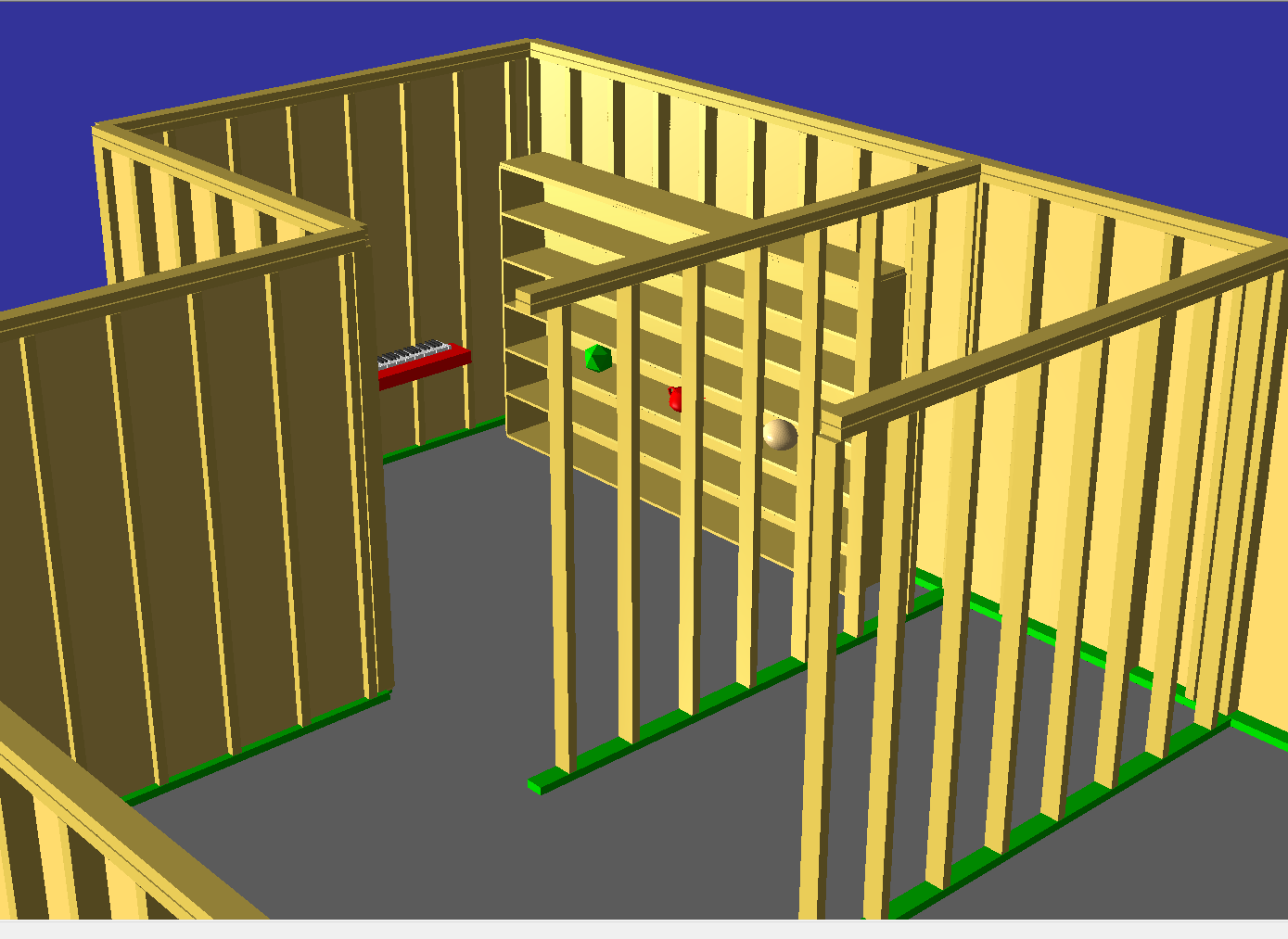
A world model is therefore needed that the AI can interact with, and even be a part of.
Stay Tuned!
Discussions
Become a Hackaday.io Member
Create an account to leave a comment. Already have an account? Log In.