 Fabrizio Rovelli

OrbitFabric
OrbitFabric is an open source, model first Mission Data Contract framework for small spacecraft.
Its purpose is to keep mission semantics explicit, consistent, reviewable and reusable across engineering activities that would otherwise maintain their own partially overlapping representation of the mission.
Typical examples include flight software structures, ground dictionaries, validation fixtures, simulation inputs, documentation, payload integration definitions, fault handling logic, storage assumptions, downlink configuration and external engineering tools.
The problem OrbitFabric addresses is not that these representations exist.
The problem is that each of them can gradually become its own interpretation of the mission.
OrbitFabric introduces one explicit Mission Data Contract and makes other artifacts derive from, or consume, that contract through controlled interfaces.
The architectural rule
The central rule of the project is deliberately strict:
The Mission Model is the semantic source of truth.

OrbitFabric Core owns Mission Data Contract interpretation.

Derived artifacts remain derived.

Downstream tools consume explicit Core owned facts.
This distinction has become increasingly important as the project has grown.
A consumer should not independently parse the Mission Model and reconstruct OrbitFabric semantics for itself.
A visualization tool should not invent relationships because two identifiers look related.
An integration adapter should not silently reinterpret the source YAML when a required Core surface is incompatible.
The goal is to preserve one semantic authority while allowing many different consumers.
Mission Data Contract
The Mission Data Contract is expressed as a structured YAML Mission Model.
The current stable model covers:
- spacecraft identity and mission metadata
- subsystems
- operational modes and transitions
- telemetry
- commands
- events
- faults
- packets
- policies
- payload contracts
- data products
- storage and retention intent
- contact and downlink assumptions
- commandability
- autonomy and recovery intent
Operational scenarios are defined separately and exercise the contract as deterministic engineering evidence.
A typical mission workspace contains:
mission/
    spacecraft.yaml
    subsystems.yaml
    modes.yaml
    telemetry.yaml
    commands.yaml
    events.yaml
    faults.yaml
    packets.yaml
    policies.yaml
    payloads.yaml
    data_products.yaml
    contacts.yaml
    commandability.yaml

scenarios/
    *.yaml
The YAML files are the authored representation, but the important concept is not YAML itself.
The important concept is the semantic contract represented by those files and interpreted by Core.
OrbitFabric Core
OrbitFabric Core is the semantic authority of the ecosystem.
The current baseline is OrbitFabric Core v1.2.0.
The stable Mission Data Contract compatibility commitment started with v1.0.0.
Core performs several distinct engineering functions.
Structural validation and semantic linting
Core first determines whether a Mission Model is structurally valid and then checks semantic consistency across the declared domains.
Examples include identifier validity, references between entities, command and telemetry consistency, operational relationships, payload lifecycle declarations, data product continuity and recovery intent.
Diagnostics are available both for humans and as structured machine readable output.
Deterministic scenario evidence
OrbitFabric scenarios exercise declared mission behavior in a deterministic host side environment.
They can drive telemetry values, dispatch commands, observe events, follow mode transitions and evaluate explicit expectations.
This is intentionally not spacecraft dynamics simulation and not flight execution.
The objective is to provide reproducible evidence about the declared Mission Data Contract.
Generated documentation
Core can generate reviewable documentation directly from the validated Mission Model.
Generated documents are useful...
Read more »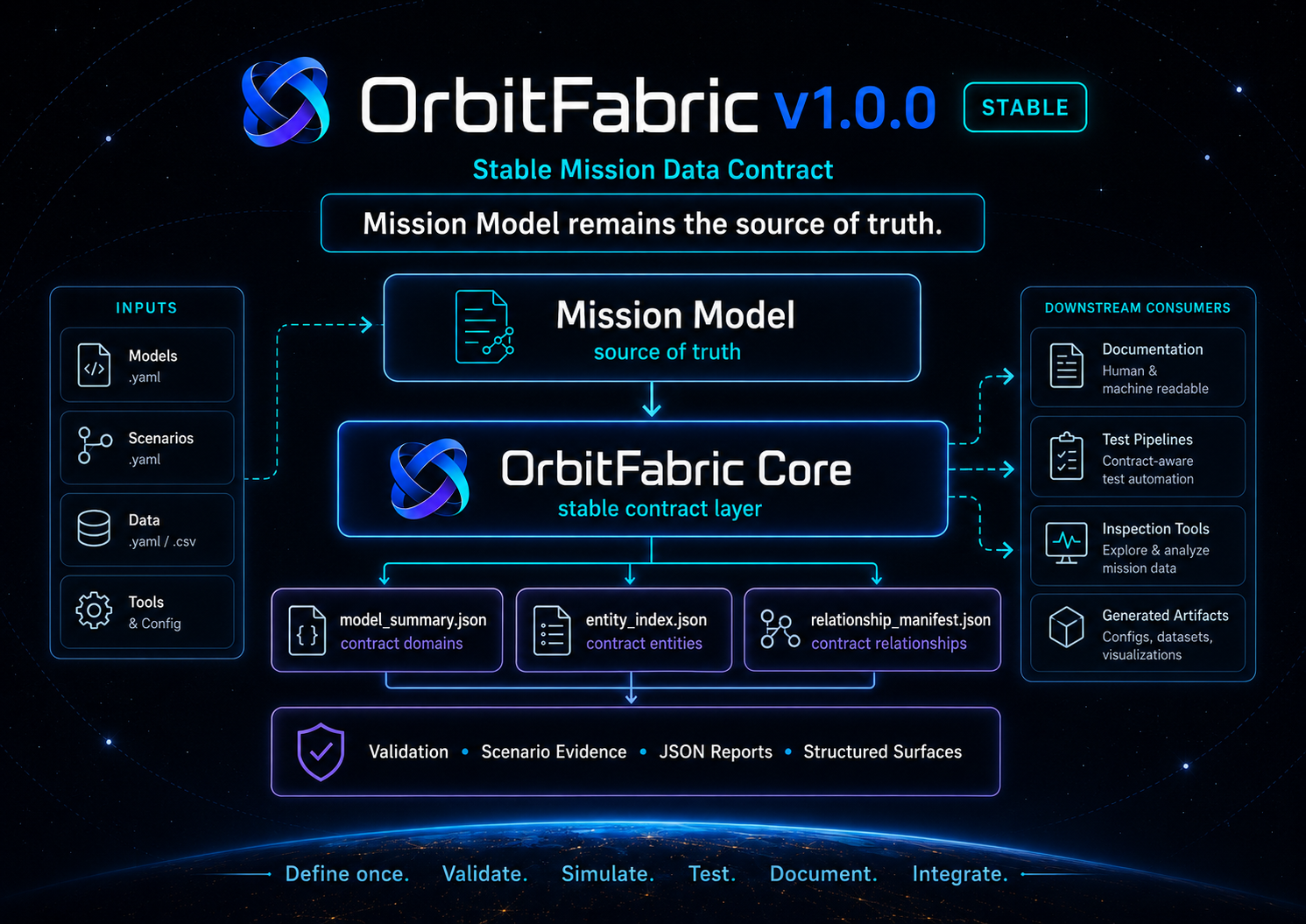
 Kutluhan Aktar
 luckyluke751
 MacGruber
 Adrelien