 Himanshu Dada
A compact and intelligent Smart Golf Ball system designed to help golfers analyze and improve their gameplay using real-time motion tracking and wireless connectivity. The project combines embedded hardware, ultra-low-power firmware, BLE communication, cloud integration, and a mobile application into a single production-ready IoT solution. The goal was to create a regulation-size golf ball capable of tracking acceleration, rotation, impact force, and movement patterns without affecting the ball’s balance or performance.
Step 1 – Project Planning & Architecture
The development process started with defining the hardware architecture, wireless communication requirements, sensor selection, and compact mechanical constraints. Special attention was given to achieving reliable performance within the limited space available inside a golf ball enclosure.
Step 2 – Custom PCB Design
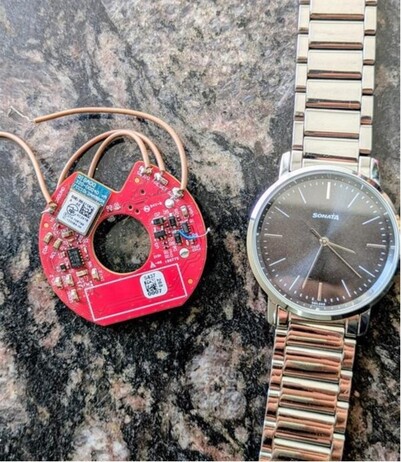
A custom miniaturized 4-layer PCB was engineered to fit inside the golf ball while maintaining balanced weight distribution and durability. The design integrated:
- Nordic nRF BLE chipset
- Power management circuitry
- Battery charging system
- 9-axis IMU sensor
- RF antenna optimization
The PCB was optimized for compact size, low power consumption, and manufacturing readiness.
Step 3 – Sensor Integration & Motion Tracking
The Smart Golf Ball uses a 9-axis IMU sensor to capture:
- Acceleration
- Rotation
- Swing motion
- Impact force
- Ball movement patterns
Sensor fusion algorithms were implemented to improve motion accuracy and gameplay analytics.
Step 4 – Embedded Firmware Development
Ultra-low-power firmware was developed to manage sensor communication, BLE connectivity, motion tracking, and battery optimization. Features included:
- Wake-on-motion detection
- Intelligent sleep modes
- Optimized BLE advertising intervals
- Real-time data processing
- Low-power system management
This project also demonstrates expertise in Embedded Software Development Services for advanced IoT sports applications.
Step 5 – BLE Communication & Mobile App Integration
Bluetooth Low Energy (BLE 5.0) was implemented for real-time wireless communication between the Smart Golf Ball and a mobile application. The mobile app provides:
- Live shot analytics
- Swing performance monitoring
- Speed and trajectory visualization
- Gameplay history tracking
- Cloud synchronization
The system enables golfers to analyze their performance directly from smartphones.
Step 6 – Cloud Integration & Data Analytics
Cloud integration was implemented for long-term gameplay storage and analytics. The backend architecture supports real-time synchronization, historical data analysis, and future scalability for connected sports ecosystems.
Step 7 – Testing & Product Optimization
Multiple prototypes were tested for:
- Impact resistance
- Wireless signal stability
- Battery performance
- Sensor accuracy
- RF reliability
- Real-world gameplay durability
Hardware and firmware optimizations were continuously refined to achieve stable operation in an extremely compact form factor.
Key Features
- BLE 5.0 wireless communication
- Real-time motion and swing tracking
- Acceleration, rotation, and impact detection
- 9-axis IMU sensor integration
- Ultra-low-power embedded firmware
- Custom compact PCB design
- Mobile app analytics dashboard
- Cloud-connected gameplay tracking
- Wake-on-motion functionality
- Long battery life optimization
- Manufacturing-ready hardware
Technologies Used
- Nordic nRF BLE chipset
- BLE 5.0
- Embedded C firmware
- IMU sensors
- Custom PCB Design
- React Native mobile application
- Azure cloud integration
- Low-power embedded systems architecture
Final Outcome
The final solution delivered a production-ready IoT sports device capable of collecting and transmitting real-time gameplay data with high reliability and low power consumption. The Smart Golf Ball demonstrates expertise in embedded systems, BLE communication, miniaturized electronics, firmware optimization, and connected mobile ecosystems for modern IoT products. This project highlights how advanced embedded technology can transform traditional sports equipment into intelligent connected devices.