Close
0%
0%

LCR-T4 Transistor Tester Lithium Battery Mod

A modification for the LCR-T4 transistor tester that replaces the 9V battery with a lithium cell and preserves the power-saving circuit

Similar projects worth following
The LCR-T4 transistor tester is an inexpensive and useful tool found on countless electronics workbenches. Most versions are powered by a 9V battery, which can be inconvenient, expensive to replace, and wasteful for frequent use.

This project converts the tester to operate from a single lithium-ion cell charged by a TP4056 module. The key design goal was to preserve the tester's original power-saving behavior. Many lithium conversions add a separate power switch. However, this modification reuses the existing power control circuitry so the tester still powers on and shuts down automatically just like the original design.

Required Components

  • TP4056 lithium charger module with protection circuit
  • A boost converter module capable of producing 9V output from a single lithium cell (e.g. MT3608 or TPS63070 boost converter module)
  • A single-cell lithium-ion or lithium-polymer battery
  • Wire and solder

Drawback: No Lithium Battery Voltage Monitoring

The voltage display will always show the regulated boost converter output near 9V, so there is no way to monitor the actual lithium cell charge level. Connecting the voltage detection point directly to the lithium cell was attempted, but the tester has a minimum voltage threshold for startup and will refuse to boot at lithium cell voltages, making this approach unworkable. The TP4056's protection circuit handles undervoltage by cutting power at the cutoff threshold. The only indication of a depleted battery is that the tester simply won't turn on.
LCR-T4 Schematic - Roland Elmiger.pdf

The best LCR-T4 Schematic I could find online. Kudos to Roland Elmiger!

Adobe Portable Document Format - 298.10 kB - 06/02/2026 at 02:42

Preview

  • 1 × LCR-T4 Transistor Tester
  • 1 × Boost Converter Module MT3608, TPS63070, or any other 9V module
  • 1 × TP4056 Lithium Charger Module Recommended with protection circuit
  • 1 × Lithium Battery

View project log

  • 1
    Cut the PCB Traces

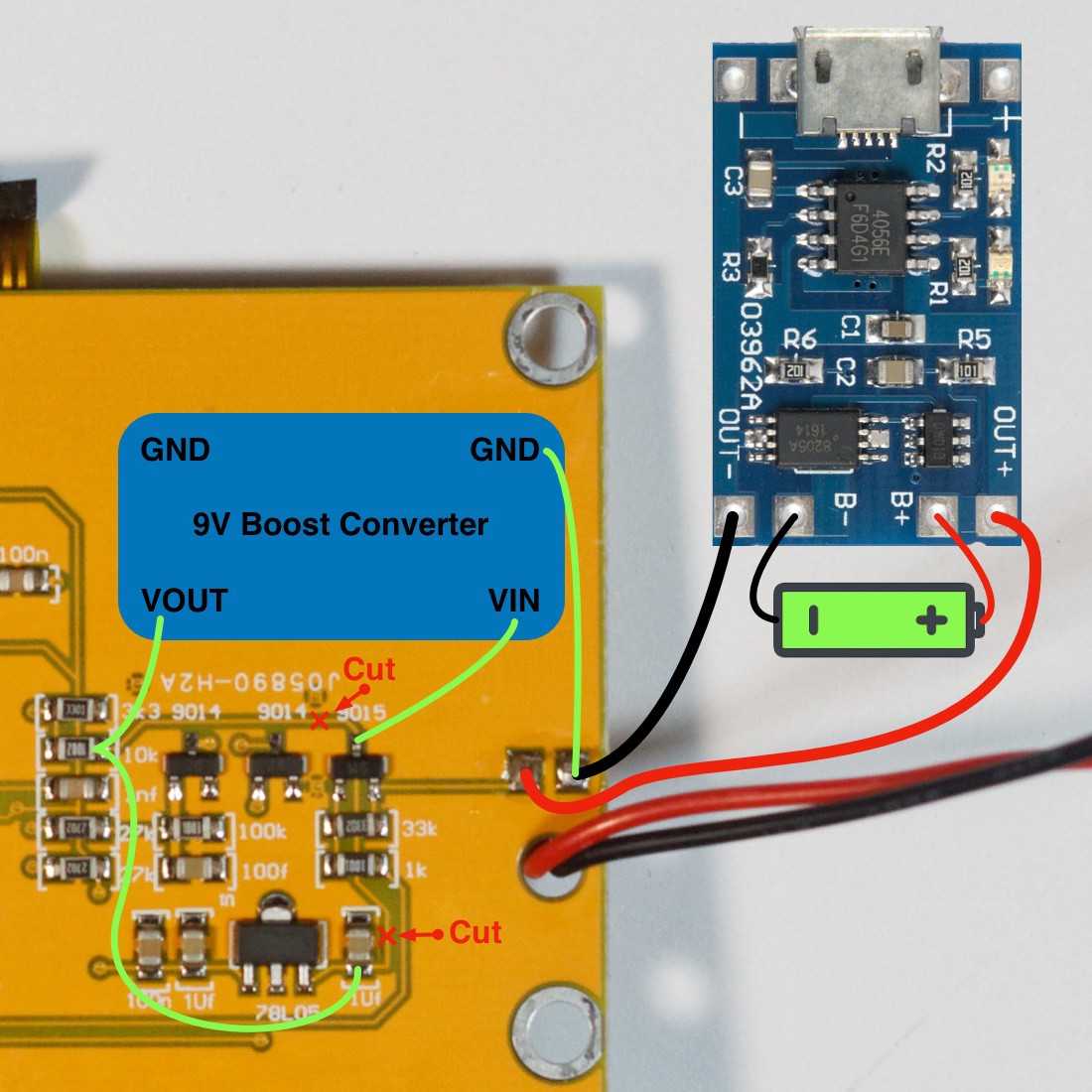
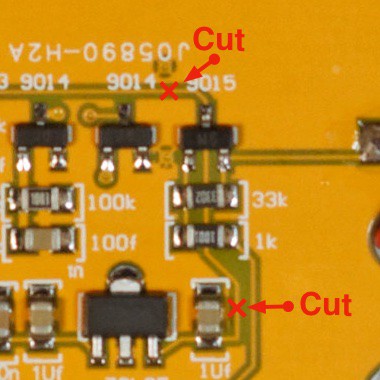
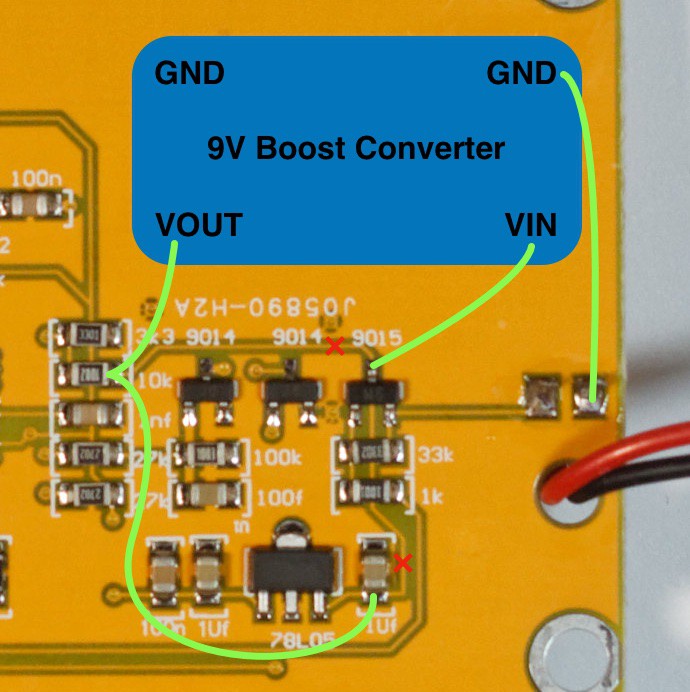
    Locate the 9015 PNP transistor on the bottom of the PCB. This transistor is part of the original power control circuit. Using a sharp knife, cut the traces running from its collector to both the LDO regulator and the voltage divider. This isolates the collector so the boost converter can be inserted in between.

    Note: After cutting, verify the cuts with a multimeter in continuity mode. An incomplete cut will leave the boost converter's output connected back through the trace, which can cause back-voltage on the input and potentially damage the boost converter.

  • 2
    Wire the Boost Converter

    Wire the boost converter module as follows:

    1. VIN to the 9015 collector
    2. VOUT to the LDO regulator input and the voltage divider
    3. GND to the 9V input negative rail

    Pre-tune the boost converter output to 9V before installation by powering it from a bench supply and adjusting the trimmer potentiometer.

  • 3
    Connect the Battery to the TP4056 Module

    Solder the lithium cell's positive and negative leads to the B+ and B− pads on the TP4056 module respectively.

View all 5 instructions

Enjoy this project?

Share

Discussions

morganflint wrote 8 hours ago point

Won't it be better to choose a lower voltage for the boost converter?
As it's followed by the linear regulator U1, I'd choose the lowest output voltage that provides enough margin for U1 to work, maybe around 6.5-7V (you'll need an adjustable one).
Another (maybe better) possibility is using a 5V boost converter, connecting its output to the output of U1 (if the noise in the output of the boost converter is low enough, so the filtering effect of the linear regulator isn't needed)

  Are you sure? yes | no

Gabriel wrote a day ago point

I’ll try to have a look at the source code, I’m sure the starting voltage threshold could be adjusted to work with lithium. Maybe the voltage divider on the ADC input could be changed too, either to improve resolution, or for a hardware-only mod. See schematic here on page 10: https://github.com/Mikrocontroller-net/transistortester/blob/master/Doku/trunk/pdftex/english/ttester.pdf

  Are you sure? yes | no

Mingjie Li wrote a day ago point

Wonderful idea! I will prepare a USBasp and probably another LCT-T4 for experiment.

  Are you sure? yes | no

Ken Yap wrote 3 days ago point

Interesting. I went a different way. I bought one of those lithium cell and boost converter packaged in the 9V battery form factor case that has a USB C charging socket. It will be a swap replacement. Problem is I have to open the case when the battery needs charging. I was considering drilling a hole in the case where the USB C socket is so that I don't have to open the case. Or maybe this doesn't happen often enough to bother. I'm waiting for the current disposable battery to run down first before putting the replacement in.

  Are you sure? yes | no

Mingjie Li wrote 3 days ago point

The USB-C rechargeable 9V packs are a clean drop-in, the main trade-off being the internal boost converter's continuous standby current draw. I actually drilled an ugly hole in it for a USB trigger module.

I tried two approaches before landing on this one. First, using a USB trigger module, it worked but killed the portability. Then I tried a 18650 battery with a TP4056 charging protection module and TPS63070 boost converter. TPS63070 module's quiescent current is around 6 mA or 1 mA with its power-saving feature enabled, which quietly drains the battery over time.

That led me to dig into the schematic more carefully. The LCR-T4 already has a battery-saving circuit built in, so I decided to integrate the solution around that rather than fight against the quiescent current problem. The result is nearly zero drain as the boost converter gets fully cut off just like the original 9V battery would be. The only quiescent current is from DW01A, which is around 4 µA.

  Are you sure? yes | no

Ken Yap wrote 3 days ago point

Interesting. I'll see what happens with the battery life between charges. I don't mind charging it more often but I don't want any parts outside of the case.

  Are you sure? yes | no

Mingjie Li wrote 3 days ago point

Everything is in the case since portability is important for me. I even hid the boost converter on the bottom of the PCB, and I'm thinking about reusing the ugly hole for charging.

  Are you sure? yes | no

Ken Yap wrote 3 days ago point

Yup, we agree on portability.

  Are you sure? yes | no

Similar Projects

Does this project spark your interest?

Become a member to follow this project and never miss any updates