 schuyler4
Here is the measurement signal chain again:
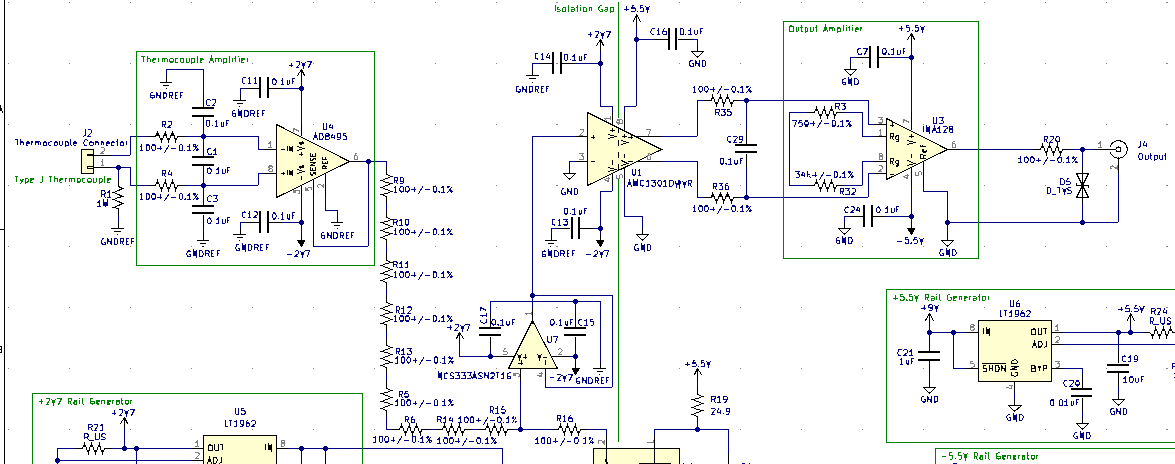
The AD8495 is used with a K type thermal couple. This is gives an output of 5mV/deg C with a +/-2 deg C non linearity error. The AMC1301 has a maximum differential input voltage of +/-0.25V, so without the 10X division this means a maximum temperature of 50 deg C, and a maximum temperature of 500 deg C with the 10X division. The NCS333ASN2T1G buffer is needed, because the AMC1301 has an input bias current of -30uA. This would give a voltage offset of -27mV without the buffer. The NCS333ASN2T1G has an input bias current of 400pA and an offset voltage of up to 10uV. The input bias current generates a negligible offset. The offset voltage will add a 0.002 deg C error with 1X division and a 0.2 deg C error with 10X division. The AMC1301 has a gain of 8.2 with an error of +/-0.05%. The INA128 gain is then set to 2.439, so the final output is 0.1V/(deg C) or 0.01V/(deg C). The INA128 has an output offset voltage of 243.9uV.
Let's see if we can add up all these errors. Basically we have +/-2.2 deg C or +/-2.002 with 10X division plus +/-0.05% gain error. Plus another 0.0024 deg C or 0.024 deg C from the INA128 offset voltage. This does not include errors from resistor tolerance.
As for noise, we have 32nV/sqrt(Hz) from AD8495 times a full system gain of 2000 is 64uV/sqrt(Hz). We then have 62nV/sqrt(Hz) from the NCS333ASN2T1G times a gain of 10. so 620nV/sqrt(Hz). Adding these two together we get ~64uV/sqrt(Hz). Multiplying this by this system bandwidth ~10kHz, we get an output noise of 6.4mVrms. This corresponds to about 0.2 deg C of noise in 1X mode and about 2 deg C of noise in 10X mode. This might turn out looking like a lot of noise, but the bandwidth can always be lowered to reduce it.
No doubt a lot of this is wrong, as I probably did some incorrect math in there somewhere. But hopefully it's a good order of magnitude estimate.
Discussions
Become a Hackaday.io Member
Create an account to leave a comment. Already have an account? Log In.