Close
0%
0%

Patternflow

Patternflow is an open-source LED synthesizer played with the fingertips.

Similar projects worth following
Patternflow is an open-source LED synthesizer — turn four knobs with your fingertips and shape a living, creative-coding pattern on a 128×64 LED matrix in real time.

It's a contemporary reinterpretation of Nam June Paik's 1960s piece Participation TV: instead of just watching the art, you become the one making it.

It started as a single post on r/arduino that racked up 150K views and a lot more comments asking "how do I build one" than "where can I buy one." That's why every part of it — schematics, firmware, 3D models, the browser-based pattern editor — is open source.

The goal isn't to sell one clever device, it's to build an ecosystem where anyone can make their own version, contribute a pattern, or push the hardware somewhere I haven't thought of yet.


Patternflow is an open-source LED synthesizer. Turn four knobs with your fingertips and shape a living, creative-coding pattern on a 128×64 LED matrix in real time. It's a contemporary reinterpretation of Nam June Paik's 1960s piece Participation TV — instead of watching the art, you make it.

The design stays minimal on purpose. It runs off a standard USB power bank, so there's nothing tethering it to a wall — pick it up and take it outside, to a jam session, wherever.

Build it your way 

There's more than one path in. Full guides exist for the 3D-printed enclosure with the custom PCB, a laser-cut enclosure version is in progress, and if you don't want to touch a PCB at all, there's a breadboard-and-jumper-wires guide that skips it entirely.

Try it before you build it

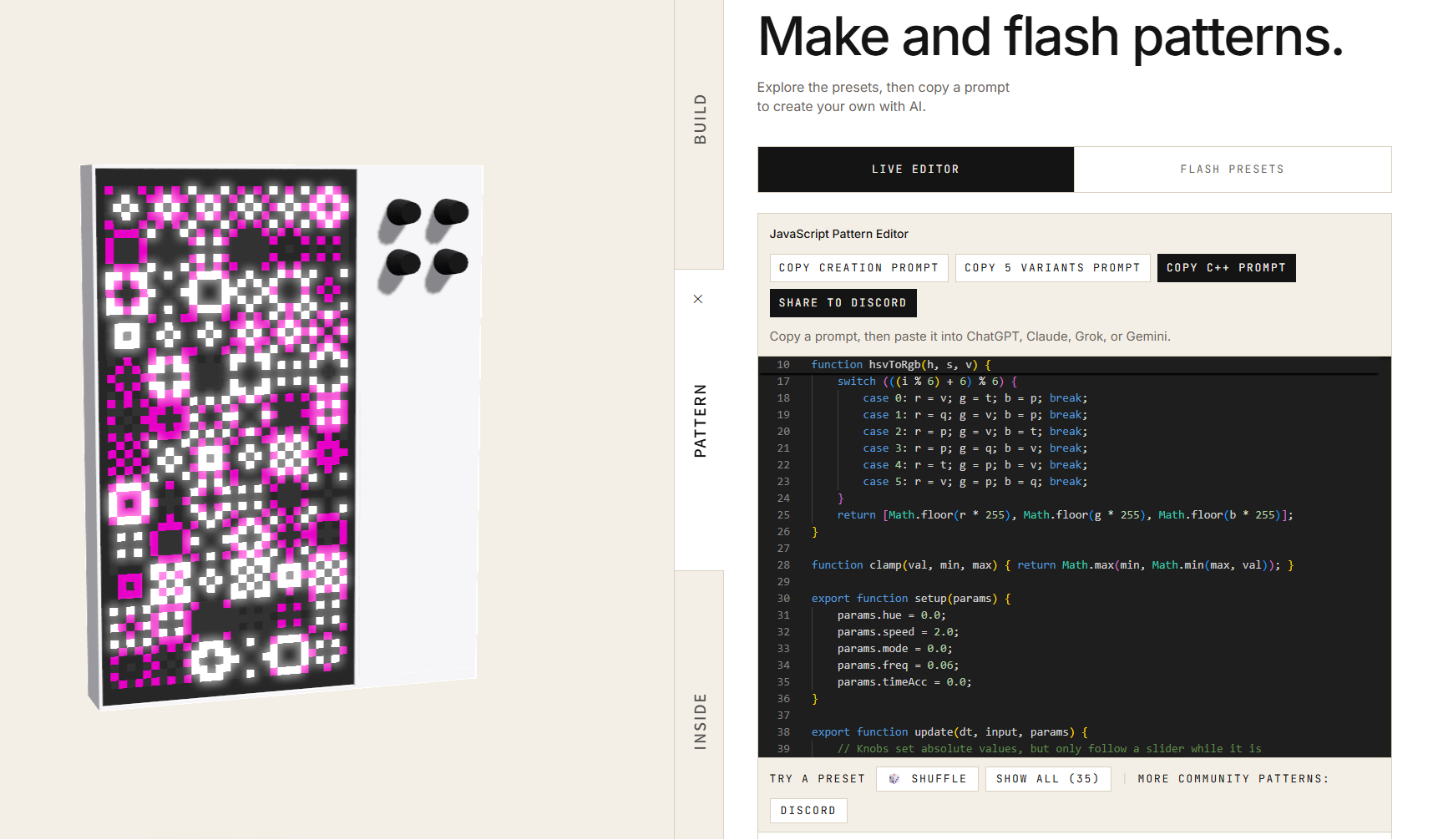
The browser-based Pattern Live Simulator runs the same four knobs the physical device has. Find something you like, and if you've got hardware on hand, flash it straight from the browser over Web Serial — no IDE, no drivers.
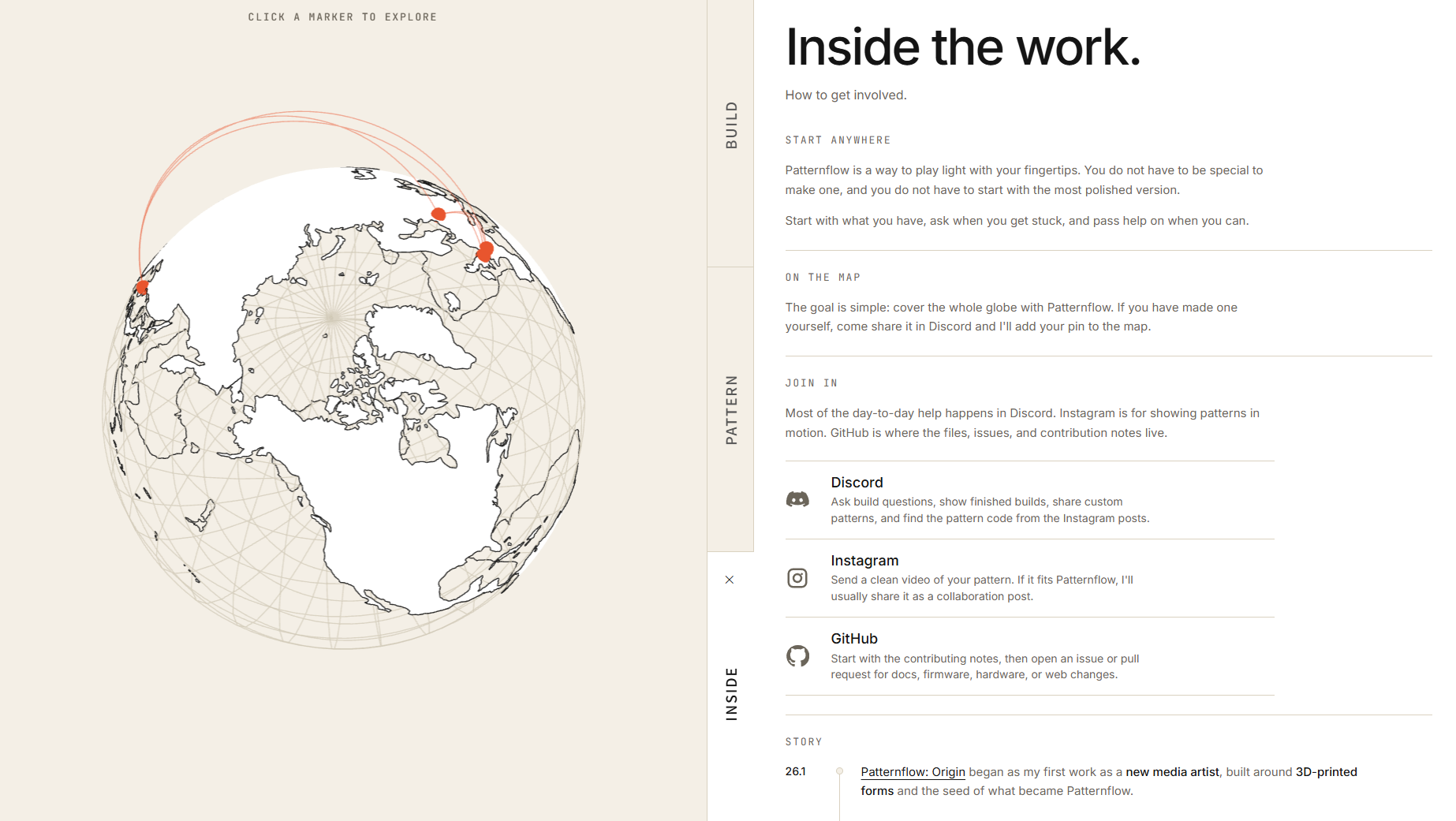
The globe

Share what you build in the Discord and a point gets added to a live globe on the site, one dot per creator, wherever they are. The goal isn't to sell a device. It's to cover that globe until there's no dark space left.
Why open source 

This started as a single post on r/arduino — 150K views, 3,700 upvotes, and far more people asking how to build one than how to buy one. Every part of it is open: schematics, firmware, 3D models, the pattern editor, the build guides themselves.

patternflow_case.blend

blend - 47.18 MB - 07/20/2026 at 13:03

Download

patternflow_v3_firmware.zip

x-zip-compressed - 721.93 kB - 07/20/2026 at 13:03

Download

patternflow_v3.3mf

3mf - 266.91 kB - 07/20/2026 at 13:03

Download

patternflow_v3_case_stl_pack.zip

x-zip-compressed - 386.21 kB - 07/20/2026 at 13:03

Download

patternflow_v3.0_gerber.zip

x-zip-compressed - 158.37 kB - 07/20/2026 at 13:03

Download

  • 1 × LED matrix panel — HUB75, 128×64, P2.5, 320×160mm Recommend same thing in build guide... Because mounting-screw positions
  • 1 × USB power bank, 5V Must fit the case compartment
  • 1 × ESP32-S3 DevKit N16R8
  • 2 × Female pin socket 1×22, 2.54mm PPPC221LFBN-RC (Sullins)
  • 4 × Rotary encoder EC11, 5-pin, 20mm shaft PEC11R-4220F-S0024 (Bourns)

View all 10 components

  • Four Months, One Snap-Fit Case

    Seunghun LEE07/20/2026 at 13:43 0 comments

    This is the first log for this project. I've been writing progress updates on the journal at least once a week, and now that v3.0.0 is out, it's time to write it up properly here on Hackaday too.

    Patternflow is an open-source LED synthesizer built from a 128×64 LED matrix, four rotary encoders, and an ESP32-S3. Think of it as a present-day take on Nam June Paik's Participation TV. Turn a knob and the creative-coding pattern running on the matrix shifts in real time under your fingertips.

    I tagged v1.0.0 back in April, and I've rebuilt the thing from the ground up three times since. v3 took the longest by far. I didn't expect it to take this long. I figured fixing one problem would be the end of it. Instead, the more I fixed, the more there was left to fix.

    Parts I didn't actually need

    The biggest change is that I pulled every SMD part off the PCB. They'd been there in the first place because an AI assistant told me they were needed, so I just went with it. Then one unit broke mid-exhibition, and I remembered someone in the community mentioning that desoldering the encoder cap and resistor hadn't caused any issues for them. Nothing to lose, so I pulled them and tested. Worked fine. So I stripped it down to through-hole only. Cheaper to build, and more to the point, it's now hand-solderable start to finish, which matters a lot if this ever becomes a workshop kit. (More on this in Refocus and Experiment After Experiment.)

    USB-C, and the one I fried

    For the retail version I added a USB-C power adapter to the board. Turns out that's a nightmare to hand-solder. I actually shorted and burned one out. So the finished unit (the one going out through Crowd Supply) keeps the USB-C, while the DIY community version keeps the original two-pin screw terminal. While I was at it, I rearranged the module layout and shrank the board overall. (The full mess is in Worn Out.)

    Printing the enclosure in one piece

    The case used to be printed top and bottom separately and glued together. This time I redesigned it with snap-fits so a large-format printer could print it as a single piece. Sounds simple. In practice it was "revise, send it to the school's printer, wait a few days, check the failure, revise again," on repeat. That uncertain waiting was the hardest part of v3 by a wide margin. (I wrote about that loop in The Next Step.)

    Crowd Supply is taking longer than I thought

    Now that the hardware's done, let's talk funding. I signed the Crowd Supply contract a while back and figured it would move fast. It hasn't. To move past pre-launch I need 150 subscribers, and even after emailing the news directly to about 100 people already on the waitlist, only around 15% converted to a subscription. Honestly, that surprised me. These were people who'd already raised their hand once. Turns out crowdfunding is a much slower game than I expected.

    Still, open source is starting to actually work

    The numbers are slow, but there's a good sign underneath them. Lately other artists have started picking Patternflow up, reinterpreting it as their own project, and sharing that back out. It feels less like selling a device now and more like something actually spreading. That was the whole point of going open source in the first place, and it's starting to happen, bit by bit. (More on that in I Hope It Works Out.)

    What's next

    I think the hardware is solid enough now to carry the Crowd Supply launch. From here I'm shifting focus to software and community. Right now the community runs on Discord, and it turns out Discord is banned in more countries than I expected. So I'm rebuilding the main hub on the web instead, not killing Discord, just moving the center of gravity. Pattern sharing will probably be the core of it. (This week's thinking on that is in v3 and Beyond.)

    The four-month hardware slog is over. Now it's time to think more and move less. I'll keep logging progress here and on the journal.

View project log

View all 4 instructions

Enjoy this project?

Share

Discussions

Similar Projects

Does this project spark your interest?

Become a member to follow this project and never miss any updates