### Vision
Decentralized water tech fails without grid power or imports. The **Autogenous Capillary-Plasma System (ACPS)** replaces mechanics with fundamental physics. It is a zero-power, sub-$10 purification engine 3D-printable locally from recycled PETG (CERN-OHL-S licensed).
### Mechanics
1. **Acoustic Baffles:** Gravity-driven standing waves isolate heavy mud.
2. **Chelation Core:** Compostable bio-aerogel traps metals & shifts color at saturation.
3. **Plasma Stage:** Passive pressure accumulator triggers a piezo-driven non-thermal plasma arc, destroying viral RNA without electricity.
### Bounties & Repo
We need hackers to solve our open GitHub issues:
* **Firmware:** Klipper macros for 120-150Hz phononic extrusion alignment.
* **CFD:** Baffle shape optimization.
* **Chem:** Bio-aerogel validation.
While the structural housing and chelation core are fully open-source and fabricated locally, the plasma generation stage relies on standard, mass-produced Commercial Off-The-Shelf (COTS) piezoelectric elements to maintain a sub-$10 build cost.
### Piezoelectric Element Requirements
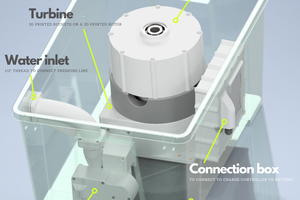
The internal Venturi nozzle housing is slotted to accept standard cylindrical or rectangular PZT (Lead Zirconate Titanate) crystal elements salvaged or bulk-purchased from industrial supply chains.
* **Primary Sourcing Pathway:** Standard push-button mechanical piezo igniters (commonly manufactured for commercial gas grills or utility lighters).
* **Mechanical Input Threshold:** The fluidic accumulator's snap-valve must deliver a minimum mechanical impact force of $\geq 15\text{ N}$ against the crystal face.
* **Electrical Output Target:** The chosen element must reliably yield a momentary open-circuit voltage pulse of $10\text{ kV}$ to $15\text{ kV}$ upon mechanical deformation to ignite the non-thermal Dielectric Barrier Discharge (DBD) plasma arc across the fluid constriction.
### Integration Protocol
During the digital fabrication of the Venturi nozzle housing, the printing sequence is paused at layer height $42.4\text{ mm}$ (if utilizing our optimized Klipper macro footprint). The COTS piezo crystals and their corresponding recessed tungsten electrode pins are slipped directly into the printed internal cavities. Printing then resumes, permanently potting and sealing the electronics within the waterproof PETG metamaterial matrix without requiring external fasteners or ga
Decentralized water infrastructure is fundamentally broken. When a community relies on imported membranes, replacement chemical filters, or electrical pumps, the lifecycle of that technology is doomed to fail. When it breaks, the system is abandoned.
The Autogenous Capillary-Plasma System (ACPS) represents a total shift in philosophy: we are replacing mechanical complexity with fundamental physics. By utilizing fluid dynamics, structural color, acoustics, and non-thermal plasma, we have designed a hospital-grade sterilization platform that costs under $10.00 USD to produce, uses zero external power, requires no imported consumables, and can be printed locally on a cheap desktop 3D printer.
We have open-sourced the entire blueprint under the CERN Open Hardware Licence (CERN-OHL-S) to integrate with global microloan flywheels like Water.org's WaterCredit. Now, we need the Hackaday community to help us refine and build it.
How the System Works
The ACPS is a municipal-grade water plant compressed into a kitchen-table-sized passive appliance:
Acoustic Mud Separation: Uses the kinetic energy of poured water to generate acoustic standing waves inside corrugated baffles, separating heavy suspended solids (mud) before they ever hit a filter.
Optical Resonance Chelation Core: A biodegradable, locally synthesized Chitosan-Cellulose aerogel binds heavy metals. Using structural color, the molecular lattice physically swells as it saturates, shifting from white to a highly visible iridescent dark crimson at 85\% saturation—a zero-power optical replacement alarm.
Autogenous Plasma Sterilization: The system collects gravity-fed water over hours in a pressurized accumulator. When triggered, a snap-valve violently fires the pressurized fluid through a Venturi nozzle lined with a piezoelectric quartz matrix. The mechanical compression generates a high-voltage, low-current plasma arc across the fluid stream, instantly shredding viral RNA and industrial pesticides on contact without any battery or grid power.
The Hackaday Call to Action: The Bounties
We are releasing this project with three clear, highly technical engineering bounties. If you have a 3D printer, a background in fluid dynamics, or a passion for materials science, we need your brain:
1. The Firmware Bounty: Klipper Phononic Extrusion Macro
The Challenge: To print the sub-millimeter tolerances required for the internal Venturi nozzle on a cheap desktop FDM printer (like an Ender 3), we need to prevent layer delamination under high pressure.
The Hack: We want to utilize Phononic-Assisted Extrusion—modulating the stepper motor micro-stepping in the extruder during printing to vibrate the nozzle at 120\text{ Hz} to 150\text{ Hz}. This physically aligns the PETG polymer chains as they transition from liquid to solid.
What we need: Firmware hackers to refine a G-code post-processor or Klipper macro to induce this micro-vibration automatically on critical internal geometries.
2. The Fluid Dynamics Bounty: Baffle Optimization
The Challenge: Refine the phononic geometry of the corrugated pre-filtration baffles.
What we need: CFD (Computational Fluid Dynamics) simulations to optimize the pitch and...